Liming Xu, Yong Liu, Yuquan Li, Xiaoyang Xuan, Xingtao Xu, Zhiwei Gong and Likun Pan
{"title":"用于性能卓越的对称超级电容器和电容式去离子的石墨烯支撑双极共价有机框架","authors":"Liming Xu, Yong Liu, Yuquan Li, Xiaoyang Xuan, Xingtao Xu, Zhiwei Gong and Likun Pan","doi":"10.1039/D4TA06293K","DOIUrl":null,"url":null,"abstract":"<p >Bipolar covalent organic frameworks (COFs) with dual active center characteristics have attracted much attention owing to their higher capacity and power/energy output, and good cycling stability, which endow them with high promise for being applied in Faraday-based symmetric supercapacitors (SSCs) and capacitive deionization (CDI). Herein, we fabricated a bipolar covalent organic framework (DQHBA-COF) integrating pyrazine and 1,4-dihydropyrazine species and employed graphene as a conductive substrate to guide the uniform dispersion of the COF on its surface. The DQHBA-COF in the as-prepared nanocomposite (DQHBArGO) displays improved conductivity and excellent ion storage efficiency due to the acquisition of π-electrons delocalized from graphene. Consequently, the aqueous Na<small><sup>+</sup></small> SSC based on DQHBArGO-75 achieves a high energy output of 59.2 W h kg<small><sup>−1</sup></small> and excellent cycling stability. Additionally, the DQHBArGO-75-based symmetric CDI system exhibits an astonishing salt removal capacity of 74.9 mg g<small><sup>−1</sup></small> along with outstanding recycling ability (no degradation after 100 cycles). This work highlights a new perspective for designing Faraday material-based SCs and CDI systems with symmetrical architectures.</p>","PeriodicalId":82,"journal":{"name":"Journal of Materials Chemistry A","volume":" 43","pages":" 29814-29825"},"PeriodicalIF":9.5000,"publicationDate":"2024-09-28","publicationTypes":"Journal Article","fieldsOfStudy":null,"isOpenAccess":false,"openAccessPdf":"","citationCount":"0","resultStr":"{\"title\":\"Graphene-sustained bipolar covalent organic framework for symmetric supercapacitors and capacitive deionization systems with superior performance†\",\"authors\":\"Liming Xu, Yong Liu, Yuquan Li, Xiaoyang Xuan, Xingtao Xu, Zhiwei Gong and Likun Pan\",\"doi\":\"10.1039/D4TA06293K\",\"DOIUrl\":null,\"url\":null,\"abstract\":\"<p >Bipolar covalent organic frameworks (COFs) with dual active center characteristics have attracted much attention owing to their higher capacity and power/energy output, and good cycling stability, which endow them with high promise for being applied in Faraday-based symmetric supercapacitors (SSCs) and capacitive deionization (CDI). Herein, we fabricated a bipolar covalent organic framework (DQHBA-COF) integrating pyrazine and 1,4-dihydropyrazine species and employed graphene as a conductive substrate to guide the uniform dispersion of the COF on its surface. The DQHBA-COF in the as-prepared nanocomposite (DQHBArGO) displays improved conductivity and excellent ion storage efficiency due to the acquisition of π-electrons delocalized from graphene. Consequently, the aqueous Na<small><sup>+</sup></small> SSC based on DQHBArGO-75 achieves a high energy output of 59.2 W h kg<small><sup>−1</sup></small> and excellent cycling stability. Additionally, the DQHBArGO-75-based symmetric CDI system exhibits an astonishing salt removal capacity of 74.9 mg g<small><sup>−1</sup></small> along with outstanding recycling ability (no degradation after 100 cycles). This work highlights a new perspective for designing Faraday material-based SCs and CDI systems with symmetrical architectures.</p>\",\"PeriodicalId\":82,\"journal\":{\"name\":\"Journal of Materials Chemistry A\",\"volume\":\" 43\",\"pages\":\" 29814-29825\"},\"PeriodicalIF\":9.5000,\"publicationDate\":\"2024-09-28\",\"publicationTypes\":\"Journal Article\",\"fieldsOfStudy\":null,\"isOpenAccess\":false,\"openAccessPdf\":\"\",\"citationCount\":\"0\",\"resultStr\":null,\"platform\":\"Semanticscholar\",\"paperid\":null,\"PeriodicalName\":\"Journal of Materials Chemistry A\",\"FirstCategoryId\":\"88\",\"ListUrlMain\":\"https://pubs.rsc.org/en/content/articlelanding/2024/ta/d4ta06293k\",\"RegionNum\":2,\"RegionCategory\":\"材料科学\",\"ArticlePicture\":[],\"TitleCN\":null,\"AbstractTextCN\":null,\"PMCID\":null,\"EPubDate\":\"\",\"PubModel\":\"\",\"JCR\":\"Q1\",\"JCRName\":\"CHEMISTRY, PHYSICAL\",\"Score\":null,\"Total\":0}","platform":"Semanticscholar","paperid":null,"PeriodicalName":"Journal of Materials Chemistry A","FirstCategoryId":"88","ListUrlMain":"https://pubs.rsc.org/en/content/articlelanding/2024/ta/d4ta06293k","RegionNum":2,"RegionCategory":"材料科学","ArticlePicture":[],"TitleCN":null,"AbstractTextCN":null,"PMCID":null,"EPubDate":"","PubModel":"","JCR":"Q1","JCRName":"CHEMISTRY, PHYSICAL","Score":null,"Total":0}
Graphene-sustained bipolar covalent organic framework for symmetric supercapacitors and capacitive deionization systems with superior performance†
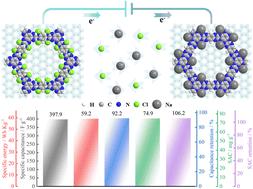
Bipolar covalent organic frameworks (COFs) with dual active center characteristics have attracted much attention owing to their higher capacity and power/energy output, and good cycling stability, which endow them with high promise for being applied in Faraday-based symmetric supercapacitors (SSCs) and capacitive deionization (CDI). Herein, we fabricated a bipolar covalent organic framework (DQHBA-COF) integrating pyrazine and 1,4-dihydropyrazine species and employed graphene as a conductive substrate to guide the uniform dispersion of the COF on its surface. The DQHBA-COF in the as-prepared nanocomposite (DQHBArGO) displays improved conductivity and excellent ion storage efficiency due to the acquisition of π-electrons delocalized from graphene. Consequently, the aqueous Na+ SSC based on DQHBArGO-75 achieves a high energy output of 59.2 W h kg−1 and excellent cycling stability. Additionally, the DQHBArGO-75-based symmetric CDI system exhibits an astonishing salt removal capacity of 74.9 mg g−1 along with outstanding recycling ability (no degradation after 100 cycles). This work highlights a new perspective for designing Faraday material-based SCs and CDI systems with symmetrical architectures.
期刊介绍:
The Journal of Materials Chemistry A, B & C covers a wide range of high-quality studies in the field of materials chemistry, with each section focusing on specific applications of the materials studied. Journal of Materials Chemistry A emphasizes applications in energy and sustainability, including topics such as artificial photosynthesis, batteries, and fuel cells. Journal of Materials Chemistry B focuses on applications in biology and medicine, while Journal of Materials Chemistry C covers applications in optical, magnetic, and electronic devices. Example topic areas within the scope of Journal of Materials Chemistry A include catalysis, green/sustainable materials, sensors, and water treatment, among others.




 京公网安备 11010802042870号
京ICP备2023020795号-1
京公网安备 11010802042870号
京ICP备2023020795号-1

 分享
分享
 求助内容:
求助内容: 应助结果提醒方式:
 扫码关注我们
