{"title":"流浪者的方向:从迷走神经单轴突洞察心脏神经控制。","authors":"Varun Malik","doi":"10.1113/JP287381","DOIUrl":null,"url":null,"abstract":"<p>Cardiac neural control remains an enigma and the reward for ‘untangling’ the role of the ‘wandering’ vagus in human health and disease, immense. With each heartbeat, the autonomic nervous system (ANS) precisely controls cardiac function, with autonomic dysfunction either triggering or perpetuating several disorders, particularly arrhythmias (Malik & Shivkumar, <span>2024</span>). Afferent neurons within the vagus form several, complex, nested feedback loops at multiple neuraxial levels, integrating sympathetic and parasympathetic cardiac control. Under resting conditions, vagal efferent activity predominates, resulting in slower heart rates. Recently, insights from direct vagal nerve recordings during exercise in an ovine model challenge the traditional ‘yin’ and ‘yang’ view of the parasympathetic and sympathetic components of the ANS, whereby each works in opposition. Rather, cardiac vagus activity increases in concert with sympathetic tone, supporting the exercising heart (Shanks et al., <span>2023</span>). Such invasive cardiac vagal recordings were hitherto not feasible in humans.</p><p>In this issue of <i>The Journal of physiology</i>, Farmer and colleagues extend their pioneering use of vagal nerve microneurography in humans (Ottaviani et al., <span>2020</span>) to measure activity from single axons that synchronizes with cardiac activity (Farmer et al., <span>2025</span>). Fifteen healthy human participants (aged 19–59) of either sex underwent percutaneous insertion of a sterile tungsten microelectrode using ultrasound guidance into either left or right vagus (in one participant, both vagi, on separate occasions). It was necessary to determine whether the anatomic location was suitable for percutaneous entry (avoiding the carotid artery). The microelectrode was inserted caudal to the carotid bulb, with minor adjustments penetrating different nerve fascicles. Recordings were simultaneous with electrocardiograms (ECG), respiratory rate and blood pressure, and made at baseline and during slow, deep breathing, for each fascicle position.</p><p>Single units (axons) were identified, offline, after digital filtering, using template matching functions. Cardiac and respiratory rhythmicity was determined using cross-correlograms assessing variations in axonal firing frequency, phasic with R wave frequency (ECG) and respiration rate, respectively. Further, functional classification was attempted by assessing axonal firing frequency within the cardiac cycle and spike characteristics (positive, suggestive of myelinated axons, and negative, unmyelinated). Positive spikes with cardiac and expiratory (respiratory) rhythmicity were considered to resemble cardioinhibitory efferent neurons. Negative spikes (possible unmyelinated neurons) that displayed cardiac and expiratory rhythmicity were classified as cardiac efferent neurons. The remainder of the positive spikes (possible myelinated neurons) were classified as afferent neurons, which were then further sub-classified based on the timing of their peak frequency within the cardiac cycle as: (1) low-pressure (volume-regulating) cardiopulmonary baroreceptors with inferences made as to whether they respond to stretch, filling or both, based prior animal work; or (2) high-pressure arterial blood-pressure-regulating baroceptors (thought to have peak firing rates prior to the T wave, with rapid onset).</p><p>Single units were isolated from the recordings of 9 of the 15 participants studied. It is unclear how many participants were excluded due to unfavourable anatomy, which is of relevance for future studies. There were no major complications. Self-limited adverse effects were headache, pain and throat discomfort. Overall, 44 patterns resembling axons that displayed cardiac rhythmicity were identified (36 from the right vagus nerve). The use of slow deep breathing increased inclusion of neurons that displayed only minimal cardiac rhythmicity at rest. Seven possible cardio-inhibitory neurons were identified with maximal firing frequencies at the lowest heart rate during respiratory sinus arrhythmia. Negative spikes (possible cardiac efferent neurons) also had higher frequency with lower heart rates, supporting their classification as cardiac efferent neurons.</p><p>The authors are to be heartily congratulated on an important study that will drive the field of cardiac neuroscience. There are some important limitations, which are also discussed in the paper. Cardiac rhythmicity may not be present in neurons involved in cardiac control. Second, there are limited axon samples, without data regarding discarded recordings owing to lack of rhythmicity. Nevertheless, the finding of increased firing rates in neurons thought to be efferents correlating with lower heart rates is supportive of their involvement in cardiac control. Afferent classification, whilst attempted, could not be confirmed within this experiment and the descriptions are presumptive. Further work with perturbations of cardiac volume and blood pressure (such as using lower body negative pressure) will be imperative to delineate these further (Malik et al., <span>2021</span>). Accounting for laterality of vagal cardiac control will be also be important.</p><p>This work is expected to make substantial contributions toward understanding cardiac autonomic physiology in humans, particularly afferent, regulatory cardiac control in human health and disease, as illustrated in Fig. 1. Afferent autonomic dysfunction occurs in hypertension, heart failure and, recently, also in patients with atrial fibrillation (Malik et al., <span>2021</span>). In conclusion, this technique provides an unprecedented opportunity to understand cardiac interoception in health and disease.</p>","PeriodicalId":50088,"journal":{"name":"Journal of Physiology-London","volume":"603 7","pages":"1905-1906"},"PeriodicalIF":4.6000,"publicationDate":"2024-09-26","publicationTypes":"Journal Article","fieldsOfStudy":null,"isOpenAccess":false,"openAccessPdf":"https://onlinelibrary.wiley.com/doi/epdf/10.1113/JP287381","citationCount":"0","resultStr":"{\"title\":\"Direction from the wanderer: insight into cardiac neural control from single axons within the vagus nerve\",\"authors\":\"Varun Malik\",\"doi\":\"10.1113/JP287381\",\"DOIUrl\":null,\"url\":null,\"abstract\":\"<p>Cardiac neural control remains an enigma and the reward for ‘untangling’ the role of the ‘wandering’ vagus in human health and disease, immense. With each heartbeat, the autonomic nervous system (ANS) precisely controls cardiac function, with autonomic dysfunction either triggering or perpetuating several disorders, particularly arrhythmias (Malik & Shivkumar, <span>2024</span>). Afferent neurons within the vagus form several, complex, nested feedback loops at multiple neuraxial levels, integrating sympathetic and parasympathetic cardiac control. Under resting conditions, vagal efferent activity predominates, resulting in slower heart rates. Recently, insights from direct vagal nerve recordings during exercise in an ovine model challenge the traditional ‘yin’ and ‘yang’ view of the parasympathetic and sympathetic components of the ANS, whereby each works in opposition. Rather, cardiac vagus activity increases in concert with sympathetic tone, supporting the exercising heart (Shanks et al., <span>2023</span>). Such invasive cardiac vagal recordings were hitherto not feasible in humans.</p><p>In this issue of <i>The Journal of physiology</i>, Farmer and colleagues extend their pioneering use of vagal nerve microneurography in humans (Ottaviani et al., <span>2020</span>) to measure activity from single axons that synchronizes with cardiac activity (Farmer et al., <span>2025</span>). Fifteen healthy human participants (aged 19–59) of either sex underwent percutaneous insertion of a sterile tungsten microelectrode using ultrasound guidance into either left or right vagus (in one participant, both vagi, on separate occasions). It was necessary to determine whether the anatomic location was suitable for percutaneous entry (avoiding the carotid artery). The microelectrode was inserted caudal to the carotid bulb, with minor adjustments penetrating different nerve fascicles. Recordings were simultaneous with electrocardiograms (ECG), respiratory rate and blood pressure, and made at baseline and during slow, deep breathing, for each fascicle position.</p><p>Single units (axons) were identified, offline, after digital filtering, using template matching functions. Cardiac and respiratory rhythmicity was determined using cross-correlograms assessing variations in axonal firing frequency, phasic with R wave frequency (ECG) and respiration rate, respectively. Further, functional classification was attempted by assessing axonal firing frequency within the cardiac cycle and spike characteristics (positive, suggestive of myelinated axons, and negative, unmyelinated). Positive spikes with cardiac and expiratory (respiratory) rhythmicity were considered to resemble cardioinhibitory efferent neurons. Negative spikes (possible unmyelinated neurons) that displayed cardiac and expiratory rhythmicity were classified as cardiac efferent neurons. The remainder of the positive spikes (possible myelinated neurons) were classified as afferent neurons, which were then further sub-classified based on the timing of their peak frequency within the cardiac cycle as: (1) low-pressure (volume-regulating) cardiopulmonary baroreceptors with inferences made as to whether they respond to stretch, filling or both, based prior animal work; or (2) high-pressure arterial blood-pressure-regulating baroceptors (thought to have peak firing rates prior to the T wave, with rapid onset).</p><p>Single units were isolated from the recordings of 9 of the 15 participants studied. It is unclear how many participants were excluded due to unfavourable anatomy, which is of relevance for future studies. There were no major complications. Self-limited adverse effects were headache, pain and throat discomfort. Overall, 44 patterns resembling axons that displayed cardiac rhythmicity were identified (36 from the right vagus nerve). The use of slow deep breathing increased inclusion of neurons that displayed only minimal cardiac rhythmicity at rest. Seven possible cardio-inhibitory neurons were identified with maximal firing frequencies at the lowest heart rate during respiratory sinus arrhythmia. Negative spikes (possible cardiac efferent neurons) also had higher frequency with lower heart rates, supporting their classification as cardiac efferent neurons.</p><p>The authors are to be heartily congratulated on an important study that will drive the field of cardiac neuroscience. There are some important limitations, which are also discussed in the paper. Cardiac rhythmicity may not be present in neurons involved in cardiac control. Second, there are limited axon samples, without data regarding discarded recordings owing to lack of rhythmicity. Nevertheless, the finding of increased firing rates in neurons thought to be efferents correlating with lower heart rates is supportive of their involvement in cardiac control. Afferent classification, whilst attempted, could not be confirmed within this experiment and the descriptions are presumptive. Further work with perturbations of cardiac volume and blood pressure (such as using lower body negative pressure) will be imperative to delineate these further (Malik et al., <span>2021</span>). Accounting for laterality of vagal cardiac control will be also be important.</p><p>This work is expected to make substantial contributions toward understanding cardiac autonomic physiology in humans, particularly afferent, regulatory cardiac control in human health and disease, as illustrated in Fig. 1. Afferent autonomic dysfunction occurs in hypertension, heart failure and, recently, also in patients with atrial fibrillation (Malik et al., <span>2021</span>). In conclusion, this technique provides an unprecedented opportunity to understand cardiac interoception in health and disease.</p>\",\"PeriodicalId\":50088,\"journal\":{\"name\":\"Journal of Physiology-London\",\"volume\":\"603 7\",\"pages\":\"1905-1906\"},\"PeriodicalIF\":4.6000,\"publicationDate\":\"2024-09-26\",\"publicationTypes\":\"Journal Article\",\"fieldsOfStudy\":null,\"isOpenAccess\":false,\"openAccessPdf\":\"https://onlinelibrary.wiley.com/doi/epdf/10.1113/JP287381\",\"citationCount\":\"0\",\"resultStr\":null,\"platform\":\"Semanticscholar\",\"paperid\":null,\"PeriodicalName\":\"Journal of Physiology-London\",\"FirstCategoryId\":\"3\",\"ListUrlMain\":\"https://physoc.onlinelibrary.wiley.com/doi/10.1113/JP287381\",\"RegionNum\":2,\"RegionCategory\":\"医学\",\"ArticlePicture\":[],\"TitleCN\":null,\"AbstractTextCN\":null,\"PMCID\":null,\"EPubDate\":\"\",\"PubModel\":\"\",\"JCR\":\"Q1\",\"JCRName\":\"NEUROSCIENCES\",\"Score\":null,\"Total\":0}","platform":"Semanticscholar","paperid":null,"PeriodicalName":"Journal of Physiology-London","FirstCategoryId":"3","ListUrlMain":"https://physoc.onlinelibrary.wiley.com/doi/10.1113/JP287381","RegionNum":2,"RegionCategory":"医学","ArticlePicture":[],"TitleCN":null,"AbstractTextCN":null,"PMCID":null,"EPubDate":"","PubModel":"","JCR":"Q1","JCRName":"NEUROSCIENCES","Score":null,"Total":0}
引用次数: 0
摘要
心脏神经控制仍然是一个谜,“解开”迷走神经在人类健康和疾病中的作用的奖励是巨大的。随着每一次心跳,自主神经系统(ANS)精确地控制心脏功能,而自主神经功能障碍要么触发,要么使几种疾病持续存在,尤其是心律失常(Malik &;Shivkumar, 2024)。迷走神经内的传入神经元在多个神经轴水平形成几个复杂的嵌套反馈回路,整合交感神经和副交感神经的心脏控制。在静息状态下,迷走神经传出活动占主导地位,导致心率减慢。最近,在一个羊模型的运动过程中,从直接迷走神经记录中获得的见解挑战了传统的“阴”和“阳”的观点,即ANS的副交感神经和交感神经成分是相互对立的。相反,心脏迷走神经活动增加与交感神经张力一致,支持运动的心脏(Shanks等人,2023)。迄今为止,这种有创心脏迷走神经记录在人类中是不可行的。在本期的《生理学杂志》上,Farmer及其同事扩展了他们在人类中开创性地使用迷走神经微神经造影(Ottaviani et al., 2020)来测量与心脏活动同步的单个轴突的活动(Farmer et al., 2025)。15名健康的男性参与者(年龄19-59岁)在超声引导下将无菌钨微电极经皮插入左或右迷走神经(在一个参与者中,在不同的场合,两个迷走神经)。有必要确定解剖位置是否适合经皮进入(避免颈动脉)。微电极插入颈动脉球尾侧,通过微小的调整穿透不同的神经束。记录与心电图(ECG)、呼吸频率和血压同时进行,并在基线和缓慢深呼吸时对每个肌束位置进行记录。单个单元(轴突)被识别,离线,经过数字滤波,使用模板匹配功能。心脏和呼吸节律性分别采用交叉相关图评估轴突放电频率、R波频率(ECG)和呼吸频率的变化。此外,通过评估心脏周期内轴突放电频率和尖峰特征(阳性,提示轴突有髓鞘,阴性,无髓鞘),试图进行功能分类。心脏和呼气(呼吸)节律性的阳性尖峰被认为类似于心脏抑制性传出神经元。显示心脏和呼气节律性的负峰(可能是无髓鞘神经元)被归类为心脏传出神经元。其余的阳性尖峰(可能是有髓鞘的神经元)被分类为传入神经元,然后根据它们在心脏周期内的峰值频率的时间进一步分类为:(1)低压(容量调节)心肺压力感受器,根据先前的动物实验推断它们是否对拉伸、填充或两者都有反应;(2)高压动脉血压调节感受器(被认为在T波之前有峰值放电率,发作迅速)。研究人员从15名参与者中的9人的录音中分离出单个单元。目前尚不清楚有多少参与者因解剖结构不利而被排除在外,这与未来的研究有关。没有重大并发症。自限性不良反应为头痛、疼痛和咽喉不适。总的来说,确定了44种与显示心律的轴突相似的模式(36种来自右侧迷走神经)。缓慢深呼吸的使用增加了在休息时仅表现出最小心律的神经元的包涵。在呼吸性窦性心律失常时,7个可能的心脏抑制神经元在心率最低时具有最大的放电频率。负尖峰(可能是心脏传出神经元)也有较高的频率与较低的心率,支持其分类为心脏传出神经元。对于这项将推动心脏神经科学领域发展的重要研究,我们衷心祝贺作者。本文还讨论了一些重要的局限性。参与心脏控制的神经元可能不存在心律失常。其次,轴突样本有限,由于缺乏节律性,没有关于丢弃记录的数据。尽管如此,在被认为是与低心率相关的传出神经中增加的放电率的发现支持了它们参与心脏控制。传入分类,虽然尝试,不能确认在这个实验和描述是假定的。 进一步研究心脏容量和血压的扰动(如使用下体负压)将是必要的(Malik et al., 2021)。考虑迷走神经心脏控制的偏侧性也很重要。这项工作有望为理解人类心脏自主神经生理学做出重大贡献,特别是人类健康和疾病中的传入、调节心脏控制,如图1所示。传入自主神经功能障碍发生在高血压、心力衰竭和心房颤动患者中(Malik et al., 2021)。总之,这项技术提供了一个前所未有的机会来了解健康和疾病中的心脏内感受。
Direction from the wanderer: insight into cardiac neural control from single axons within the vagus nerve
Cardiac neural control remains an enigma and the reward for ‘untangling’ the role of the ‘wandering’ vagus in human health and disease, immense. With each heartbeat, the autonomic nervous system (ANS) precisely controls cardiac function, with autonomic dysfunction either triggering or perpetuating several disorders, particularly arrhythmias (Malik & Shivkumar, 2024). Afferent neurons within the vagus form several, complex, nested feedback loops at multiple neuraxial levels, integrating sympathetic and parasympathetic cardiac control. Under resting conditions, vagal efferent activity predominates, resulting in slower heart rates. Recently, insights from direct vagal nerve recordings during exercise in an ovine model challenge the traditional ‘yin’ and ‘yang’ view of the parasympathetic and sympathetic components of the ANS, whereby each works in opposition. Rather, cardiac vagus activity increases in concert with sympathetic tone, supporting the exercising heart (Shanks et al., 2023). Such invasive cardiac vagal recordings were hitherto not feasible in humans.
In this issue of The Journal of physiology, Farmer and colleagues extend their pioneering use of vagal nerve microneurography in humans (Ottaviani et al., 2020) to measure activity from single axons that synchronizes with cardiac activity (Farmer et al., 2025). Fifteen healthy human participants (aged 19–59) of either sex underwent percutaneous insertion of a sterile tungsten microelectrode using ultrasound guidance into either left or right vagus (in one participant, both vagi, on separate occasions). It was necessary to determine whether the anatomic location was suitable for percutaneous entry (avoiding the carotid artery). The microelectrode was inserted caudal to the carotid bulb, with minor adjustments penetrating different nerve fascicles. Recordings were simultaneous with electrocardiograms (ECG), respiratory rate and blood pressure, and made at baseline and during slow, deep breathing, for each fascicle position.
Single units (axons) were identified, offline, after digital filtering, using template matching functions. Cardiac and respiratory rhythmicity was determined using cross-correlograms assessing variations in axonal firing frequency, phasic with R wave frequency (ECG) and respiration rate, respectively. Further, functional classification was attempted by assessing axonal firing frequency within the cardiac cycle and spike characteristics (positive, suggestive of myelinated axons, and negative, unmyelinated). Positive spikes with cardiac and expiratory (respiratory) rhythmicity were considered to resemble cardioinhibitory efferent neurons. Negative spikes (possible unmyelinated neurons) that displayed cardiac and expiratory rhythmicity were classified as cardiac efferent neurons. The remainder of the positive spikes (possible myelinated neurons) were classified as afferent neurons, which were then further sub-classified based on the timing of their peak frequency within the cardiac cycle as: (1) low-pressure (volume-regulating) cardiopulmonary baroreceptors with inferences made as to whether they respond to stretch, filling or both, based prior animal work; or (2) high-pressure arterial blood-pressure-regulating baroceptors (thought to have peak firing rates prior to the T wave, with rapid onset).
Single units were isolated from the recordings of 9 of the 15 participants studied. It is unclear how many participants were excluded due to unfavourable anatomy, which is of relevance for future studies. There were no major complications. Self-limited adverse effects were headache, pain and throat discomfort. Overall, 44 patterns resembling axons that displayed cardiac rhythmicity were identified (36 from the right vagus nerve). The use of slow deep breathing increased inclusion of neurons that displayed only minimal cardiac rhythmicity at rest. Seven possible cardio-inhibitory neurons were identified with maximal firing frequencies at the lowest heart rate during respiratory sinus arrhythmia. Negative spikes (possible cardiac efferent neurons) also had higher frequency with lower heart rates, supporting their classification as cardiac efferent neurons.
The authors are to be heartily congratulated on an important study that will drive the field of cardiac neuroscience. There are some important limitations, which are also discussed in the paper. Cardiac rhythmicity may not be present in neurons involved in cardiac control. Second, there are limited axon samples, without data regarding discarded recordings owing to lack of rhythmicity. Nevertheless, the finding of increased firing rates in neurons thought to be efferents correlating with lower heart rates is supportive of their involvement in cardiac control. Afferent classification, whilst attempted, could not be confirmed within this experiment and the descriptions are presumptive. Further work with perturbations of cardiac volume and blood pressure (such as using lower body negative pressure) will be imperative to delineate these further (Malik et al., 2021). Accounting for laterality of vagal cardiac control will be also be important.
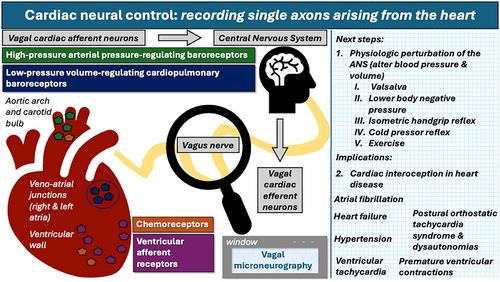
This work is expected to make substantial contributions toward understanding cardiac autonomic physiology in humans, particularly afferent, regulatory cardiac control in human health and disease, as illustrated in Fig. 1. Afferent autonomic dysfunction occurs in hypertension, heart failure and, recently, also in patients with atrial fibrillation (Malik et al., 2021). In conclusion, this technique provides an unprecedented opportunity to understand cardiac interoception in health and disease.
期刊介绍:
The Journal of Physiology publishes full-length original Research Papers and Techniques for Physiology, which are short papers aimed at disseminating new techniques for physiological research. Articles solicited by the Editorial Board include Perspectives, Symposium Reports and Topical Reviews, which highlight areas of special physiological interest. CrossTalk articles are short editorial-style invited articles framing a debate between experts in the field on controversial topics. Letters to the Editor and Journal Club articles are also published. All categories of papers are subjected to peer reivew.
The Journal of Physiology welcomes submitted research papers in all areas of physiology. Authors should present original work that illustrates new physiological principles or mechanisms. Papers on work at the molecular level, at the level of the cell membrane, single cells, tissues or organs and on systems physiology are all acceptable. Theoretical papers and papers that use computational models to further our understanding of physiological processes will be considered if based on experimentally derived data and if the hypothesis advanced is directly amenable to experimental testing. While emphasis is on human and mammalian physiology, work on lower vertebrate or invertebrate preparations may be suitable if it furthers the understanding of the functioning of other organisms including mammals.






 京公网安备 11010802042870号
京ICP备2023020795号-1
京公网安备 11010802042870号
京ICP备2023020795号-1

 分享
分享
 求助内容:
求助内容: 应助结果提醒方式:
 扫码关注我们
