Siyuan Wang, Jiaqi Wang, Baijiang Li, Prof. Jingjing Zhang
{"title":"用于生物传感和癌症治疗的光活性 CRISPR。","authors":"Siyuan Wang, Jiaqi Wang, Baijiang Li, Prof. Jingjing Zhang","doi":"10.1002/cbic.202400685","DOIUrl":null,"url":null,"abstract":"<p>Photoactivable CRISPR technology represents a transformative approach in the field of genome editing, offering unprecedented control over gene editing with high spatial and temporal precision. By harnessing the power of light to modulate the activity of CRISPR components, this innovative strategy enables precise regulation of Cas proteins, guide RNAs, and ribonucleoprotein complexes. Recent advancements in optical control methodologies, including the development of photoactivable nanocarriers, have significantly expanded the potential applications of CRISPR in biomedical fields. This Concept highlights the latest developments in designing photoactivable CRISPR systems and their promising applications in biosensing and cancer therapy. Additionally, the remaining challenges and future trends are also discussed. It is expected that the photoactivable CRISPR would facilitate translating more precise gene therapies into clinical use.</p>","PeriodicalId":140,"journal":{"name":"ChemBioChem","volume":"25 24","pages":""},"PeriodicalIF":2.8000,"publicationDate":"2024-09-24","publicationTypes":"Journal Article","fieldsOfStudy":null,"isOpenAccess":false,"openAccessPdf":"","citationCount":"0","resultStr":"{\"title\":\"Photoactivable CRISPR for Biosensing and Cancer Therapy\",\"authors\":\"Siyuan Wang, Jiaqi Wang, Baijiang Li, Prof. Jingjing Zhang\",\"doi\":\"10.1002/cbic.202400685\",\"DOIUrl\":null,\"url\":null,\"abstract\":\"<p>Photoactivable CRISPR technology represents a transformative approach in the field of genome editing, offering unprecedented control over gene editing with high spatial and temporal precision. By harnessing the power of light to modulate the activity of CRISPR components, this innovative strategy enables precise regulation of Cas proteins, guide RNAs, and ribonucleoprotein complexes. Recent advancements in optical control methodologies, including the development of photoactivable nanocarriers, have significantly expanded the potential applications of CRISPR in biomedical fields. This Concept highlights the latest developments in designing photoactivable CRISPR systems and their promising applications in biosensing and cancer therapy. Additionally, the remaining challenges and future trends are also discussed. It is expected that the photoactivable CRISPR would facilitate translating more precise gene therapies into clinical use.</p>\",\"PeriodicalId\":140,\"journal\":{\"name\":\"ChemBioChem\",\"volume\":\"25 24\",\"pages\":\"\"},\"PeriodicalIF\":2.8000,\"publicationDate\":\"2024-09-24\",\"publicationTypes\":\"Journal Article\",\"fieldsOfStudy\":null,\"isOpenAccess\":false,\"openAccessPdf\":\"\",\"citationCount\":\"0\",\"resultStr\":null,\"platform\":\"Semanticscholar\",\"paperid\":null,\"PeriodicalName\":\"ChemBioChem\",\"FirstCategoryId\":\"99\",\"ListUrlMain\":\"https://chemistry-europe.onlinelibrary.wiley.com/doi/10.1002/cbic.202400685\",\"RegionNum\":4,\"RegionCategory\":\"生物学\",\"ArticlePicture\":[],\"TitleCN\":null,\"AbstractTextCN\":null,\"PMCID\":null,\"EPubDate\":\"\",\"PubModel\":\"\",\"JCR\":\"Q3\",\"JCRName\":\"BIOCHEMISTRY & MOLECULAR BIOLOGY\",\"Score\":null,\"Total\":0}","platform":"Semanticscholar","paperid":null,"PeriodicalName":"ChemBioChem","FirstCategoryId":"99","ListUrlMain":"https://chemistry-europe.onlinelibrary.wiley.com/doi/10.1002/cbic.202400685","RegionNum":4,"RegionCategory":"生物学","ArticlePicture":[],"TitleCN":null,"AbstractTextCN":null,"PMCID":null,"EPubDate":"","PubModel":"","JCR":"Q3","JCRName":"BIOCHEMISTRY & MOLECULAR BIOLOGY","Score":null,"Total":0}
Photoactivable CRISPR for Biosensing and Cancer Therapy
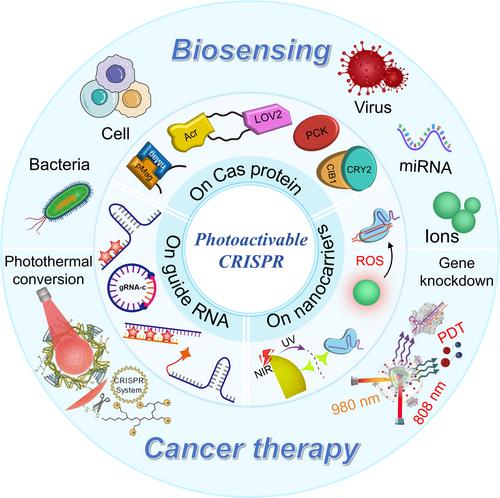
Photoactivable CRISPR technology represents a transformative approach in the field of genome editing, offering unprecedented control over gene editing with high spatial and temporal precision. By harnessing the power of light to modulate the activity of CRISPR components, this innovative strategy enables precise regulation of Cas proteins, guide RNAs, and ribonucleoprotein complexes. Recent advancements in optical control methodologies, including the development of photoactivable nanocarriers, have significantly expanded the potential applications of CRISPR in biomedical fields. This Concept highlights the latest developments in designing photoactivable CRISPR systems and their promising applications in biosensing and cancer therapy. Additionally, the remaining challenges and future trends are also discussed. It is expected that the photoactivable CRISPR would facilitate translating more precise gene therapies into clinical use.
期刊介绍:
ChemBioChem (Impact Factor 2018: 2.641) publishes important breakthroughs across all areas at the interface of chemistry and biology, including the fields of chemical biology, bioorganic chemistry, bioinorganic chemistry, synthetic biology, biocatalysis, bionanotechnology, and biomaterials. It is published on behalf of Chemistry Europe, an association of 16 European chemical societies, and supported by the Asian Chemical Editorial Society (ACES).





 京公网安备 11010802042870号
京ICP备2023020795号-1
京公网安备 11010802042870号
京ICP备2023020795号-1

 分享
分享
 求助内容:
求助内容: 应助结果提醒方式:
 扫码关注我们
