{"title":"利用非对比计算机断层扫描进行放射组学分析,预测急性肾盂肾炎患者入住重症监护病房的情况。","authors":"Toshinari Horie, Motohiro Fujiwara M.D., Yuma Waseda M.D., Ph.D., Hajime Tanaka M.D., Ph.D., Soichiro Yoshida M.D., Ph.D., Yasuhisa Fujii M.D., Ph.D.","doi":"10.1111/iju.15591","DOIUrl":null,"url":null,"abstract":"<p>Acute pyelonephritis (AP) is a severe urinary tract infection that can escalate into sepsis and which may require intensive care. In 2016, the Quick Sequential Organ Failure Assessment (qSOFA) score has been used to evaluate infection severity,<span><sup>1</sup></span> and we have reported its usefulness for predicting in-hospital-mortality among AP patients.<span><sup>2</sup></span> The qSOFA score is a valuable tool for assessing AP severity, however it does not incorporate radiological imaging. Clinically, contrast-enhanced computed tomography (CECT) is vital for evaluating various diseases, including AP. Unfortunately, due to renal impairment, many AP patients are ineligible for CECT and are only assessed using non-contrast computed tomography (NCCT). Radiomics analysis (RA) is useful for the qualitative assessment of radiological data from various diseases.<span><sup>3, 4</sup></span> RA can extract texture features from images, potentially offering improved diagnostic accuracy. In this study, we evaluated the potential of NCCT-based RA to enhance the prognostic capabilities of the qSOFA score in AP.</p><p>In this retrospective study, we analyzed 77 consecutive AP patients who had undergone NCCT at our institution from 2018 to 2022 (approval-ID: M2019-192). The diagnosis of AP and its laterality were determined by attending physicians based on clinical symptoms and imaging findings. RA was performed on renal parenchymal images using LIFEx software.<span><sup>5</sup></span> The renal parenchymal contour on the diseased side was outlined on axial slices of NCCT images, and the volume of interest (VOI) was set in each case. Based on the VOI, 164 imaging features were extracted from NCCT. The Boruta machine learning algorithm identified important features associated with high-dependency unit (HDU) admission. Receiver operating characteristics (ROC) curve analysis was conducted to define the cut-off values for the most important feature. A model incorporating the important features of RA into the qSOFA score was compared with the qSOFA score to assess the necessity for HDU admission. All statistical analyses were performed using JMP, Version 17.0 software.</p><p>The median age was 71 years, and 22 patients (29%) were male. For the qSOFA criteria, respiratory rate ≥22/min, systolic blood pressure ≤100 mmHg, and altered mental status were observed in 12 (15.6%), 17 (22.1%), and 9 (11.7%) patients, respectively. Obstructive pyelonephritis (OP) was included in 36 (46.8%) patients, and all patients were drained as part of the treatment regime. Overall, 11 patients (14.3%) required HDU admission and three patients (3.9%) died resulting from AP. Among OP patients, seven required HDU admission; obstruction was not associated with HDU admission (<i>p</i> = 0.330). The Boruta algorithm identified “GLSZM_ ZoneSizeVariance.IBSI.3NSA” (3NSA) and “GLCM_DifferenceAverage.IBSI.TF7R” as important features associated with HDU admission (Figure 1a). Considering the high correlation between these features, we focused on the most important feature, 3NSA, for subsequent analysis. ROC curve analysis defined the optimal cut-off value for 3NSA as 1.3. The combined model of 3NSA + qSOFA produced an area under the curve (AUC) value of 0.872, compared with the AUC value of 0.822 for qSOFA alone, showing a significant difference (<i>p</i> < 0.001; Figure 1b). Decision curve analysis demonstrated that our model provided a greater net benefit compared with the qSOFA model alone (Figure 1c).</p><p>In general, 3NSA represented how the volume of the compartment had changed when neighboring voxels with the same gray-level were grouped together. A low 3NSA value indicated a slight difference in the volume of similar gray-level compartments. In this study, the increased volume of similar gray-level compartments could be attributed to severe renal parenchymal inflammation, possibly due to tissue edema. In other words, a low 3NSA may mean that an edema reduced the gray-level variance within the renal parenchymal, potentially reflecting the severe infection. Further studies are needed to explore the histological aspects of these findings.</p><p>The limitations of the present study include its retrospective single-center design. The limited number of cases did not allow more detailed analyses regarding a possibly different impact of texture features based on the specific patient characteristics or the presence of an obstruction in AP. Also, multivariable analysis to investigate the effect of these variables on HDU admission was not performed due to the limited number of events. Furthermore, the diagnosis of AP or the decision for HDU admission was made by attending physicians.</p><p>In conclusion, RA using NCCT identified a factor associated with AP severity. Incorporating 3NSA into the qSOFA score could improve the accuracy of diagnosing AP severity.</p><p><b>Toshinari Horie:</b> Writing – original draft. <b>Motohiro Fujiwara:</b> Writing – review and editing. <b>Yuma Waseda:</b> Supervision. <b>Hajime Tanaka:</b> Supervision. <b>Soichiro Yoshida:</b> Conceptualization; supervision. <b>Yasuhisa Fujii:</b> Project administration.</p><p>Hajime Tanaka and Yasuhisa Fujii are Editorial Board members of International Journal of Urology and co-authors of this article. To minimize bias, they were excluded from all editorial decision-making related to the acceptance of this article for publication.</p><p>This research was approved by the institutional review board (Approval number: M2019-192).</p><p>N/A.</p><p>N/A.</p><p>N/A.</p>","PeriodicalId":14323,"journal":{"name":"International Journal of Urology","volume":"32 1","pages":"121-123"},"PeriodicalIF":2.2000,"publicationDate":"2024-09-27","publicationTypes":"Journal Article","fieldsOfStudy":null,"isOpenAccess":false,"openAccessPdf":"https://onlinelibrary.wiley.com/doi/epdf/10.1111/iju.15591","citationCount":"0","resultStr":"{\"title\":\"Radiomics analysis using non-contrast computed tomography for predicting high-dependency unit admission in patients with acute pyelonephritis\",\"authors\":\"Toshinari Horie, Motohiro Fujiwara M.D., Yuma Waseda M.D., Ph.D., Hajime Tanaka M.D., Ph.D., Soichiro Yoshida M.D., Ph.D., Yasuhisa Fujii M.D., Ph.D.\",\"doi\":\"10.1111/iju.15591\",\"DOIUrl\":null,\"url\":null,\"abstract\":\"<p>Acute pyelonephritis (AP) is a severe urinary tract infection that can escalate into sepsis and which may require intensive care. In 2016, the Quick Sequential Organ Failure Assessment (qSOFA) score has been used to evaluate infection severity,<span><sup>1</sup></span> and we have reported its usefulness for predicting in-hospital-mortality among AP patients.<span><sup>2</sup></span> The qSOFA score is a valuable tool for assessing AP severity, however it does not incorporate radiological imaging. Clinically, contrast-enhanced computed tomography (CECT) is vital for evaluating various diseases, including AP. Unfortunately, due to renal impairment, many AP patients are ineligible for CECT and are only assessed using non-contrast computed tomography (NCCT). Radiomics analysis (RA) is useful for the qualitative assessment of radiological data from various diseases.<span><sup>3, 4</sup></span> RA can extract texture features from images, potentially offering improved diagnostic accuracy. In this study, we evaluated the potential of NCCT-based RA to enhance the prognostic capabilities of the qSOFA score in AP.</p><p>In this retrospective study, we analyzed 77 consecutive AP patients who had undergone NCCT at our institution from 2018 to 2022 (approval-ID: M2019-192). The diagnosis of AP and its laterality were determined by attending physicians based on clinical symptoms and imaging findings. RA was performed on renal parenchymal images using LIFEx software.<span><sup>5</sup></span> The renal parenchymal contour on the diseased side was outlined on axial slices of NCCT images, and the volume of interest (VOI) was set in each case. Based on the VOI, 164 imaging features were extracted from NCCT. The Boruta machine learning algorithm identified important features associated with high-dependency unit (HDU) admission. Receiver operating characteristics (ROC) curve analysis was conducted to define the cut-off values for the most important feature. A model incorporating the important features of RA into the qSOFA score was compared with the qSOFA score to assess the necessity for HDU admission. All statistical analyses were performed using JMP, Version 17.0 software.</p><p>The median age was 71 years, and 22 patients (29%) were male. For the qSOFA criteria, respiratory rate ≥22/min, systolic blood pressure ≤100 mmHg, and altered mental status were observed in 12 (15.6%), 17 (22.1%), and 9 (11.7%) patients, respectively. Obstructive pyelonephritis (OP) was included in 36 (46.8%) patients, and all patients were drained as part of the treatment regime. Overall, 11 patients (14.3%) required HDU admission and three patients (3.9%) died resulting from AP. Among OP patients, seven required HDU admission; obstruction was not associated with HDU admission (<i>p</i> = 0.330). The Boruta algorithm identified “GLSZM_ ZoneSizeVariance.IBSI.3NSA” (3NSA) and “GLCM_DifferenceAverage.IBSI.TF7R” as important features associated with HDU admission (Figure 1a). Considering the high correlation between these features, we focused on the most important feature, 3NSA, for subsequent analysis. ROC curve analysis defined the optimal cut-off value for 3NSA as 1.3. The combined model of 3NSA + qSOFA produced an area under the curve (AUC) value of 0.872, compared with the AUC value of 0.822 for qSOFA alone, showing a significant difference (<i>p</i> < 0.001; Figure 1b). Decision curve analysis demonstrated that our model provided a greater net benefit compared with the qSOFA model alone (Figure 1c).</p><p>In general, 3NSA represented how the volume of the compartment had changed when neighboring voxels with the same gray-level were grouped together. A low 3NSA value indicated a slight difference in the volume of similar gray-level compartments. In this study, the increased volume of similar gray-level compartments could be attributed to severe renal parenchymal inflammation, possibly due to tissue edema. In other words, a low 3NSA may mean that an edema reduced the gray-level variance within the renal parenchymal, potentially reflecting the severe infection. Further studies are needed to explore the histological aspects of these findings.</p><p>The limitations of the present study include its retrospective single-center design. The limited number of cases did not allow more detailed analyses regarding a possibly different impact of texture features based on the specific patient characteristics or the presence of an obstruction in AP. Also, multivariable analysis to investigate the effect of these variables on HDU admission was not performed due to the limited number of events. Furthermore, the diagnosis of AP or the decision for HDU admission was made by attending physicians.</p><p>In conclusion, RA using NCCT identified a factor associated with AP severity. Incorporating 3NSA into the qSOFA score could improve the accuracy of diagnosing AP severity.</p><p><b>Toshinari Horie:</b> Writing – original draft. <b>Motohiro Fujiwara:</b> Writing – review and editing. <b>Yuma Waseda:</b> Supervision. <b>Hajime Tanaka:</b> Supervision. <b>Soichiro Yoshida:</b> Conceptualization; supervision. <b>Yasuhisa Fujii:</b> Project administration.</p><p>Hajime Tanaka and Yasuhisa Fujii are Editorial Board members of International Journal of Urology and co-authors of this article. To minimize bias, they were excluded from all editorial decision-making related to the acceptance of this article for publication.</p><p>This research was approved by the institutional review board (Approval number: M2019-192).</p><p>N/A.</p><p>N/A.</p><p>N/A.</p>\",\"PeriodicalId\":14323,\"journal\":{\"name\":\"International Journal of Urology\",\"volume\":\"32 1\",\"pages\":\"121-123\"},\"PeriodicalIF\":2.2000,\"publicationDate\":\"2024-09-27\",\"publicationTypes\":\"Journal Article\",\"fieldsOfStudy\":null,\"isOpenAccess\":false,\"openAccessPdf\":\"https://onlinelibrary.wiley.com/doi/epdf/10.1111/iju.15591\",\"citationCount\":\"0\",\"resultStr\":null,\"platform\":\"Semanticscholar\",\"paperid\":null,\"PeriodicalName\":\"International Journal of Urology\",\"FirstCategoryId\":\"3\",\"ListUrlMain\":\"https://onlinelibrary.wiley.com/doi/10.1111/iju.15591\",\"RegionNum\":3,\"RegionCategory\":\"医学\",\"ArticlePicture\":[],\"TitleCN\":null,\"AbstractTextCN\":null,\"PMCID\":null,\"EPubDate\":\"\",\"PubModel\":\"\",\"JCR\":\"Q3\",\"JCRName\":\"UROLOGY & NEPHROLOGY\",\"Score\":null,\"Total\":0}","platform":"Semanticscholar","paperid":null,"PeriodicalName":"International Journal of Urology","FirstCategoryId":"3","ListUrlMain":"https://onlinelibrary.wiley.com/doi/10.1111/iju.15591","RegionNum":3,"RegionCategory":"医学","ArticlePicture":[],"TitleCN":null,"AbstractTextCN":null,"PMCID":null,"EPubDate":"","PubModel":"","JCR":"Q3","JCRName":"UROLOGY & NEPHROLOGY","Score":null,"Total":0}
Radiomics analysis using non-contrast computed tomography for predicting high-dependency unit admission in patients with acute pyelonephritis
Acute pyelonephritis (AP) is a severe urinary tract infection that can escalate into sepsis and which may require intensive care. In 2016, the Quick Sequential Organ Failure Assessment (qSOFA) score has been used to evaluate infection severity,1 and we have reported its usefulness for predicting in-hospital-mortality among AP patients.2 The qSOFA score is a valuable tool for assessing AP severity, however it does not incorporate radiological imaging. Clinically, contrast-enhanced computed tomography (CECT) is vital for evaluating various diseases, including AP. Unfortunately, due to renal impairment, many AP patients are ineligible for CECT and are only assessed using non-contrast computed tomography (NCCT). Radiomics analysis (RA) is useful for the qualitative assessment of radiological data from various diseases.3, 4 RA can extract texture features from images, potentially offering improved diagnostic accuracy. In this study, we evaluated the potential of NCCT-based RA to enhance the prognostic capabilities of the qSOFA score in AP.
In this retrospective study, we analyzed 77 consecutive AP patients who had undergone NCCT at our institution from 2018 to 2022 (approval-ID: M2019-192). The diagnosis of AP and its laterality were determined by attending physicians based on clinical symptoms and imaging findings. RA was performed on renal parenchymal images using LIFEx software.5 The renal parenchymal contour on the diseased side was outlined on axial slices of NCCT images, and the volume of interest (VOI) was set in each case. Based on the VOI, 164 imaging features were extracted from NCCT. The Boruta machine learning algorithm identified important features associated with high-dependency unit (HDU) admission. Receiver operating characteristics (ROC) curve analysis was conducted to define the cut-off values for the most important feature. A model incorporating the important features of RA into the qSOFA score was compared with the qSOFA score to assess the necessity for HDU admission. All statistical analyses were performed using JMP, Version 17.0 software.
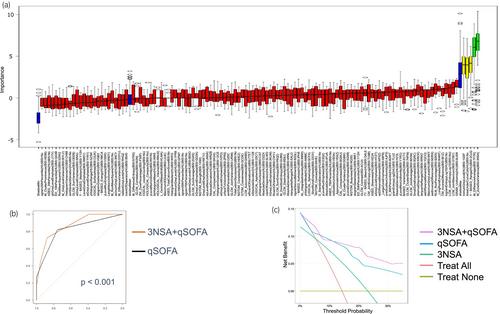
The median age was 71 years, and 22 patients (29%) were male. For the qSOFA criteria, respiratory rate ≥22/min, systolic blood pressure ≤100 mmHg, and altered mental status were observed in 12 (15.6%), 17 (22.1%), and 9 (11.7%) patients, respectively. Obstructive pyelonephritis (OP) was included in 36 (46.8%) patients, and all patients were drained as part of the treatment regime. Overall, 11 patients (14.3%) required HDU admission and three patients (3.9%) died resulting from AP. Among OP patients, seven required HDU admission; obstruction was not associated with HDU admission (p = 0.330). The Boruta algorithm identified “GLSZM_ ZoneSizeVariance.IBSI.3NSA” (3NSA) and “GLCM_DifferenceAverage.IBSI.TF7R” as important features associated with HDU admission (Figure 1a). Considering the high correlation between these features, we focused on the most important feature, 3NSA, for subsequent analysis. ROC curve analysis defined the optimal cut-off value for 3NSA as 1.3. The combined model of 3NSA + qSOFA produced an area under the curve (AUC) value of 0.872, compared with the AUC value of 0.822 for qSOFA alone, showing a significant difference (p < 0.001; Figure 1b). Decision curve analysis demonstrated that our model provided a greater net benefit compared with the qSOFA model alone (Figure 1c).
In general, 3NSA represented how the volume of the compartment had changed when neighboring voxels with the same gray-level were grouped together. A low 3NSA value indicated a slight difference in the volume of similar gray-level compartments. In this study, the increased volume of similar gray-level compartments could be attributed to severe renal parenchymal inflammation, possibly due to tissue edema. In other words, a low 3NSA may mean that an edema reduced the gray-level variance within the renal parenchymal, potentially reflecting the severe infection. Further studies are needed to explore the histological aspects of these findings.
The limitations of the present study include its retrospective single-center design. The limited number of cases did not allow more detailed analyses regarding a possibly different impact of texture features based on the specific patient characteristics or the presence of an obstruction in AP. Also, multivariable analysis to investigate the effect of these variables on HDU admission was not performed due to the limited number of events. Furthermore, the diagnosis of AP or the decision for HDU admission was made by attending physicians.
In conclusion, RA using NCCT identified a factor associated with AP severity. Incorporating 3NSA into the qSOFA score could improve the accuracy of diagnosing AP severity.
Hajime Tanaka and Yasuhisa Fujii are Editorial Board members of International Journal of Urology and co-authors of this article. To minimize bias, they were excluded from all editorial decision-making related to the acceptance of this article for publication.
This research was approved by the institutional review board (Approval number: M2019-192).
期刊介绍:
International Journal of Urology is the official English language journal of the Japanese Urological Association, publishing articles of scientific excellence in urology. Submissions of papers from all countries are considered for publication. All manuscripts are subject to peer review and are judged on the basis of their contribution of original data and ideas or interpretation.




 京公网安备 11010802042870号
京ICP备2023020795号-1
京公网安备 11010802042870号
京ICP备2023020795号-1

 分享
分享
 求助内容:
求助内容: 应助结果提醒方式:
 扫码关注我们
