Preeti Rana, Rahul Maitra, Deepanshi Saxena, Abdul Akhir, Manasa Vadakattu, Abdul Kalam, Swanand Vinayak Joshi, Ramulu Parupalli, Vasundhra Bhandari, Y. V. Madhavi, Arunava Dasgupta, Sidharth Chopra and Srinivas Nanduri
{"title":"开发萘二甲酰亚胺酰肼衍生物,作为抗耐碳青霉烯类鲍曼尼氏菌的强效抗菌剂。","authors":"Preeti Rana, Rahul Maitra, Deepanshi Saxena, Abdul Akhir, Manasa Vadakattu, Abdul Kalam, Swanand Vinayak Joshi, Ramulu Parupalli, Vasundhra Bhandari, Y. V. Madhavi, Arunava Dasgupta, Sidharth Chopra and Srinivas Nanduri","doi":"10.1039/D4MD00368C","DOIUrl":null,"url":null,"abstract":"<p >In this work, a novel series of naphthalimide hydrazide derivatives were designed, synthesized and evaluated against a bacterial pathogen panel. Most of the compounds were found to exhibit potent antibacterial activity against carbapenem-resistant <em>A. baumannii</em> BAA 1605, with MIC ranging from 0.5 to 16 μg mL<small><sup>−1</sup></small>. Compounds <strong>5b</strong>, <strong>5c</strong>, <strong>5d</strong> and <strong>5e</strong> showed the most potent antibacterial activity, with an MIC range of 0.5–1 μg mL<small><sup>−1</sup></small>. These compounds were also found to be non-toxic to Vero cells with a high selectivity index. Further, they were active against 24 clinical isolates of MDR-AB with potent antibacterial activity. In addition, synergistic studies revealed that compound <strong>5d</strong> exhibited synergism with FDA-approved drugs, as further validated through time-kill kinetic studies. These results highlight the potential of the synthesized compounds as promising leads for the development of novel and selective agents against carbapenem-resistant <em>A. baumannii</em>.</p>","PeriodicalId":21462,"journal":{"name":"RSC medicinal chemistry","volume":" 12","pages":" 4011-4017"},"PeriodicalIF":4.6000,"publicationDate":"2024-07-29","publicationTypes":"Journal Article","fieldsOfStudy":null,"isOpenAccess":false,"openAccessPdf":"","citationCount":"0","resultStr":"{\"title\":\"Development of naphthalimide hydrazide derivatives as potent antibacterial agents against carbapenem-resistant A. baumannii†\",\"authors\":\"Preeti Rana, Rahul Maitra, Deepanshi Saxena, Abdul Akhir, Manasa Vadakattu, Abdul Kalam, Swanand Vinayak Joshi, Ramulu Parupalli, Vasundhra Bhandari, Y. V. Madhavi, Arunava Dasgupta, Sidharth Chopra and Srinivas Nanduri\",\"doi\":\"10.1039/D4MD00368C\",\"DOIUrl\":null,\"url\":null,\"abstract\":\"<p >In this work, a novel series of naphthalimide hydrazide derivatives were designed, synthesized and evaluated against a bacterial pathogen panel. Most of the compounds were found to exhibit potent antibacterial activity against carbapenem-resistant <em>A. baumannii</em> BAA 1605, with MIC ranging from 0.5 to 16 μg mL<small><sup>−1</sup></small>. Compounds <strong>5b</strong>, <strong>5c</strong>, <strong>5d</strong> and <strong>5e</strong> showed the most potent antibacterial activity, with an MIC range of 0.5–1 μg mL<small><sup>−1</sup></small>. These compounds were also found to be non-toxic to Vero cells with a high selectivity index. Further, they were active against 24 clinical isolates of MDR-AB with potent antibacterial activity. In addition, synergistic studies revealed that compound <strong>5d</strong> exhibited synergism with FDA-approved drugs, as further validated through time-kill kinetic studies. These results highlight the potential of the synthesized compounds as promising leads for the development of novel and selective agents against carbapenem-resistant <em>A. baumannii</em>.</p>\",\"PeriodicalId\":21462,\"journal\":{\"name\":\"RSC medicinal chemistry\",\"volume\":\" 12\",\"pages\":\" 4011-4017\"},\"PeriodicalIF\":4.6000,\"publicationDate\":\"2024-07-29\",\"publicationTypes\":\"Journal Article\",\"fieldsOfStudy\":null,\"isOpenAccess\":false,\"openAccessPdf\":\"\",\"citationCount\":\"0\",\"resultStr\":null,\"platform\":\"Semanticscholar\",\"paperid\":null,\"PeriodicalName\":\"RSC medicinal chemistry\",\"FirstCategoryId\":\"3\",\"ListUrlMain\":\"https://pubs.rsc.org/en/content/articlelanding/2024/md/d4md00368c\",\"RegionNum\":4,\"RegionCategory\":\"医学\",\"ArticlePicture\":[],\"TitleCN\":null,\"AbstractTextCN\":null,\"PMCID\":null,\"EPubDate\":\"\",\"PubModel\":\"\",\"JCR\":\"Q2\",\"JCRName\":\"BIOCHEMISTRY & MOLECULAR BIOLOGY\",\"Score\":null,\"Total\":0}","platform":"Semanticscholar","paperid":null,"PeriodicalName":"RSC medicinal chemistry","FirstCategoryId":"3","ListUrlMain":"https://pubs.rsc.org/en/content/articlelanding/2024/md/d4md00368c","RegionNum":4,"RegionCategory":"医学","ArticlePicture":[],"TitleCN":null,"AbstractTextCN":null,"PMCID":null,"EPubDate":"","PubModel":"","JCR":"Q2","JCRName":"BIOCHEMISTRY & MOLECULAR BIOLOGY","Score":null,"Total":0}
引用次数: 0
摘要
本研究设计、合成并评估了一系列新型萘二甲酰亚胺酰肼衍生物对细菌病原体的抗菌活性。结果发现,大多数化合物对耐碳青霉烯类的鲍曼尼氏菌 BAA 1605 具有强效抗菌活性,MIC 值范围为 0.5 至 16 μg mL-1。化合物 5b、5c、5d 和 5e 的抗菌活性最强,MIC 范围为 0.5-1 μg mL-1。研究还发现,这些化合物对 Vero 细胞无毒,且具有较高的选择性。此外,这些化合物对 24 种临床分离的 MDR-AB 具有很强的抗菌活性。此外,协同作用研究表明,化合物 5d 与美国 FDA 批准的药物具有协同作用,这一点通过时间致死动力学研究得到了进一步验证。这些结果凸显了合成化合物作为新型选择性抗耐碳青霉烯类鲍曼尼菌药物开发先导的潜力。
Development of naphthalimide hydrazide derivatives as potent antibacterial agents against carbapenem-resistant A. baumannii†
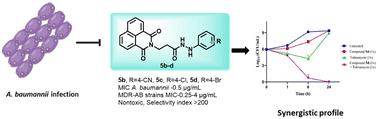
In this work, a novel series of naphthalimide hydrazide derivatives were designed, synthesized and evaluated against a bacterial pathogen panel. Most of the compounds were found to exhibit potent antibacterial activity against carbapenem-resistant A. baumannii BAA 1605, with MIC ranging from 0.5 to 16 μg mL−1. Compounds 5b, 5c, 5d and 5e showed the most potent antibacterial activity, with an MIC range of 0.5–1 μg mL−1. These compounds were also found to be non-toxic to Vero cells with a high selectivity index. Further, they were active against 24 clinical isolates of MDR-AB with potent antibacterial activity. In addition, synergistic studies revealed that compound 5d exhibited synergism with FDA-approved drugs, as further validated through time-kill kinetic studies. These results highlight the potential of the synthesized compounds as promising leads for the development of novel and selective agents against carbapenem-resistant A. baumannii.




 京公网安备 11010802042870号
京ICP备2023020795号-1
京公网安备 11010802042870号
京ICP备2023020795号-1

 分享
分享
 求助内容:
求助内容: 应助结果提醒方式:
 扫码关注我们
