Xiaoyu Zhao;Zuolu Wang;Te Han;Wenxian Yang;Fengshou Gu;Andrew David Ball
{"title":"一种用于锂离子电池少镜头多域健康状态估计的元学习方法","authors":"Xiaoyu Zhao;Zuolu Wang;Te Han;Wenxian Yang;Fengshou Gu;Andrew David Ball","doi":"10.1109/TTE.2024.3470551","DOIUrl":null,"url":null,"abstract":"Diverse electrochemical characteristics and complex operational conditions of the lithium-ion battery cause multidomain discrepancies in practical applications, which poses huge challenges to the robust state-of-health (SOH) estimation based on small samples. This article proposes a novel meta-learning method for few-shot multidomain battery SOH estimation using relaxation voltages (RVs). First, a convolutional neural network (CNN)-Attention-based parallel network is developed to enhance the extraction of transferable health features across multiple domains. Second, the loss interaction difference of multiple target domain tasks is proposed to improve the meta-learning method for comprehensive task judgment. Finally, the cross-domain validation is conducted on two types of batteries operating under three working temperatures. The results reveal that the proposed method can provide higher estimation accuracy compared to state-of-the-art network architectures. By only using six cycles from one target battery, it achieves lower average root-mean-square error (RMSE) and mean absolute error (MAE) of 2.28% and 1.79% for NCA batteries and 1.38% and 1.14% for NCM batteries, outperforming traditional methods without pretraining and transfer learning (TL).","PeriodicalId":56269,"journal":{"name":"IEEE Transactions on Transportation Electrification","volume":"11 1","pages":"4830-4840"},"PeriodicalIF":8.5000,"publicationDate":"2024-09-30","publicationTypes":"Journal Article","fieldsOfStudy":null,"isOpenAccess":false,"openAccessPdf":"","citationCount":"0","resultStr":"{\"title\":\"A Meta-Learning Method for Few-Shot Multidomain State-of-Health Estimation of Lithium-Ion Batteries\",\"authors\":\"Xiaoyu Zhao;Zuolu Wang;Te Han;Wenxian Yang;Fengshou Gu;Andrew David Ball\",\"doi\":\"10.1109/TTE.2024.3470551\",\"DOIUrl\":null,\"url\":null,\"abstract\":\"Diverse electrochemical characteristics and complex operational conditions of the lithium-ion battery cause multidomain discrepancies in practical applications, which poses huge challenges to the robust state-of-health (SOH) estimation based on small samples. This article proposes a novel meta-learning method for few-shot multidomain battery SOH estimation using relaxation voltages (RVs). First, a convolutional neural network (CNN)-Attention-based parallel network is developed to enhance the extraction of transferable health features across multiple domains. Second, the loss interaction difference of multiple target domain tasks is proposed to improve the meta-learning method for comprehensive task judgment. Finally, the cross-domain validation is conducted on two types of batteries operating under three working temperatures. The results reveal that the proposed method can provide higher estimation accuracy compared to state-of-the-art network architectures. By only using six cycles from one target battery, it achieves lower average root-mean-square error (RMSE) and mean absolute error (MAE) of 2.28% and 1.79% for NCA batteries and 1.38% and 1.14% for NCM batteries, outperforming traditional methods without pretraining and transfer learning (TL).\",\"PeriodicalId\":56269,\"journal\":{\"name\":\"IEEE Transactions on Transportation Electrification\",\"volume\":\"11 1\",\"pages\":\"4830-4840\"},\"PeriodicalIF\":8.5000,\"publicationDate\":\"2024-09-30\",\"publicationTypes\":\"Journal Article\",\"fieldsOfStudy\":null,\"isOpenAccess\":false,\"openAccessPdf\":\"\",\"citationCount\":\"0\",\"resultStr\":null,\"platform\":\"Semanticscholar\",\"paperid\":null,\"PeriodicalName\":\"IEEE Transactions on Transportation Electrification\",\"FirstCategoryId\":\"5\",\"ListUrlMain\":\"https://ieeexplore.ieee.org/document/10699429/\",\"RegionNum\":1,\"RegionCategory\":\"工程技术\",\"ArticlePicture\":[],\"TitleCN\":null,\"AbstractTextCN\":null,\"PMCID\":null,\"EPubDate\":\"\",\"PubModel\":\"\",\"JCR\":\"Q1\",\"JCRName\":\"ENGINEERING, ELECTRICAL & ELECTRONIC\",\"Score\":null,\"Total\":0}","platform":"Semanticscholar","paperid":null,"PeriodicalName":"IEEE Transactions on Transportation Electrification","FirstCategoryId":"5","ListUrlMain":"https://ieeexplore.ieee.org/document/10699429/","RegionNum":1,"RegionCategory":"工程技术","ArticlePicture":[],"TitleCN":null,"AbstractTextCN":null,"PMCID":null,"EPubDate":"","PubModel":"","JCR":"Q1","JCRName":"ENGINEERING, ELECTRICAL & ELECTRONIC","Score":null,"Total":0}
A Meta-Learning Method for Few-Shot Multidomain State-of-Health Estimation of Lithium-Ion Batteries
Diverse electrochemical characteristics and complex operational conditions of the lithium-ion battery cause multidomain discrepancies in practical applications, which poses huge challenges to the robust state-of-health (SOH) estimation based on small samples. This article proposes a novel meta-learning method for few-shot multidomain battery SOH estimation using relaxation voltages (RVs). First, a convolutional neural network (CNN)-Attention-based parallel network is developed to enhance the extraction of transferable health features across multiple domains. Second, the loss interaction difference of multiple target domain tasks is proposed to improve the meta-learning method for comprehensive task judgment. Finally, the cross-domain validation is conducted on two types of batteries operating under three working temperatures. The results reveal that the proposed method can provide higher estimation accuracy compared to state-of-the-art network architectures. By only using six cycles from one target battery, it achieves lower average root-mean-square error (RMSE) and mean absolute error (MAE) of 2.28% and 1.79% for NCA batteries and 1.38% and 1.14% for NCM batteries, outperforming traditional methods without pretraining and transfer learning (TL).
期刊介绍:
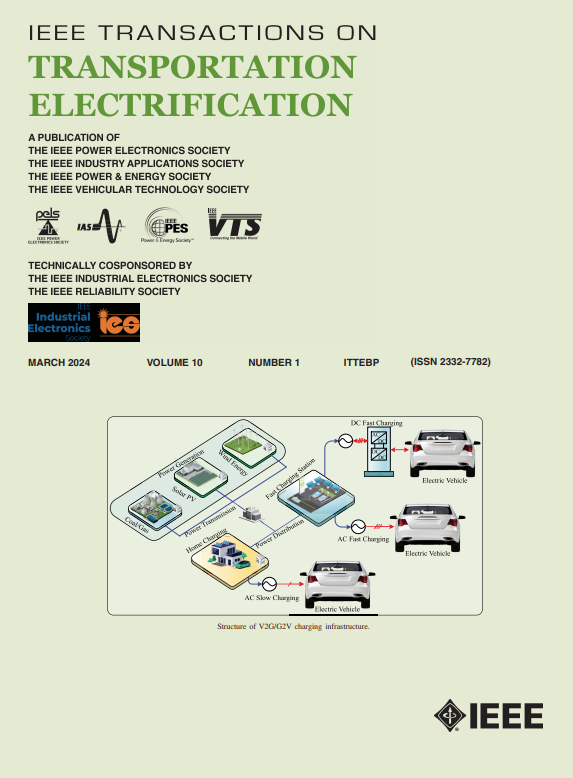
IEEE Transactions on Transportation Electrification is focused on components, sub-systems, systems, standards, and grid interface technologies related to power and energy conversion, propulsion, and actuation for all types of electrified vehicles including on-road, off-road, off-highway, and rail vehicles, airplanes, and ships.




 京公网安备 11010802042870号
京ICP备2023020795号-1
京公网安备 11010802042870号
京ICP备2023020795号-1

 分享
分享
 求助内容:
求助内容: 应助结果提醒方式:
 扫码关注我们
