{"title":"现代植入式心律转复除颤器的不当治疗:单腔设备中单腔和双腔鉴别器的倾向得分匹配比较 THe sINGle lead Study(THINGS 研究)。","authors":"Mauro Biffi MD , Giovanni Statuto MD, PhD , Valeria Calvi MD , Matteo Iori MD , Elia De Maria MD , Maria Giulia Bolognesi MD, PhD , Giuseppe Allocca MD , Francesca Notarangelo MD , Valeria Carinci MD , Ernesto Ammendola MD , Giulio Boggian MD , Davide Saporito MD , Luigi Mancini MD , Domenico Potenza MD , Eduardo Celentano MD, FHRS , Davide Giorgi MD, PhD , Matteo Ziacchi MD, PhD","doi":"10.1016/j.hrthm.2024.10.004","DOIUrl":null,"url":null,"abstract":"<div><h3>Background</h3><div>In patients with implantable cardioverter-defibrillators (ICDs), inappropriate therapies (ITs) are often caused by supraventricular tachyarrhythmias (SVTs).</div></div><div><h3>Objective</h3><div>We aimed to estimate the incidence of IT in modern single-lead ICDs.</div></div><div><h3>Methods</h3><div>The THINGS study enrolled patients with single-lead ICDs with 2 SVT discrimination modalities: dual chamber (DC) with an atrial floating dipole or single chamber (SC) with morphology criterion. All devices were programmed with 2-zone therapy: ventricular tachycardia (VT) zone from 170 beats/min with ≥15 seconds (≥36 beats) detection time and SVT discriminators; and ventricular fibrillation (VF) zone from 214 beats/min with ≥7 seconds (≥24 beats) detection time. The primary end point was the first occurrence of IT, adjudicated by an independent board.</div></div><div><h3>Results</h3><div>A total of 526 patients (median age, 66 years; 83% male), 183 (34.8%) with DC and 343 (65.2%) with SC discrimination, were observed for a median of 2.2 years. The incidence rate of IT was 4.2% (95% confidence interval [CI], 2.7%–6.4%) at 1 year and 7.1% (95% CI, 5.0%–9.9%) at 2 years. Younger age (adjusted hazard ratio, 0.97; 95% CI, 0.95–0.99; <em>P</em> = .013) and history of atrial fibrillation (adjusted hazard ratio, 2.67; 95% CI, 1.30–5.46; <em>P</em> = .007) were significantly associated with increased IT risk. In a propensity score–matched comparison, DC discrimination showed a trend toward reduced IT rates compared with SC discrimination in the VT zone (1-year incidence, 1.8% vs 3.5%; <em>P</em> = .105).</div></div><div><h3>Conclusion</h3><div>High-rate VF cutoff and prolonged detection time programming resulted in a low IT rate in single-lead ICD patients with modern SVT discriminators. A trend favoring the DC system was observed in the VT zone.</div></div>","PeriodicalId":12886,"journal":{"name":"Heart rhythm","volume":"22 7","pages":"Pages e141-e148"},"PeriodicalIF":7.0000,"publicationDate":"2025-07-01","publicationTypes":"Journal Article","fieldsOfStudy":null,"isOpenAccess":false,"openAccessPdf":"","citationCount":"0","resultStr":"{\"title\":\"Inappropriate therapies in modern implantable cardioverter-defibrillators: A propensity score–matched comparison between single- and dual-chamber discriminators in single-chamber devices THe sINGle lead Study (THINGS Study)\",\"authors\":\"Mauro Biffi MD , Giovanni Statuto MD, PhD , Valeria Calvi MD , Matteo Iori MD , Elia De Maria MD , Maria Giulia Bolognesi MD, PhD , Giuseppe Allocca MD , Francesca Notarangelo MD , Valeria Carinci MD , Ernesto Ammendola MD , Giulio Boggian MD , Davide Saporito MD , Luigi Mancini MD , Domenico Potenza MD , Eduardo Celentano MD, FHRS , Davide Giorgi MD, PhD , Matteo Ziacchi MD, PhD\",\"doi\":\"10.1016/j.hrthm.2024.10.004\",\"DOIUrl\":null,\"url\":null,\"abstract\":\"<div><h3>Background</h3><div>In patients with implantable cardioverter-defibrillators (ICDs), inappropriate therapies (ITs) are often caused by supraventricular tachyarrhythmias (SVTs).</div></div><div><h3>Objective</h3><div>We aimed to estimate the incidence of IT in modern single-lead ICDs.</div></div><div><h3>Methods</h3><div>The THINGS study enrolled patients with single-lead ICDs with 2 SVT discrimination modalities: dual chamber (DC) with an atrial floating dipole or single chamber (SC) with morphology criterion. All devices were programmed with 2-zone therapy: ventricular tachycardia (VT) zone from 170 beats/min with ≥15 seconds (≥36 beats) detection time and SVT discriminators; and ventricular fibrillation (VF) zone from 214 beats/min with ≥7 seconds (≥24 beats) detection time. The primary end point was the first occurrence of IT, adjudicated by an independent board.</div></div><div><h3>Results</h3><div>A total of 526 patients (median age, 66 years; 83% male), 183 (34.8%) with DC and 343 (65.2%) with SC discrimination, were observed for a median of 2.2 years. The incidence rate of IT was 4.2% (95% confidence interval [CI], 2.7%–6.4%) at 1 year and 7.1% (95% CI, 5.0%–9.9%) at 2 years. Younger age (adjusted hazard ratio, 0.97; 95% CI, 0.95–0.99; <em>P</em> = .013) and history of atrial fibrillation (adjusted hazard ratio, 2.67; 95% CI, 1.30–5.46; <em>P</em> = .007) were significantly associated with increased IT risk. In a propensity score–matched comparison, DC discrimination showed a trend toward reduced IT rates compared with SC discrimination in the VT zone (1-year incidence, 1.8% vs 3.5%; <em>P</em> = .105).</div></div><div><h3>Conclusion</h3><div>High-rate VF cutoff and prolonged detection time programming resulted in a low IT rate in single-lead ICD patients with modern SVT discriminators. A trend favoring the DC system was observed in the VT zone.</div></div>\",\"PeriodicalId\":12886,\"journal\":{\"name\":\"Heart rhythm\",\"volume\":\"22 7\",\"pages\":\"Pages e141-e148\"},\"PeriodicalIF\":7.0000,\"publicationDate\":\"2025-07-01\",\"publicationTypes\":\"Journal Article\",\"fieldsOfStudy\":null,\"isOpenAccess\":false,\"openAccessPdf\":\"\",\"citationCount\":\"0\",\"resultStr\":null,\"platform\":\"Semanticscholar\",\"paperid\":null,\"PeriodicalName\":\"Heart rhythm\",\"FirstCategoryId\":\"3\",\"ListUrlMain\":\"https://www.sciencedirect.com/science/article/pii/S1547527124034179\",\"RegionNum\":2,\"RegionCategory\":\"医学\",\"ArticlePicture\":[],\"TitleCN\":null,\"AbstractTextCN\":null,\"PMCID\":null,\"EPubDate\":\"2024/10/5 0:00:00\",\"PubModel\":\"Epub\",\"JCR\":\"Q1\",\"JCRName\":\"CARDIAC & CARDIOVASCULAR SYSTEMS\",\"Score\":null,\"Total\":0}","platform":"Semanticscholar","paperid":null,"PeriodicalName":"Heart rhythm","FirstCategoryId":"3","ListUrlMain":"https://www.sciencedirect.com/science/article/pii/S1547527124034179","RegionNum":2,"RegionCategory":"医学","ArticlePicture":[],"TitleCN":null,"AbstractTextCN":null,"PMCID":null,"EPubDate":"2024/10/5 0:00:00","PubModel":"Epub","JCR":"Q1","JCRName":"CARDIAC & CARDIOVASCULAR SYSTEMS","Score":null,"Total":0}
引用次数: 0
摘要
背景:在植入式心律转复除颤器(ICD)患者中,不适当治疗(IT)通常是由室上性快速性心律失常(SVT)引起的:估计现代单导联 ICD 的 IT 发生率:THINGS 研究招募了使用两种 SVT 识别模式的单导联 ICD 患者:通过心房浮动偶极子识别双腔 (DC) 或通过形态学标准识别单腔 (SC)。所有设备均采用双区疗法编程:(i) VT 区为每分钟 170 次,检测时间≥15 秒(≥36 次),并配有 SVT 鉴别器;(ii) VF 区为每分钟 214 次,检测时间≥7 秒(≥24 次)。主要终点是首次发生 IT,由独立委员会裁定:共对 526 名患者(中位年龄 66 岁,83% 为男性)进行了中位 2.2 年的随访,其中 183 人(34.8%)患有直流阻塞,343 人(65.2%)患有直流阻塞。1 年的 IT 发病率为 4.2%(95% CI,2.7%-6.4%),2 年的 IT 发病率为 7.1%(95% CI,5.0%-9.9%)。年轻(调整后 HR 0.97,95% CI 0.95-0.99,P=0.013)和心房颤动病史(调整后 HR 2.67,95% CI 1.30-5.46,P=0.007)与 IT 风险增加显著相关。在倾向分数匹配比较中,与VT区的SC判别相比,DC判别有降低IT率的趋势(1年发生率为1.8% vs. 3.5%,P=0.105):结论:使用现代 SVT 鉴别器的单导联 ICD 患者,其高频率 VF 截止和较长的检测时间编程导致了较低的 IT 发生率。在 VT 区观察到了有利于 DC 系统的趋势。
Inappropriate therapies in modern implantable cardioverter-defibrillators: A propensity score–matched comparison between single- and dual-chamber discriminators in single-chamber devices THe sINGle lead Study (THINGS Study)
Background
In patients with implantable cardioverter-defibrillators (ICDs), inappropriate therapies (ITs) are often caused by supraventricular tachyarrhythmias (SVTs).
Objective
We aimed to estimate the incidence of IT in modern single-lead ICDs.
Methods
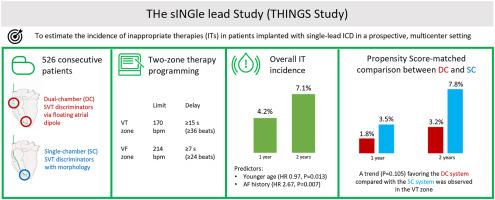
The THINGS study enrolled patients with single-lead ICDs with 2 SVT discrimination modalities: dual chamber (DC) with an atrial floating dipole or single chamber (SC) with morphology criterion. All devices were programmed with 2-zone therapy: ventricular tachycardia (VT) zone from 170 beats/min with ≥15 seconds (≥36 beats) detection time and SVT discriminators; and ventricular fibrillation (VF) zone from 214 beats/min with ≥7 seconds (≥24 beats) detection time. The primary end point was the first occurrence of IT, adjudicated by an independent board.
Results
A total of 526 patients (median age, 66 years; 83% male), 183 (34.8%) with DC and 343 (65.2%) with SC discrimination, were observed for a median of 2.2 years. The incidence rate of IT was 4.2% (95% confidence interval [CI], 2.7%–6.4%) at 1 year and 7.1% (95% CI, 5.0%–9.9%) at 2 years. Younger age (adjusted hazard ratio, 0.97; 95% CI, 0.95–0.99; P = .013) and history of atrial fibrillation (adjusted hazard ratio, 2.67; 95% CI, 1.30–5.46; P = .007) were significantly associated with increased IT risk. In a propensity score–matched comparison, DC discrimination showed a trend toward reduced IT rates compared with SC discrimination in the VT zone (1-year incidence, 1.8% vs 3.5%; P = .105).
Conclusion
High-rate VF cutoff and prolonged detection time programming resulted in a low IT rate in single-lead ICD patients with modern SVT discriminators. A trend favoring the DC system was observed in the VT zone.
期刊介绍:
HeartRhythm, the official Journal of the Heart Rhythm Society and the Cardiac Electrophysiology Society, is a unique journal for fundamental discovery and clinical applicability.
HeartRhythm integrates the entire cardiac electrophysiology (EP) community from basic and clinical academic researchers, private practitioners, engineers, allied professionals, industry, and trainees, all of whom are vital and interdependent members of our EP community.
The Heart Rhythm Society is the international leader in science, education, and advocacy for cardiac arrhythmia professionals and patients, and the primary information resource on heart rhythm disorders. Its mission is to improve the care of patients by promoting research, education, and optimal health care policies and standards.




 京公网安备 11010802042870号
京ICP备2023020795号-1
京公网安备 11010802042870号
京ICP备2023020795号-1

 分享
分享
 求助内容:
求助内容: 应助结果提醒方式:
 扫码关注我们
