Xue Yang, Donghui Cui, Tingting Zhang, Yu Liu and Fengyan Li
{"title":"具有多个活性位点的 Z 型 POMOF 衍生 Cu/WO2 改性 C-BiOBr 上的 LSPR 增强光催化固定 N2","authors":"Xue Yang, Donghui Cui, Tingting Zhang, Yu Liu and Fengyan Li","doi":"10.1039/D4QI02128B","DOIUrl":null,"url":null,"abstract":"<p >The conception and production of nitrogen-fixing photocatalysts with efficient charge separation rates and multiple active sites have been the focus of research. In this paper, we prepared Cu/WO<small><sub>2</sub></small> nanoparticles by high-temperature calcination of polyoxometalate based open frameworks (POMOFs) and then anchored them in interstitial carbon-doped BiOBr using a one-step hydrothermal method to obtain a novel Z-scheme Cu/WO<small><sub>2</sub></small>/C-BOB ternary heterostructure. The ammonia generation rate over the Cu/WO<small><sub>2</sub></small>/C-BOB heterojunction is 477.5 μmol g<small><sup>−1</sup></small> h<small><sup>−1</sup></small> in deionized water without any sacrificial reagents under the full solar spectrum, which is nearly 6.1 times greater than that of pure BiOBr. The synergistic effect of heteroatom doping, Z-scheme heterojunction and oxygen vacancies inhibits the recombination of photogenerated carriers and maintains their maximum redox capacity, providing more reaction sites and significantly improving the photocatalytic performance. In addition, the localized surface plasmon resonance (LSPR) effect of Cu NPs enhances light absorption and induces high-energy hot electrons to produce additional oxygen vacancies. Meanwhile, we explored the charge transfer pathways and possible reaction mechanisms of the heterojunctions through experimental characterization and DFT calculations, which provided a new idea to synergistically utilize the LSPR effect and Z-scheme heterostructures for the design of efficient photocatalysts.</p>","PeriodicalId":79,"journal":{"name":"Inorganic Chemistry Frontiers","volume":" 23","pages":" 8246-8257"},"PeriodicalIF":6.4000,"publicationDate":"2024-10-08","publicationTypes":"Journal Article","fieldsOfStudy":null,"isOpenAccess":false,"openAccessPdf":"","citationCount":"0","resultStr":"{\"title\":\"LSPR-enhanced photocatalytic N2 fixation over Z-scheme POMOF-derived Cu/WO2 modified C-BiOBr with multiple active sites†\",\"authors\":\"Xue Yang, Donghui Cui, Tingting Zhang, Yu Liu and Fengyan Li\",\"doi\":\"10.1039/D4QI02128B\",\"DOIUrl\":null,\"url\":null,\"abstract\":\"<p >The conception and production of nitrogen-fixing photocatalysts with efficient charge separation rates and multiple active sites have been the focus of research. In this paper, we prepared Cu/WO<small><sub>2</sub></small> nanoparticles by high-temperature calcination of polyoxometalate based open frameworks (POMOFs) and then anchored them in interstitial carbon-doped BiOBr using a one-step hydrothermal method to obtain a novel Z-scheme Cu/WO<small><sub>2</sub></small>/C-BOB ternary heterostructure. The ammonia generation rate over the Cu/WO<small><sub>2</sub></small>/C-BOB heterojunction is 477.5 μmol g<small><sup>−1</sup></small> h<small><sup>−1</sup></small> in deionized water without any sacrificial reagents under the full solar spectrum, which is nearly 6.1 times greater than that of pure BiOBr. The synergistic effect of heteroatom doping, Z-scheme heterojunction and oxygen vacancies inhibits the recombination of photogenerated carriers and maintains their maximum redox capacity, providing more reaction sites and significantly improving the photocatalytic performance. In addition, the localized surface plasmon resonance (LSPR) effect of Cu NPs enhances light absorption and induces high-energy hot electrons to produce additional oxygen vacancies. Meanwhile, we explored the charge transfer pathways and possible reaction mechanisms of the heterojunctions through experimental characterization and DFT calculations, which provided a new idea to synergistically utilize the LSPR effect and Z-scheme heterostructures for the design of efficient photocatalysts.</p>\",\"PeriodicalId\":79,\"journal\":{\"name\":\"Inorganic Chemistry Frontiers\",\"volume\":\" 23\",\"pages\":\" 8246-8257\"},\"PeriodicalIF\":6.4000,\"publicationDate\":\"2024-10-08\",\"publicationTypes\":\"Journal Article\",\"fieldsOfStudy\":null,\"isOpenAccess\":false,\"openAccessPdf\":\"\",\"citationCount\":\"0\",\"resultStr\":null,\"platform\":\"Semanticscholar\",\"paperid\":null,\"PeriodicalName\":\"Inorganic Chemistry Frontiers\",\"FirstCategoryId\":\"92\",\"ListUrlMain\":\"https://pubs.rsc.org/en/content/articlelanding/2024/qi/d4qi02128b\",\"RegionNum\":1,\"RegionCategory\":\"化学\",\"ArticlePicture\":[],\"TitleCN\":null,\"AbstractTextCN\":null,\"PMCID\":null,\"EPubDate\":\"\",\"PubModel\":\"\",\"JCR\":\"Q1\",\"JCRName\":\"CHEMISTRY, INORGANIC & NUCLEAR\",\"Score\":null,\"Total\":0}","platform":"Semanticscholar","paperid":null,"PeriodicalName":"Inorganic Chemistry Frontiers","FirstCategoryId":"92","ListUrlMain":"https://pubs.rsc.org/en/content/articlelanding/2024/qi/d4qi02128b","RegionNum":1,"RegionCategory":"化学","ArticlePicture":[],"TitleCN":null,"AbstractTextCN":null,"PMCID":null,"EPubDate":"","PubModel":"","JCR":"Q1","JCRName":"CHEMISTRY, INORGANIC & NUCLEAR","Score":null,"Total":0}
引用次数: 0
摘要
构思和生产具有高效电荷分离率和多个活性位点的固氮光催化剂一直是研究的重点。本文通过高温煅烧聚氧化金属基开放框架(POMOFs)制备了 Cu/WO2 纳米颗粒,然后采用一步水热法将其锚定在间隙碳掺杂的 BiOBr 中,得到了新型 Z 型 Cu/WO2/C-BOB 三元异质结构。杂原子掺杂、Z 型异质结和氧空位的协同作用抑制了光生载流子的重组,保持了其最大氧化还原能力,提供了更多的反应位点,显著提高了光催化性能。此外,Cu NPs 的局部表面等离子体共振效应(LSPR)增强了光吸收,并促使高能热电子产生更多的氧空位。同时,我们通过实验表征和 DFT 计算探索了异质结的电荷转移途径和可能的反应机制,为协同利用 LSPR 效应和 Z 型异质结构设计高效光催化剂提供了新思路。
LSPR-enhanced photocatalytic N2 fixation over Z-scheme POMOF-derived Cu/WO2 modified C-BiOBr with multiple active sites†
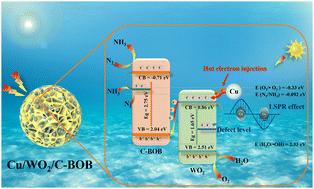
The conception and production of nitrogen-fixing photocatalysts with efficient charge separation rates and multiple active sites have been the focus of research. In this paper, we prepared Cu/WO2 nanoparticles by high-temperature calcination of polyoxometalate based open frameworks (POMOFs) and then anchored them in interstitial carbon-doped BiOBr using a one-step hydrothermal method to obtain a novel Z-scheme Cu/WO2/C-BOB ternary heterostructure. The ammonia generation rate over the Cu/WO2/C-BOB heterojunction is 477.5 μmol g−1 h−1 in deionized water without any sacrificial reagents under the full solar spectrum, which is nearly 6.1 times greater than that of pure BiOBr. The synergistic effect of heteroatom doping, Z-scheme heterojunction and oxygen vacancies inhibits the recombination of photogenerated carriers and maintains their maximum redox capacity, providing more reaction sites and significantly improving the photocatalytic performance. In addition, the localized surface plasmon resonance (LSPR) effect of Cu NPs enhances light absorption and induces high-energy hot electrons to produce additional oxygen vacancies. Meanwhile, we explored the charge transfer pathways and possible reaction mechanisms of the heterojunctions through experimental characterization and DFT calculations, which provided a new idea to synergistically utilize the LSPR effect and Z-scheme heterostructures for the design of efficient photocatalysts.




 京公网安备 11010802042870号
京ICP备2023020795号-1
京公网安备 11010802042870号
京ICP备2023020795号-1

 分享
分享
 求助内容:
求助内容: 应助结果提醒方式:
 扫码关注我们
