Xiangyu Miao, Rui Han, Juan Tian, Prof. Dr. Yuanchi Ma, Prof. Dr. Alejandro J. Müller, Prof. Dr. Zhibo Li
{"title":"通过 \"储备-释放 \"结晶策略从多嵌段共聚物中制造超强、坚韧和可生物降解的热塑性弹性体。","authors":"Xiangyu Miao, Rui Han, Juan Tian, Prof. Dr. Yuanchi Ma, Prof. Dr. Alejandro J. Müller, Prof. Dr. Zhibo Li","doi":"10.1002/anie.202417627","DOIUrl":null,"url":null,"abstract":"<p>Simultaneously attaining high strength and toughness has been a significant challenge in designing thermoplastic elastomers, especially biodegradable ones. In this context, we present a class of biodegradable elastomers based on multiblock copolyesters that afford extraordinary strength, toughness, and low-strain resilience despite expedient chemical synthesis and sample processing. With the incorporation of the semi-crystalline soft block and the judicious selection of block periodicity, the thermoplastic materials feature low quiescent crystallinity (“reserve”) albeit with vast potential for strain-induced crystallization (“release”), resulting in their significantly enhanced ultimate strength and energy-dissipating capabilities. Moreover, a breadth of mechanical responses of the materials – from reinforced elastomers to shape-memory materials to toughened thermoplastics – can be achieved by orthogonal variation of segment lengths and ratios. This work and the “reserve-release” crystallization strategy herein highlight the double crystalline multiblock chain architecture as a potential avenue towards reconciling the strength-toughness trade-off in thermoplastic elastomers and can possibly be extended to other biodegradable building blocks to deliver functional materials with diverse mechanical performances.</p>","PeriodicalId":125,"journal":{"name":"Angewandte Chemie International Edition","volume":"64 5","pages":""},"PeriodicalIF":16.9000,"publicationDate":"2024-10-09","publicationTypes":"Journal Article","fieldsOfStudy":null,"isOpenAccess":false,"openAccessPdf":"","citationCount":"0","resultStr":"{\"title\":\"Building Ultrastrong, Tough and Biodegradable Thermoplastic Elastomers from Multiblock Copolyesters Via a “Reserve-Release” Crystallization Strategy\",\"authors\":\"Xiangyu Miao, Rui Han, Juan Tian, Prof. Dr. Yuanchi Ma, Prof. Dr. Alejandro J. Müller, Prof. Dr. Zhibo Li\",\"doi\":\"10.1002/anie.202417627\",\"DOIUrl\":null,\"url\":null,\"abstract\":\"<p>Simultaneously attaining high strength and toughness has been a significant challenge in designing thermoplastic elastomers, especially biodegradable ones. In this context, we present a class of biodegradable elastomers based on multiblock copolyesters that afford extraordinary strength, toughness, and low-strain resilience despite expedient chemical synthesis and sample processing. With the incorporation of the semi-crystalline soft block and the judicious selection of block periodicity, the thermoplastic materials feature low quiescent crystallinity (“reserve”) albeit with vast potential for strain-induced crystallization (“release”), resulting in their significantly enhanced ultimate strength and energy-dissipating capabilities. Moreover, a breadth of mechanical responses of the materials – from reinforced elastomers to shape-memory materials to toughened thermoplastics – can be achieved by orthogonal variation of segment lengths and ratios. This work and the “reserve-release” crystallization strategy herein highlight the double crystalline multiblock chain architecture as a potential avenue towards reconciling the strength-toughness trade-off in thermoplastic elastomers and can possibly be extended to other biodegradable building blocks to deliver functional materials with diverse mechanical performances.</p>\",\"PeriodicalId\":125,\"journal\":{\"name\":\"Angewandte Chemie International Edition\",\"volume\":\"64 5\",\"pages\":\"\"},\"PeriodicalIF\":16.9000,\"publicationDate\":\"2024-10-09\",\"publicationTypes\":\"Journal Article\",\"fieldsOfStudy\":null,\"isOpenAccess\":false,\"openAccessPdf\":\"\",\"citationCount\":\"0\",\"resultStr\":null,\"platform\":\"Semanticscholar\",\"paperid\":null,\"PeriodicalName\":\"Angewandte Chemie International Edition\",\"FirstCategoryId\":\"92\",\"ListUrlMain\":\"https://onlinelibrary.wiley.com/doi/10.1002/anie.202417627\",\"RegionNum\":1,\"RegionCategory\":\"化学\",\"ArticlePicture\":[],\"TitleCN\":null,\"AbstractTextCN\":null,\"PMCID\":null,\"EPubDate\":\"\",\"PubModel\":\"\",\"JCR\":\"Q1\",\"JCRName\":\"CHEMISTRY, MULTIDISCIPLINARY\",\"Score\":null,\"Total\":0}","platform":"Semanticscholar","paperid":null,"PeriodicalName":"Angewandte Chemie International Edition","FirstCategoryId":"92","ListUrlMain":"https://onlinelibrary.wiley.com/doi/10.1002/anie.202417627","RegionNum":1,"RegionCategory":"化学","ArticlePicture":[],"TitleCN":null,"AbstractTextCN":null,"PMCID":null,"EPubDate":"","PubModel":"","JCR":"Q1","JCRName":"CHEMISTRY, MULTIDISCIPLINARY","Score":null,"Total":0}
Building Ultrastrong, Tough and Biodegradable Thermoplastic Elastomers from Multiblock Copolyesters Via a “Reserve-Release” Crystallization Strategy
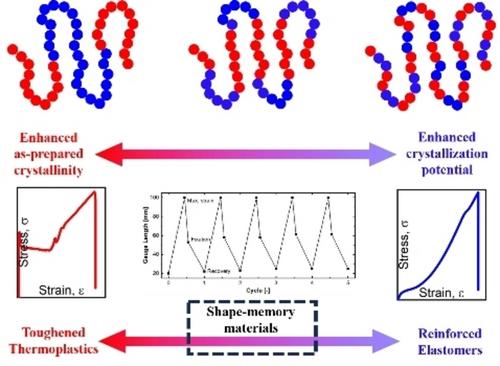
Simultaneously attaining high strength and toughness has been a significant challenge in designing thermoplastic elastomers, especially biodegradable ones. In this context, we present a class of biodegradable elastomers based on multiblock copolyesters that afford extraordinary strength, toughness, and low-strain resilience despite expedient chemical synthesis and sample processing. With the incorporation of the semi-crystalline soft block and the judicious selection of block periodicity, the thermoplastic materials feature low quiescent crystallinity (“reserve”) albeit with vast potential for strain-induced crystallization (“release”), resulting in their significantly enhanced ultimate strength and energy-dissipating capabilities. Moreover, a breadth of mechanical responses of the materials – from reinforced elastomers to shape-memory materials to toughened thermoplastics – can be achieved by orthogonal variation of segment lengths and ratios. This work and the “reserve-release” crystallization strategy herein highlight the double crystalline multiblock chain architecture as a potential avenue towards reconciling the strength-toughness trade-off in thermoplastic elastomers and can possibly be extended to other biodegradable building blocks to deliver functional materials with diverse mechanical performances.
期刊介绍:
Angewandte Chemie, a journal of the German Chemical Society (GDCh), maintains a leading position among scholarly journals in general chemistry with an impressive Impact Factor of 16.6 (2022 Journal Citation Reports, Clarivate, 2023). Published weekly in a reader-friendly format, it features new articles almost every day. Established in 1887, Angewandte Chemie is a prominent chemistry journal, offering a dynamic blend of Review-type articles, Highlights, Communications, and Research Articles on a weekly basis, making it unique in the field.




 京公网安备 11010802042870号
京ICP备2023020795号-1
京公网安备 11010802042870号
京ICP备2023020795号-1

 分享
分享
 求助内容:
求助内容: 应助结果提醒方式:
 扫码关注我们
