Guang Zeng, Wenshuo Gao, Weicheng Qiu, Guanling Li, Shousen Chen, Xin He, Guoxing Sun, Weijia Yang and Yue Xin
{"title":"微相分离诱导的聚齐瓦离子凝胶具有坚韧、高导电性、自愈合和形状记忆特性,适用于可穿戴电气设备","authors":"Guang Zeng, Wenshuo Gao, Weicheng Qiu, Guanling Li, Shousen Chen, Xin He, Guoxing Sun, Weijia Yang and Yue Xin","doi":"10.1039/D4TA04228J","DOIUrl":null,"url":null,"abstract":"<p >Ionogels have aroused great attention due to their unique advantages for constructing wearable devices. However, the mechanical properties and ion conductivity of ionogels are often negatively correlated in current research. Furthermore, integrating advanced functionalities such as self-healing and shape–memory into a robust and conductive ionogel remains challenging. Herein, we developed a polyzwitterionic ionogel through the copolymerization of zwitterionic [2-(methacryloyloxy)ethyl]dimethyl-(3-sulfopropyl) (SBMA) and acrylamide (AAm) in the ionic liquid (IL) 1-ethyl-3-methylimidazolium ethyl sulfate (EMIES). The facile ability of the polyacrylamide (PAM) segments to engage in hydrogen bonds makes them easily aggregated in EMIES, resulting in the formation of polymer-rich domains. In contrast, poly[2-(methacryloyloxy)ethyl]dimethyl-(3-sulfopropyl) (PSBMA) segments combined with EMIES form a solvent-rich phase due to their good compatibility. Therefore, an interpenetrating phase-separated structure is produced during the polymerization. The polymer-rich phase can dissipate energy and provide high strength, while the solvent-rich phase enables an ionogel with high stretchability. Additionally, the zwitterionic groups on PSBMA can provide separate and continuous ion conductive pathways, facilitating ion transport. The resulting ionogel presents balanced mechanical and electrical properties with a high toughness of 2.7 MJ m<small><sup>−3</sup></small> and ion conductivity of 1.3 mS cm<small><sup>−1</sup></small>, as well as desirable self-healing ability, which are attributed to the synergy of its phase separation and zwitterionicity. The resulting PSBMA/PAAm ionogel demonstrated excellent performance as a temperature and strain sensor. Remarkably, the ionogel possessed outstanding shape–memory properties, making the ionogel able to be fixed on a human joint or object with nonzero Gaussian curvature and maintain the sensing functions. Therefore, the morphing ionogel-based sensor displays huge versatility and potential for detecting the signal variations for objects with sophisticated geometries.</p>","PeriodicalId":82,"journal":{"name":"Journal of Materials Chemistry A","volume":" 44","pages":" 30618-30628"},"PeriodicalIF":9.5000,"publicationDate":"2024-10-11","publicationTypes":"Journal Article","fieldsOfStudy":null,"isOpenAccess":false,"openAccessPdf":"","citationCount":"0","resultStr":"{\"title\":\"Microphase-separation-induced polyzwitterionic ionogel with tough, highly conductive, self-healing and shape–memory properties for wearable electrical devices†\",\"authors\":\"Guang Zeng, Wenshuo Gao, Weicheng Qiu, Guanling Li, Shousen Chen, Xin He, Guoxing Sun, Weijia Yang and Yue Xin\",\"doi\":\"10.1039/D4TA04228J\",\"DOIUrl\":null,\"url\":null,\"abstract\":\"<p >Ionogels have aroused great attention due to their unique advantages for constructing wearable devices. However, the mechanical properties and ion conductivity of ionogels are often negatively correlated in current research. Furthermore, integrating advanced functionalities such as self-healing and shape–memory into a robust and conductive ionogel remains challenging. Herein, we developed a polyzwitterionic ionogel through the copolymerization of zwitterionic [2-(methacryloyloxy)ethyl]dimethyl-(3-sulfopropyl) (SBMA) and acrylamide (AAm) in the ionic liquid (IL) 1-ethyl-3-methylimidazolium ethyl sulfate (EMIES). The facile ability of the polyacrylamide (PAM) segments to engage in hydrogen bonds makes them easily aggregated in EMIES, resulting in the formation of polymer-rich domains. In contrast, poly[2-(methacryloyloxy)ethyl]dimethyl-(3-sulfopropyl) (PSBMA) segments combined with EMIES form a solvent-rich phase due to their good compatibility. Therefore, an interpenetrating phase-separated structure is produced during the polymerization. The polymer-rich phase can dissipate energy and provide high strength, while the solvent-rich phase enables an ionogel with high stretchability. Additionally, the zwitterionic groups on PSBMA can provide separate and continuous ion conductive pathways, facilitating ion transport. The resulting ionogel presents balanced mechanical and electrical properties with a high toughness of 2.7 MJ m<small><sup>−3</sup></small> and ion conductivity of 1.3 mS cm<small><sup>−1</sup></small>, as well as desirable self-healing ability, which are attributed to the synergy of its phase separation and zwitterionicity. The resulting PSBMA/PAAm ionogel demonstrated excellent performance as a temperature and strain sensor. Remarkably, the ionogel possessed outstanding shape–memory properties, making the ionogel able to be fixed on a human joint or object with nonzero Gaussian curvature and maintain the sensing functions. Therefore, the morphing ionogel-based sensor displays huge versatility and potential for detecting the signal variations for objects with sophisticated geometries.</p>\",\"PeriodicalId\":82,\"journal\":{\"name\":\"Journal of Materials Chemistry A\",\"volume\":\" 44\",\"pages\":\" 30618-30628\"},\"PeriodicalIF\":9.5000,\"publicationDate\":\"2024-10-11\",\"publicationTypes\":\"Journal Article\",\"fieldsOfStudy\":null,\"isOpenAccess\":false,\"openAccessPdf\":\"\",\"citationCount\":\"0\",\"resultStr\":null,\"platform\":\"Semanticscholar\",\"paperid\":null,\"PeriodicalName\":\"Journal of Materials Chemistry A\",\"FirstCategoryId\":\"88\",\"ListUrlMain\":\"https://pubs.rsc.org/en/content/articlelanding/2024/ta/d4ta04228j\",\"RegionNum\":2,\"RegionCategory\":\"材料科学\",\"ArticlePicture\":[],\"TitleCN\":null,\"AbstractTextCN\":null,\"PMCID\":null,\"EPubDate\":\"\",\"PubModel\":\"\",\"JCR\":\"Q1\",\"JCRName\":\"CHEMISTRY, PHYSICAL\",\"Score\":null,\"Total\":0}","platform":"Semanticscholar","paperid":null,"PeriodicalName":"Journal of Materials Chemistry A","FirstCategoryId":"88","ListUrlMain":"https://pubs.rsc.org/en/content/articlelanding/2024/ta/d4ta04228j","RegionNum":2,"RegionCategory":"材料科学","ArticlePicture":[],"TitleCN":null,"AbstractTextCN":null,"PMCID":null,"EPubDate":"","PubModel":"","JCR":"Q1","JCRName":"CHEMISTRY, PHYSICAL","Score":null,"Total":0}
Microphase-separation-induced polyzwitterionic ionogel with tough, highly conductive, self-healing and shape–memory properties for wearable electrical devices†
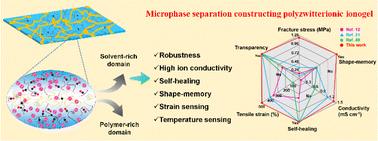
Ionogels have aroused great attention due to their unique advantages for constructing wearable devices. However, the mechanical properties and ion conductivity of ionogels are often negatively correlated in current research. Furthermore, integrating advanced functionalities such as self-healing and shape–memory into a robust and conductive ionogel remains challenging. Herein, we developed a polyzwitterionic ionogel through the copolymerization of zwitterionic [2-(methacryloyloxy)ethyl]dimethyl-(3-sulfopropyl) (SBMA) and acrylamide (AAm) in the ionic liquid (IL) 1-ethyl-3-methylimidazolium ethyl sulfate (EMIES). The facile ability of the polyacrylamide (PAM) segments to engage in hydrogen bonds makes them easily aggregated in EMIES, resulting in the formation of polymer-rich domains. In contrast, poly[2-(methacryloyloxy)ethyl]dimethyl-(3-sulfopropyl) (PSBMA) segments combined with EMIES form a solvent-rich phase due to their good compatibility. Therefore, an interpenetrating phase-separated structure is produced during the polymerization. The polymer-rich phase can dissipate energy and provide high strength, while the solvent-rich phase enables an ionogel with high stretchability. Additionally, the zwitterionic groups on PSBMA can provide separate and continuous ion conductive pathways, facilitating ion transport. The resulting ionogel presents balanced mechanical and electrical properties with a high toughness of 2.7 MJ m−3 and ion conductivity of 1.3 mS cm−1, as well as desirable self-healing ability, which are attributed to the synergy of its phase separation and zwitterionicity. The resulting PSBMA/PAAm ionogel demonstrated excellent performance as a temperature and strain sensor. Remarkably, the ionogel possessed outstanding shape–memory properties, making the ionogel able to be fixed on a human joint or object with nonzero Gaussian curvature and maintain the sensing functions. Therefore, the morphing ionogel-based sensor displays huge versatility and potential for detecting the signal variations for objects with sophisticated geometries.
期刊介绍:
The Journal of Materials Chemistry A, B & C covers a wide range of high-quality studies in the field of materials chemistry, with each section focusing on specific applications of the materials studied. Journal of Materials Chemistry A emphasizes applications in energy and sustainability, including topics such as artificial photosynthesis, batteries, and fuel cells. Journal of Materials Chemistry B focuses on applications in biology and medicine, while Journal of Materials Chemistry C covers applications in optical, magnetic, and electronic devices. Example topic areas within the scope of Journal of Materials Chemistry A include catalysis, green/sustainable materials, sensors, and water treatment, among others.




 京公网安备 11010802042870号
京ICP备2023020795号-1
京公网安备 11010802042870号
京ICP备2023020795号-1

 分享
分享
 求助内容:
求助内容: 应助结果提醒方式:
 扫码关注我们
