{"title":"多变量融合协方差矩阵网络及其在训练样本较少的多通道故障诊断中的应用","authors":"Junchao Guo;Fengshou Gu;Andrew D. Ball","doi":"10.1109/TCYB.2024.3474651","DOIUrl":null,"url":null,"abstract":"Due to the large number of monitoring variables in engineering, it is extremely to reflect fault information in machinery and equipment with a single channel signal, which poses a significant challenge for fault diagnosis. Furthermore, most existing intelligent recognition methods rely on label samples, yet ignore the high cost of label interpretation in practical engineering. In this work, a novel multivariate fusion covariance matrix network (MFCMN) is developed for multichannel fault diagnosis with fewer training samples. First, the collected multichannel signals are separated into mode functions by using cyclic autocorrelation analysis. Thereafter, the acquired mode functions are utilized to construct the multivariate fusion covariance matrix (MFCM), which retains the linkage of signals from different channels. Finally, MFCM is fed into the standard autoencoder to form the MFCMN network, which is applied to implement multichannel fault diagnosis. To assess effectiveness, the MFCMN is compared with the deep residual network (ResNet), convolutional neural network (CNN), long short-term memory (LSTM), and K-nearest neighbor (KNN) in two experimental cases with fewer training samples. The results clarify that the MFCMN offers excellent performance and high accuracy in multichannel fault diagnosis.","PeriodicalId":13112,"journal":{"name":"IEEE Transactions on Cybernetics","volume":"55 1","pages":"77-85"},"PeriodicalIF":10.5000,"publicationDate":"2024-10-15","publicationTypes":"Journal Article","fieldsOfStudy":null,"isOpenAccess":false,"openAccessPdf":"","citationCount":"0","resultStr":"{\"title\":\"Multivariate Fusion Covariance Matrix Network and Its Application in Multichannel Fault Diagnosis With Fewer Training Samples\",\"authors\":\"Junchao Guo;Fengshou Gu;Andrew D. Ball\",\"doi\":\"10.1109/TCYB.2024.3474651\",\"DOIUrl\":null,\"url\":null,\"abstract\":\"Due to the large number of monitoring variables in engineering, it is extremely to reflect fault information in machinery and equipment with a single channel signal, which poses a significant challenge for fault diagnosis. Furthermore, most existing intelligent recognition methods rely on label samples, yet ignore the high cost of label interpretation in practical engineering. In this work, a novel multivariate fusion covariance matrix network (MFCMN) is developed for multichannel fault diagnosis with fewer training samples. First, the collected multichannel signals are separated into mode functions by using cyclic autocorrelation analysis. Thereafter, the acquired mode functions are utilized to construct the multivariate fusion covariance matrix (MFCM), which retains the linkage of signals from different channels. Finally, MFCM is fed into the standard autoencoder to form the MFCMN network, which is applied to implement multichannel fault diagnosis. To assess effectiveness, the MFCMN is compared with the deep residual network (ResNet), convolutional neural network (CNN), long short-term memory (LSTM), and K-nearest neighbor (KNN) in two experimental cases with fewer training samples. The results clarify that the MFCMN offers excellent performance and high accuracy in multichannel fault diagnosis.\",\"PeriodicalId\":13112,\"journal\":{\"name\":\"IEEE Transactions on Cybernetics\",\"volume\":\"55 1\",\"pages\":\"77-85\"},\"PeriodicalIF\":10.5000,\"publicationDate\":\"2024-10-15\",\"publicationTypes\":\"Journal Article\",\"fieldsOfStudy\":null,\"isOpenAccess\":false,\"openAccessPdf\":\"\",\"citationCount\":\"0\",\"resultStr\":null,\"platform\":\"Semanticscholar\",\"paperid\":null,\"PeriodicalName\":\"IEEE Transactions on Cybernetics\",\"FirstCategoryId\":\"94\",\"ListUrlMain\":\"https://ieeexplore.ieee.org/document/10717454/\",\"RegionNum\":1,\"RegionCategory\":\"计算机科学\",\"ArticlePicture\":[],\"TitleCN\":null,\"AbstractTextCN\":null,\"PMCID\":null,\"EPubDate\":\"\",\"PubModel\":\"\",\"JCR\":\"Q1\",\"JCRName\":\"AUTOMATION & CONTROL SYSTEMS\",\"Score\":null,\"Total\":0}","platform":"Semanticscholar","paperid":null,"PeriodicalName":"IEEE Transactions on Cybernetics","FirstCategoryId":"94","ListUrlMain":"https://ieeexplore.ieee.org/document/10717454/","RegionNum":1,"RegionCategory":"计算机科学","ArticlePicture":[],"TitleCN":null,"AbstractTextCN":null,"PMCID":null,"EPubDate":"","PubModel":"","JCR":"Q1","JCRName":"AUTOMATION & CONTROL SYSTEMS","Score":null,"Total":0}
Multivariate Fusion Covariance Matrix Network and Its Application in Multichannel Fault Diagnosis With Fewer Training Samples
Due to the large number of monitoring variables in engineering, it is extremely to reflect fault information in machinery and equipment with a single channel signal, which poses a significant challenge for fault diagnosis. Furthermore, most existing intelligent recognition methods rely on label samples, yet ignore the high cost of label interpretation in practical engineering. In this work, a novel multivariate fusion covariance matrix network (MFCMN) is developed for multichannel fault diagnosis with fewer training samples. First, the collected multichannel signals are separated into mode functions by using cyclic autocorrelation analysis. Thereafter, the acquired mode functions are utilized to construct the multivariate fusion covariance matrix (MFCM), which retains the linkage of signals from different channels. Finally, MFCM is fed into the standard autoencoder to form the MFCMN network, which is applied to implement multichannel fault diagnosis. To assess effectiveness, the MFCMN is compared with the deep residual network (ResNet), convolutional neural network (CNN), long short-term memory (LSTM), and K-nearest neighbor (KNN) in two experimental cases with fewer training samples. The results clarify that the MFCMN offers excellent performance and high accuracy in multichannel fault diagnosis.
期刊介绍:
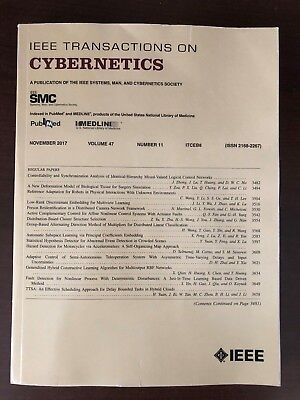
The scope of the IEEE Transactions on Cybernetics includes computational approaches to the field of cybernetics. Specifically, the transactions welcomes papers on communication and control across machines or machine, human, and organizations. The scope includes such areas as computational intelligence, computer vision, neural networks, genetic algorithms, machine learning, fuzzy systems, cognitive systems, decision making, and robotics, to the extent that they contribute to the theme of cybernetics or demonstrate an application of cybernetics principles.




 京公网安备 11010802042870号
京ICP备2023020795号-1
京公网安备 11010802042870号
京ICP备2023020795号-1

 分享
分享
 求助内容:
求助内容: 应助结果提醒方式:
 扫码关注我们
