{"title":"Zingiber baumii Chatan & Promprom:来自泰国的新银杏科物种","authors":"Wilawan Promprom, Phukphon Munglue, Wannachai Chatan","doi":"10.1002/ece3.70449","DOIUrl":null,"url":null,"abstract":"<p><i>Zingiber baumii</i> Chatan & Promprom, a new species from the Zingiberaceae family, is described from Sakon Nakhon Province in northeastern Thailand. This species was identified during field expeditions conducted between 2018 and 2024 in Phu Pha Yol National Park. The morphological characteristics of <i>Z. baumii</i>, such as red or pinkish-red leaf sheaths, leaf blades (1.5−) 2.0–3.0 cm wide, pink petioles, and bright yellow corolla with a red patch, distinguish it from closely related species such as <i>Z. isanense</i> Triboun & K. Larsen. <i>Zingiber baumii</i> grows in slightly shaded dry dipterocarp forests at elevations of 300–380 m. The preliminary conservation assessment indicates that this species should be classified as Endangered (EN) according to IUCN criteria due to its limited distribution and small population size. Detailed morphological comparisons with related species are provided, along with illustrations and habitat descriptions.</p>","PeriodicalId":11467,"journal":{"name":"Ecology and Evolution","volume":"14 10","pages":""},"PeriodicalIF":2.6000,"publicationDate":"2024-10-17","publicationTypes":"Journal Article","fieldsOfStudy":null,"isOpenAccess":false,"openAccessPdf":"https://onlinelibrary.wiley.com/doi/epdf/10.1002/ece3.70449","citationCount":"0","resultStr":"{\"title\":\"Zingiber baumii Chatan & Promprom: A New Species of Zingiberaceae From Thailand\",\"authors\":\"Wilawan Promprom, Phukphon Munglue, Wannachai Chatan\",\"doi\":\"10.1002/ece3.70449\",\"DOIUrl\":null,\"url\":null,\"abstract\":\"<p><i>Zingiber baumii</i> Chatan & Promprom, a new species from the Zingiberaceae family, is described from Sakon Nakhon Province in northeastern Thailand. This species was identified during field expeditions conducted between 2018 and 2024 in Phu Pha Yol National Park. The morphological characteristics of <i>Z. baumii</i>, such as red or pinkish-red leaf sheaths, leaf blades (1.5−) 2.0–3.0 cm wide, pink petioles, and bright yellow corolla with a red patch, distinguish it from closely related species such as <i>Z. isanense</i> Triboun & K. Larsen. <i>Zingiber baumii</i> grows in slightly shaded dry dipterocarp forests at elevations of 300–380 m. The preliminary conservation assessment indicates that this species should be classified as Endangered (EN) according to IUCN criteria due to its limited distribution and small population size. Detailed morphological comparisons with related species are provided, along with illustrations and habitat descriptions.</p>\",\"PeriodicalId\":11467,\"journal\":{\"name\":\"Ecology and Evolution\",\"volume\":\"14 10\",\"pages\":\"\"},\"PeriodicalIF\":2.6000,\"publicationDate\":\"2024-10-17\",\"publicationTypes\":\"Journal Article\",\"fieldsOfStudy\":null,\"isOpenAccess\":false,\"openAccessPdf\":\"https://onlinelibrary.wiley.com/doi/epdf/10.1002/ece3.70449\",\"citationCount\":\"0\",\"resultStr\":null,\"platform\":\"Semanticscholar\",\"paperid\":null,\"PeriodicalName\":\"Ecology and Evolution\",\"FirstCategoryId\":\"99\",\"ListUrlMain\":\"https://onlinelibrary.wiley.com/doi/10.1002/ece3.70449\",\"RegionNum\":2,\"RegionCategory\":\"生物学\",\"ArticlePicture\":[],\"TitleCN\":null,\"AbstractTextCN\":null,\"PMCID\":null,\"EPubDate\":\"\",\"PubModel\":\"\",\"JCR\":\"Q2\",\"JCRName\":\"ECOLOGY\",\"Score\":null,\"Total\":0}","platform":"Semanticscholar","paperid":null,"PeriodicalName":"Ecology and Evolution","FirstCategoryId":"99","ListUrlMain":"https://onlinelibrary.wiley.com/doi/10.1002/ece3.70449","RegionNum":2,"RegionCategory":"生物学","ArticlePicture":[],"TitleCN":null,"AbstractTextCN":null,"PMCID":null,"EPubDate":"","PubModel":"","JCR":"Q2","JCRName":"ECOLOGY","Score":null,"Total":0}
引用次数: 0
摘要
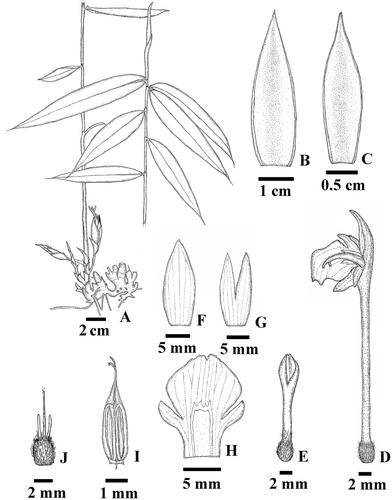
Zingiber baumii Chatan & Promprom是一种来自泰国东北部沙坤那空府的新物种,描述了该物种。该物种是 2018 年至 2024 年期间在普帕约国家公园(Phu Pha Yol National Park)进行野外考察时发现的。Z. baumii的形态特征,如红色或粉红色叶鞘、叶片(1.5-)2.0-3.0厘米宽、粉红色叶柄和带有红色斑块的鲜黄色花冠,将其与Z. isanense Triboun & K. Larsen等近缘种区分开来。Zingiber baumii生长在海拔300-380米、稍有遮蔽的干燥双子叶林中。初步保护评估表明,根据世界自然保护联盟(IUCN)的标准,该物种应被列为濒危物种(EN),因为其分布范围有限,种群规模较小。该报告提供了与相关物种的详细形态比较,以及插图和栖息地描述。
Zingiber baumii Chatan & Promprom: A New Species of Zingiberaceae From Thailand
Zingiber baumii Chatan & Promprom, a new species from the Zingiberaceae family, is described from Sakon Nakhon Province in northeastern Thailand. This species was identified during field expeditions conducted between 2018 and 2024 in Phu Pha Yol National Park. The morphological characteristics of Z. baumii, such as red or pinkish-red leaf sheaths, leaf blades (1.5−) 2.0–3.0 cm wide, pink petioles, and bright yellow corolla with a red patch, distinguish it from closely related species such as Z. isanense Triboun & K. Larsen. Zingiber baumii grows in slightly shaded dry dipterocarp forests at elevations of 300–380 m. The preliminary conservation assessment indicates that this species should be classified as Endangered (EN) according to IUCN criteria due to its limited distribution and small population size. Detailed morphological comparisons with related species are provided, along with illustrations and habitat descriptions.
期刊介绍:
Ecology and Evolution is the peer reviewed journal for rapid dissemination of research in all areas of ecology, evolution and conservation science. The journal gives priority to quality research reports, theoretical or empirical, that develop our understanding of organisms and their diversity, interactions between them, and the natural environment.
Ecology and Evolution gives prompt and equal consideration to papers reporting theoretical, experimental, applied and descriptive work in terrestrial and aquatic environments. The journal will consider submissions across taxa in areas including but not limited to micro and macro ecological and evolutionary processes, characteristics of and interactions between individuals, populations, communities and the environment, physiological responses to environmental change, population genetics and phylogenetics, relatedness and kin selection, life histories, systematics and taxonomy, conservation genetics, extinction, speciation, adaption, behaviour, biodiversity, species abundance, macroecology, population and ecosystem dynamics, and conservation policy.




 京公网安备 11010802042870号
京ICP备2023020795号-1
京公网安备 11010802042870号
京ICP备2023020795号-1

 分享
分享
 求助内容:
求助内容: 应助结果提醒方式:
 扫码关注我们
