Arnab Dutta , Krzysztof Dzieszkowski , Marco Farinone , Łukasz Orzeł , Krzysztof Kruczała , Monika Kijewska , Miłosz Pawlicki
{"title":"折叠动态大环系统以稳定其阳离子激态","authors":"Arnab Dutta , Krzysztof Dzieszkowski , Marco Farinone , Łukasz Orzeł , Krzysztof Kruczała , Monika Kijewska , Miłosz Pawlicki","doi":"10.1039/d4qo01566e","DOIUrl":null,"url":null,"abstract":"<div><div>Precise design of unsaturated systems remains an important factor that determines the quality of formed products based on a specific spatial orientation, but also defines the available π-electron density open for post-synthetic modulation <em>via</em> redox change. Three strictly defined reagents showing different degrees of flexibility, but also introducing two mutual orientations of the reacting ends (parallel and obtuse), determine the quality of the formed products obtained <em>via</em> an intramolecular or an intermolecular reaction. The redox-activated transformation of mono- and double-looped systems results in dissimilar oxidation states of a strongly π-conjugated dication (two-electron process) or a cation radical (one-electron process), derived from the differences in the dynamic skeleton documented for the monomer and dimer, respectively.</div></div>","PeriodicalId":94379,"journal":{"name":"Organic chemistry frontiers : an international journal of organic chemistry","volume":"12 1","pages":"Pages 200-208"},"PeriodicalIF":0.0000,"publicationDate":"2024-10-28","publicationTypes":"Journal Article","fieldsOfStudy":null,"isOpenAccess":false,"openAccessPdf":"","citationCount":"0","resultStr":"{\"title\":\"Folding of a dynamic macrocyclic system to stabilize its cation radical state†\",\"authors\":\"Arnab Dutta , Krzysztof Dzieszkowski , Marco Farinone , Łukasz Orzeł , Krzysztof Kruczała , Monika Kijewska , Miłosz Pawlicki\",\"doi\":\"10.1039/d4qo01566e\",\"DOIUrl\":null,\"url\":null,\"abstract\":\"<div><div>Precise design of unsaturated systems remains an important factor that determines the quality of formed products based on a specific spatial orientation, but also defines the available π-electron density open for post-synthetic modulation <em>via</em> redox change. Three strictly defined reagents showing different degrees of flexibility, but also introducing two mutual orientations of the reacting ends (parallel and obtuse), determine the quality of the formed products obtained <em>via</em> an intramolecular or an intermolecular reaction. The redox-activated transformation of mono- and double-looped systems results in dissimilar oxidation states of a strongly π-conjugated dication (two-electron process) or a cation radical (one-electron process), derived from the differences in the dynamic skeleton documented for the monomer and dimer, respectively.</div></div>\",\"PeriodicalId\":94379,\"journal\":{\"name\":\"Organic chemistry frontiers : an international journal of organic chemistry\",\"volume\":\"12 1\",\"pages\":\"Pages 200-208\"},\"PeriodicalIF\":0.0000,\"publicationDate\":\"2024-10-28\",\"publicationTypes\":\"Journal Article\",\"fieldsOfStudy\":null,\"isOpenAccess\":false,\"openAccessPdf\":\"\",\"citationCount\":\"0\",\"resultStr\":null,\"platform\":\"Semanticscholar\",\"paperid\":null,\"PeriodicalName\":\"Organic chemistry frontiers : an international journal of organic chemistry\",\"FirstCategoryId\":\"1085\",\"ListUrlMain\":\"https://www.sciencedirect.com/org/science/article/pii/S2052412924007575\",\"RegionNum\":0,\"RegionCategory\":null,\"ArticlePicture\":[],\"TitleCN\":null,\"AbstractTextCN\":null,\"PMCID\":null,\"EPubDate\":\"2024/10/18 0:00:00\",\"PubModel\":\"Epub\",\"JCR\":\"\",\"JCRName\":\"\",\"Score\":null,\"Total\":0}","platform":"Semanticscholar","paperid":null,"PeriodicalName":"Organic chemistry frontiers : an international journal of organic chemistry","FirstCategoryId":"1085","ListUrlMain":"https://www.sciencedirect.com/org/science/article/pii/S2052412924007575","RegionNum":0,"RegionCategory":null,"ArticlePicture":[],"TitleCN":null,"AbstractTextCN":null,"PMCID":null,"EPubDate":"2024/10/18 0:00:00","PubModel":"Epub","JCR":"","JCRName":"","Score":null,"Total":0}
Folding of a dynamic macrocyclic system to stabilize its cation radical state†
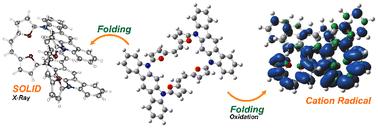
Precise design of unsaturated systems remains an important factor that determines the quality of formed products based on a specific spatial orientation, but also defines the available π-electron density open for post-synthetic modulation via redox change. Three strictly defined reagents showing different degrees of flexibility, but also introducing two mutual orientations of the reacting ends (parallel and obtuse), determine the quality of the formed products obtained via an intramolecular or an intermolecular reaction. The redox-activated transformation of mono- and double-looped systems results in dissimilar oxidation states of a strongly π-conjugated dication (two-electron process) or a cation radical (one-electron process), derived from the differences in the dynamic skeleton documented for the monomer and dimer, respectively.




 京公网安备 11010802042870号
京ICP备2023020795号-1
京公网安备 11010802042870号
京ICP备2023020795号-1

 分享
分享

 求助内容:
求助内容: 应助结果提醒方式:
 扫码关注我们
