Md. Tarekuzzaman, Mohammad Hasin Ishraq, Md. Shahazan Parves, M. A. Rayhan, Sohail Ahmad, Md. Rasheduzzaman, K A Al Mamun, M. Moazzam Hossen and Md. Zahid Hasan
{"title":"利用光电、热力学和光伏特性深入研究无铅锗氯化石太阳能电池:DFT 和 SCAPS-1D 框架","authors":"Md. Tarekuzzaman, Mohammad Hasin Ishraq, Md. Shahazan Parves, M. A. Rayhan, Sohail Ahmad, Md. Rasheduzzaman, K A Al Mamun, M. Moazzam Hossen and Md. Zahid Hasan","doi":"10.1039/D4CP02974G","DOIUrl":null,"url":null,"abstract":"<p >Potassium germanium chloride (KGeCl<small><sub>3</sub></small>) has emerged as a promising contender for use as an absorber material for lead-free perovskite solar cells (PSCs), offering significant potential in this domain. In this study, we conducted a density functional theory (DFT) investigation to analyze and assess the structural, electronic, thermomechanical, and optical characteristics of the cubic KGeCl<small><sub>3</sub></small> absorber. The positive phonon dispersion curve confirmed the dynamical stability of KGeCl<small><sub>3</sub></small>. The elastic constant satisfied the Born criteria, validating the mechanical stability and ductility of solid KGeCl<small><sub>3</sub></small>. The electronic band structure and density of states (DOS) confirmed that the KGeCl<small><sub>3</sub></small> material is a semiconductor with a direct band gap of 0.754 eV (GGA) and 0.803 eV (mGGA-RSCAN). The study identified key optical parameters, including absorption, conductivity, reflectivity, dielectric function, refractive index, and loss function, revealing the potential suitability of KGeCl<small><sub>3</sub></small> for solar applications. The Helmholtz free energy (<em>F</em>), internal energy (<em>E</em>), entropy (<em>S</em>), and specific heat capacity (<em>C</em><small><sub>v</sub></small>) are computed based on the phonon density of states. Additionally, we investigated twenty-four configurations comprising different combinations of electron transport layers (ETLs) and hole transport layers (HTLs) in SCAPS-1D software. For this purpose, ETLs such as Ws<small><sub>2</sub></small>, ZnSe, PCBM, and C<small><sub>60</sub></small> and HTLs such as CBTS, CdTe, CFTS, Cu<small><sub>2</sub></small>O, P3HT, and PEDOT:PSS are employed. The highlighted structure, ITO/CBTS/KGeCl<small><sub>3</sub></small>/Ws<small><sub>2</sub></small>/Ni, demonstrates remarkable performance with an efficiency of 22.01%, a <em>V</em><small><sub>oc</sub></small> of 0.6799 V, a <em>J</em><small><sub>sc</sub></small> of 41.439 mA cm<small><sup>−2</sup></small>, and a FF of 78.12%. To analyze photovoltaic (PV) performance, we chose the top four solar cell (SC) configurations. Moreover, a comprehensive examination was conducted to assess the impact of various factors, including the thickness of different layers, capacitance, Mott–Schottky behavior, series and shunt resistance, temperature, and generation–recombination rates, as well as <em>J</em>–<em>V</em> (current–voltage density) and quantum efficiency (QE) characteristics.</p>","PeriodicalId":99,"journal":{"name":"Physical Chemistry Chemical Physics","volume":" 43","pages":" 27704-27734"},"PeriodicalIF":3.0000,"publicationDate":"2024-10-19","publicationTypes":"Journal Article","fieldsOfStudy":null,"isOpenAccess":false,"openAccessPdf":"","citationCount":"0","resultStr":"{\"title\":\"An in-depth investigation of lead-free KGeCl3 perovskite solar cells employing optoelectronic, thermomechanical, and photovoltaic properties: DFT and SCAPS-1D frameworks\",\"authors\":\"Md. Tarekuzzaman, Mohammad Hasin Ishraq, Md. Shahazan Parves, M. A. Rayhan, Sohail Ahmad, Md. Rasheduzzaman, K A Al Mamun, M. Moazzam Hossen and Md. Zahid Hasan\",\"doi\":\"10.1039/D4CP02974G\",\"DOIUrl\":null,\"url\":null,\"abstract\":\"<p >Potassium germanium chloride (KGeCl<small><sub>3</sub></small>) has emerged as a promising contender for use as an absorber material for lead-free perovskite solar cells (PSCs), offering significant potential in this domain. In this study, we conducted a density functional theory (DFT) investigation to analyze and assess the structural, electronic, thermomechanical, and optical characteristics of the cubic KGeCl<small><sub>3</sub></small> absorber. The positive phonon dispersion curve confirmed the dynamical stability of KGeCl<small><sub>3</sub></small>. The elastic constant satisfied the Born criteria, validating the mechanical stability and ductility of solid KGeCl<small><sub>3</sub></small>. The electronic band structure and density of states (DOS) confirmed that the KGeCl<small><sub>3</sub></small> material is a semiconductor with a direct band gap of 0.754 eV (GGA) and 0.803 eV (mGGA-RSCAN). The study identified key optical parameters, including absorption, conductivity, reflectivity, dielectric function, refractive index, and loss function, revealing the potential suitability of KGeCl<small><sub>3</sub></small> for solar applications. The Helmholtz free energy (<em>F</em>), internal energy (<em>E</em>), entropy (<em>S</em>), and specific heat capacity (<em>C</em><small><sub>v</sub></small>) are computed based on the phonon density of states. Additionally, we investigated twenty-four configurations comprising different combinations of electron transport layers (ETLs) and hole transport layers (HTLs) in SCAPS-1D software. For this purpose, ETLs such as Ws<small><sub>2</sub></small>, ZnSe, PCBM, and C<small><sub>60</sub></small> and HTLs such as CBTS, CdTe, CFTS, Cu<small><sub>2</sub></small>O, P3HT, and PEDOT:PSS are employed. The highlighted structure, ITO/CBTS/KGeCl<small><sub>3</sub></small>/Ws<small><sub>2</sub></small>/Ni, demonstrates remarkable performance with an efficiency of 22.01%, a <em>V</em><small><sub>oc</sub></small> of 0.6799 V, a <em>J</em><small><sub>sc</sub></small> of 41.439 mA cm<small><sup>−2</sup></small>, and a FF of 78.12%. To analyze photovoltaic (PV) performance, we chose the top four solar cell (SC) configurations. Moreover, a comprehensive examination was conducted to assess the impact of various factors, including the thickness of different layers, capacitance, Mott–Schottky behavior, series and shunt resistance, temperature, and generation–recombination rates, as well as <em>J</em>–<em>V</em> (current–voltage density) and quantum efficiency (QE) characteristics.</p>\",\"PeriodicalId\":99,\"journal\":{\"name\":\"Physical Chemistry Chemical Physics\",\"volume\":\" 43\",\"pages\":\" 27704-27734\"},\"PeriodicalIF\":3.0000,\"publicationDate\":\"2024-10-19\",\"publicationTypes\":\"Journal Article\",\"fieldsOfStudy\":null,\"isOpenAccess\":false,\"openAccessPdf\":\"\",\"citationCount\":\"0\",\"resultStr\":null,\"platform\":\"Semanticscholar\",\"paperid\":null,\"PeriodicalName\":\"Physical Chemistry Chemical Physics\",\"FirstCategoryId\":\"92\",\"ListUrlMain\":\"https://pubs.rsc.org/en/content/articlelanding/2024/cp/d4cp02974g\",\"RegionNum\":3,\"RegionCategory\":\"化学\",\"ArticlePicture\":[],\"TitleCN\":null,\"AbstractTextCN\":null,\"PMCID\":null,\"EPubDate\":\"\",\"PubModel\":\"\",\"JCR\":\"Q3\",\"JCRName\":\"CHEMISTRY, PHYSICAL\",\"Score\":null,\"Total\":0}","platform":"Semanticscholar","paperid":null,"PeriodicalName":"Physical Chemistry Chemical Physics","FirstCategoryId":"92","ListUrlMain":"https://pubs.rsc.org/en/content/articlelanding/2024/cp/d4cp02974g","RegionNum":3,"RegionCategory":"化学","ArticlePicture":[],"TitleCN":null,"AbstractTextCN":null,"PMCID":null,"EPubDate":"","PubModel":"","JCR":"Q3","JCRName":"CHEMISTRY, PHYSICAL","Score":null,"Total":0}
An in-depth investigation of lead-free KGeCl3 perovskite solar cells employing optoelectronic, thermomechanical, and photovoltaic properties: DFT and SCAPS-1D frameworks
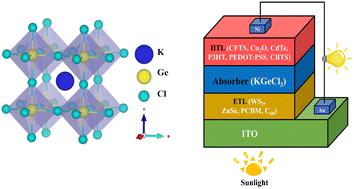
Potassium germanium chloride (KGeCl3) has emerged as a promising contender for use as an absorber material for lead-free perovskite solar cells (PSCs), offering significant potential in this domain. In this study, we conducted a density functional theory (DFT) investigation to analyze and assess the structural, electronic, thermomechanical, and optical characteristics of the cubic KGeCl3 absorber. The positive phonon dispersion curve confirmed the dynamical stability of KGeCl3. The elastic constant satisfied the Born criteria, validating the mechanical stability and ductility of solid KGeCl3. The electronic band structure and density of states (DOS) confirmed that the KGeCl3 material is a semiconductor with a direct band gap of 0.754 eV (GGA) and 0.803 eV (mGGA-RSCAN). The study identified key optical parameters, including absorption, conductivity, reflectivity, dielectric function, refractive index, and loss function, revealing the potential suitability of KGeCl3 for solar applications. The Helmholtz free energy (F), internal energy (E), entropy (S), and specific heat capacity (Cv) are computed based on the phonon density of states. Additionally, we investigated twenty-four configurations comprising different combinations of electron transport layers (ETLs) and hole transport layers (HTLs) in SCAPS-1D software. For this purpose, ETLs such as Ws2, ZnSe, PCBM, and C60 and HTLs such as CBTS, CdTe, CFTS, Cu2O, P3HT, and PEDOT:PSS are employed. The highlighted structure, ITO/CBTS/KGeCl3/Ws2/Ni, demonstrates remarkable performance with an efficiency of 22.01%, a Voc of 0.6799 V, a Jsc of 41.439 mA cm−2, and a FF of 78.12%. To analyze photovoltaic (PV) performance, we chose the top four solar cell (SC) configurations. Moreover, a comprehensive examination was conducted to assess the impact of various factors, including the thickness of different layers, capacitance, Mott–Schottky behavior, series and shunt resistance, temperature, and generation–recombination rates, as well as J–V (current–voltage density) and quantum efficiency (QE) characteristics.
期刊介绍:
Physical Chemistry Chemical Physics (PCCP) is an international journal co-owned by 19 physical chemistry and physics societies from around the world. This journal publishes original, cutting-edge research in physical chemistry, chemical physics and biophysical chemistry. To be suitable for publication in PCCP, articles must include significant innovation and/or insight into physical chemistry; this is the most important criterion that reviewers and Editors will judge against when evaluating submissions.
The journal has a broad scope and welcomes contributions spanning experiment, theory, computation and data science. Topical coverage includes spectroscopy, dynamics, kinetics, statistical mechanics, thermodynamics, electrochemistry, catalysis, surface science, quantum mechanics, quantum computing and machine learning. Interdisciplinary research areas such as polymers and soft matter, materials, nanoscience, energy, surfaces/interfaces, and biophysical chemistry are welcomed if they demonstrate significant innovation and/or insight into physical chemistry. Joined experimental/theoretical studies are particularly appreciated when complementary and based on up-to-date approaches.





 京公网安备 11010802042870号
京ICP备2023020795号-1
京公网安备 11010802042870号
京ICP备2023020795号-1

 分享
分享
 求助内容:
求助内容: 应助结果提醒方式:
 扫码关注我们
