{"title":"一次性合成具有优异湿度稳定性的异质结构 CsPbBr3/PdSe 纳米线","authors":"Shuai Ye, Mingyi Huang, Jun Song and Junle Qu","doi":"10.1039/D4NR03554B","DOIUrl":null,"url":null,"abstract":"<p >Lead halide perovskite nanowires (NWs) have garnered increasing attention owing to their unique properties, including axial carrier transportation, low pumping thresholds, and polarized emission. However, their intrinsic instability significantly limits their applications. In this study, heterostructured CsPbBr<small><sub>3</sub></small>/PbSe NWs with a diameter of 10 nm and lengths ranging from several to tens of microns were successfully synthesized <em>via</em> a one-pot solution-phase process. Photoluminescence measurements revealed that the CsPbBr<small><sub>3</sub></small>/PbSe NWs emitted green fluorescence with a narrow width of 16 nm and a high photoluminescence quantum yield (PLQY) of 37.6%. The obtained CsPbBr<small><sub>3</sub></small>/PbSe NWs underwent anion exchange with I<small><sup>−</sup></small> ion precursors to transform into CsPbBr<small><sub>3−<em>x</em></sub></small>I<small><sub><em>x</em></sub></small>/PbSe, but not with Cl<small><sup>−</sup></small> ion precursors. Remarkably, these heterostructured CsPbBr<small><sub>3</sub></small>/PbSe NWs remained stable when immersed in water or exposed to air for several months, demonstrating excellent humidity stability. This study offers an effective approach for preparing stable CsPbBr<small><sub>3</sub></small> NWs and fosters their future applications in optoelectronic devices.</p>","PeriodicalId":92,"journal":{"name":"Nanoscale","volume":" 46","pages":" 21326-21332"},"PeriodicalIF":5.1000,"publicationDate":"2024-10-21","publicationTypes":"Journal Article","fieldsOfStudy":null,"isOpenAccess":false,"openAccessPdf":"","citationCount":"0","resultStr":"{\"title\":\"One-pot synthesis of heterostructured CsPbBr3/PdSe nanowires with excellent humidity stability†\",\"authors\":\"Shuai Ye, Mingyi Huang, Jun Song and Junle Qu\",\"doi\":\"10.1039/D4NR03554B\",\"DOIUrl\":null,\"url\":null,\"abstract\":\"<p >Lead halide perovskite nanowires (NWs) have garnered increasing attention owing to their unique properties, including axial carrier transportation, low pumping thresholds, and polarized emission. However, their intrinsic instability significantly limits their applications. In this study, heterostructured CsPbBr<small><sub>3</sub></small>/PbSe NWs with a diameter of 10 nm and lengths ranging from several to tens of microns were successfully synthesized <em>via</em> a one-pot solution-phase process. Photoluminescence measurements revealed that the CsPbBr<small><sub>3</sub></small>/PbSe NWs emitted green fluorescence with a narrow width of 16 nm and a high photoluminescence quantum yield (PLQY) of 37.6%. The obtained CsPbBr<small><sub>3</sub></small>/PbSe NWs underwent anion exchange with I<small><sup>−</sup></small> ion precursors to transform into CsPbBr<small><sub>3−<em>x</em></sub></small>I<small><sub><em>x</em></sub></small>/PbSe, but not with Cl<small><sup>−</sup></small> ion precursors. Remarkably, these heterostructured CsPbBr<small><sub>3</sub></small>/PbSe NWs remained stable when immersed in water or exposed to air for several months, demonstrating excellent humidity stability. This study offers an effective approach for preparing stable CsPbBr<small><sub>3</sub></small> NWs and fosters their future applications in optoelectronic devices.</p>\",\"PeriodicalId\":92,\"journal\":{\"name\":\"Nanoscale\",\"volume\":\" 46\",\"pages\":\" 21326-21332\"},\"PeriodicalIF\":5.1000,\"publicationDate\":\"2024-10-21\",\"publicationTypes\":\"Journal Article\",\"fieldsOfStudy\":null,\"isOpenAccess\":false,\"openAccessPdf\":\"\",\"citationCount\":\"0\",\"resultStr\":null,\"platform\":\"Semanticscholar\",\"paperid\":null,\"PeriodicalName\":\"Nanoscale\",\"FirstCategoryId\":\"88\",\"ListUrlMain\":\"https://pubs.rsc.org/en/content/articlelanding/2024/nr/d4nr03554b\",\"RegionNum\":3,\"RegionCategory\":\"材料科学\",\"ArticlePicture\":[],\"TitleCN\":null,\"AbstractTextCN\":null,\"PMCID\":null,\"EPubDate\":\"\",\"PubModel\":\"\",\"JCR\":\"Q1\",\"JCRName\":\"CHEMISTRY, MULTIDISCIPLINARY\",\"Score\":null,\"Total\":0}","platform":"Semanticscholar","paperid":null,"PeriodicalName":"Nanoscale","FirstCategoryId":"88","ListUrlMain":"https://pubs.rsc.org/en/content/articlelanding/2024/nr/d4nr03554b","RegionNum":3,"RegionCategory":"材料科学","ArticlePicture":[],"TitleCN":null,"AbstractTextCN":null,"PMCID":null,"EPubDate":"","PubModel":"","JCR":"Q1","JCRName":"CHEMISTRY, MULTIDISCIPLINARY","Score":null,"Total":0}
One-pot synthesis of heterostructured CsPbBr3/PdSe nanowires with excellent humidity stability†
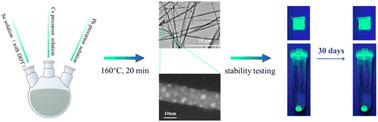
Lead halide perovskite nanowires (NWs) have garnered increasing attention owing to their unique properties, including axial carrier transportation, low pumping thresholds, and polarized emission. However, their intrinsic instability significantly limits their applications. In this study, heterostructured CsPbBr3/PbSe NWs with a diameter of 10 nm and lengths ranging from several to tens of microns were successfully synthesized via a one-pot solution-phase process. Photoluminescence measurements revealed that the CsPbBr3/PbSe NWs emitted green fluorescence with a narrow width of 16 nm and a high photoluminescence quantum yield (PLQY) of 37.6%. The obtained CsPbBr3/PbSe NWs underwent anion exchange with I− ion precursors to transform into CsPbBr3−xIx/PbSe, but not with Cl− ion precursors. Remarkably, these heterostructured CsPbBr3/PbSe NWs remained stable when immersed in water or exposed to air for several months, demonstrating excellent humidity stability. This study offers an effective approach for preparing stable CsPbBr3 NWs and fosters their future applications in optoelectronic devices.
期刊介绍:
Nanoscale is a high-impact international journal, publishing high-quality research across nanoscience and nanotechnology. Nanoscale publishes a full mix of research articles on experimental and theoretical work, including reviews, communications, and full papers.Highly interdisciplinary, this journal appeals to scientists, researchers and professionals interested in nanoscience and nanotechnology, quantum materials and quantum technology, including the areas of physics, chemistry, biology, medicine, materials, energy/environment, information technology, detection science, healthcare and drug discovery, and electronics.




 京公网安备 11010802042870号
京ICP备2023020795号-1
京公网安备 11010802042870号
京ICP备2023020795号-1

 分享
分享
 求助内容:
求助内容: 应助结果提醒方式:
 扫码关注我们
