Zeyi Wang, Shuling Liu, Chenglong Wang, Dan Ren, Yanling Hu, Yujie Ma and Chao Wang
{"title":"通过溶热 P2S5 和层状双氢氧化物构建的用于电催化氧进化的铁掺杂硫化镍 @ 磷酸盐异质纳米片","authors":"Zeyi Wang, Shuling Liu, Chenglong Wang, Dan Ren, Yanling Hu, Yujie Ma and Chao Wang","doi":"10.1039/D4TA06350C","DOIUrl":null,"url":null,"abstract":"<p >The design of efficient and active electrocatalysts for the oxygen evolution reaction (OER) is crucial for hydrogen generation from water electrolysis. Here, crystalline iron-doped nickel sulfide core-amorphous iron-doped nickel phosphate shell heterostructured nanosheets grown on nickel foam (Ni<small><sub>0.9</sub></small>Fe<small><sub>0.1</sub></small>S@NiFe(PO<small><sub>4</sub></small>)<small><sub><em>x</em></sub></small>/NF) are prepared by a solvothermal reaction of nickel iron layered double hydroxides on NF (NiFe-LDH/NF) with P<small><sub>2</sub></small>S<small><sub>5</sub></small>. The heterogeneous interface induces the electronic interaction between the Ni<small><sub>0.9</sub></small>Fe<small><sub>0.1</sub></small>S and NiFe(PO<small><sub>4</sub></small>)<small><sub><em>x</em></sub></small> phases, which is beneficial for the OER. The electrode exhibits excellent OER performance, requiring only 208 mV and 246 mV at current densities of 10 mA cm<small><sup>−2</sup></small> and 100 mA cm<small><sup>−2</sup></small>, respectively, and a low Tafel slope of 38.75 mV dec<small><sup>−1</sup></small> in 1 M KOH. The OER mechanistic pathways of both Ni<small><sub>0.9</sub></small>Fe<small><sub>0.1</sub></small>S@NiFe(PO<small><sub>4</sub></small>)<small><sub><em>x</em></sub></small>/NF and NiFe-LDH/NF involve decoupled electron and proton transfer processes. The increase in the acidity of Ni sites leads to the enhanced participation of LOM for Ni<small><sub>0.9</sub></small>Fe<small><sub>0.1</sub></small>S@NiFe(PO<small><sub>4</sub></small>)<small><sub><em>x</em></sub></small>/NF. Additionally, the electrode also shows long-term durability (150 h), with the conversion of surface metal sulfides and phosphates to hydroxides and (oxy)hydroxides.</p>","PeriodicalId":82,"journal":{"name":"Journal of Materials Chemistry A","volume":" 45","pages":" 31233-31243"},"PeriodicalIF":9.5000,"publicationDate":"2024-10-21","publicationTypes":"Journal Article","fieldsOfStudy":null,"isOpenAccess":false,"openAccessPdf":"","citationCount":"0","resultStr":"{\"title\":\"Iron-doped nickel sulfide@phosphate heterostructure nanosheets constructed from solvothermal P2S5 and layered double hydroxides for electrocatalytic oxygen evolution†\",\"authors\":\"Zeyi Wang, Shuling Liu, Chenglong Wang, Dan Ren, Yanling Hu, Yujie Ma and Chao Wang\",\"doi\":\"10.1039/D4TA06350C\",\"DOIUrl\":null,\"url\":null,\"abstract\":\"<p >The design of efficient and active electrocatalysts for the oxygen evolution reaction (OER) is crucial for hydrogen generation from water electrolysis. Here, crystalline iron-doped nickel sulfide core-amorphous iron-doped nickel phosphate shell heterostructured nanosheets grown on nickel foam (Ni<small><sub>0.9</sub></small>Fe<small><sub>0.1</sub></small>S@NiFe(PO<small><sub>4</sub></small>)<small><sub><em>x</em></sub></small>/NF) are prepared by a solvothermal reaction of nickel iron layered double hydroxides on NF (NiFe-LDH/NF) with P<small><sub>2</sub></small>S<small><sub>5</sub></small>. The heterogeneous interface induces the electronic interaction between the Ni<small><sub>0.9</sub></small>Fe<small><sub>0.1</sub></small>S and NiFe(PO<small><sub>4</sub></small>)<small><sub><em>x</em></sub></small> phases, which is beneficial for the OER. The electrode exhibits excellent OER performance, requiring only 208 mV and 246 mV at current densities of 10 mA cm<small><sup>−2</sup></small> and 100 mA cm<small><sup>−2</sup></small>, respectively, and a low Tafel slope of 38.75 mV dec<small><sup>−1</sup></small> in 1 M KOH. The OER mechanistic pathways of both Ni<small><sub>0.9</sub></small>Fe<small><sub>0.1</sub></small>S@NiFe(PO<small><sub>4</sub></small>)<small><sub><em>x</em></sub></small>/NF and NiFe-LDH/NF involve decoupled electron and proton transfer processes. The increase in the acidity of Ni sites leads to the enhanced participation of LOM for Ni<small><sub>0.9</sub></small>Fe<small><sub>0.1</sub></small>S@NiFe(PO<small><sub>4</sub></small>)<small><sub><em>x</em></sub></small>/NF. Additionally, the electrode also shows long-term durability (150 h), with the conversion of surface metal sulfides and phosphates to hydroxides and (oxy)hydroxides.</p>\",\"PeriodicalId\":82,\"journal\":{\"name\":\"Journal of Materials Chemistry A\",\"volume\":\" 45\",\"pages\":\" 31233-31243\"},\"PeriodicalIF\":9.5000,\"publicationDate\":\"2024-10-21\",\"publicationTypes\":\"Journal Article\",\"fieldsOfStudy\":null,\"isOpenAccess\":false,\"openAccessPdf\":\"\",\"citationCount\":\"0\",\"resultStr\":null,\"platform\":\"Semanticscholar\",\"paperid\":null,\"PeriodicalName\":\"Journal of Materials Chemistry A\",\"FirstCategoryId\":\"88\",\"ListUrlMain\":\"https://pubs.rsc.org/en/content/articlelanding/2024/ta/d4ta06350c\",\"RegionNum\":2,\"RegionCategory\":\"材料科学\",\"ArticlePicture\":[],\"TitleCN\":null,\"AbstractTextCN\":null,\"PMCID\":null,\"EPubDate\":\"\",\"PubModel\":\"\",\"JCR\":\"Q1\",\"JCRName\":\"CHEMISTRY, PHYSICAL\",\"Score\":null,\"Total\":0}","platform":"Semanticscholar","paperid":null,"PeriodicalName":"Journal of Materials Chemistry A","FirstCategoryId":"88","ListUrlMain":"https://pubs.rsc.org/en/content/articlelanding/2024/ta/d4ta06350c","RegionNum":2,"RegionCategory":"材料科学","ArticlePicture":[],"TitleCN":null,"AbstractTextCN":null,"PMCID":null,"EPubDate":"","PubModel":"","JCR":"Q1","JCRName":"CHEMISTRY, PHYSICAL","Score":null,"Total":0}
引用次数: 0
摘要
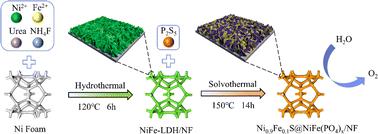
设计用于氧进化反应(OER)的高效活性电催化剂对于可再生能源的生产至关重要。在此,通过镍铁层状双氢氧化物(NiFe-LDH/NF)与 P2S5 的溶热反应,制备了生长在泡沫镍(Ni0.9Fe0.1S@NiFe(PO4)x/NF)上的结晶掺铁硫化镍核、无定形掺铁磷酸镍壳异质结构纳米片(Ni0.9Fe0.1S@NiFe(PO4)x/NF)。异质界面诱导了 Ni0.9Fe0.1S 和 NiFe(PO4)x 相之间的电子相互作用,有利于 OER。该电极具有出色的 OER 性能,在电流密度为 10 mA cm-2 和 100 mA cm-2 时,过电位分别为 208 mV 和 246 mV,在 1 M KOH 中的 Tafel 斜坡较低,为 38.75 mV dec-1。Ni0.9Fe0.1S@NiFe(PO4)x/NF 和 NiFe-LDH/NF 的 OER 机理途径都涉及解耦的电子和质子转移过程,而 Ni0.9Fe0.1S@NiFe(PO4)x/NF 的晶格氧氧化机理(LOM)的贡献率更高。镍位点酸性的增加导致 Ni0.9Fe0.1S@NiFe(PO4)x/NF 的 LOM 参与度提高。此外,随着表面金属硫化物和磷酸盐向氢氧化物和(氧)氢氧化物的转变,该电极还显示出较高的长期耐久性(150 小时)。这项研究为开发和设计异质氧进化电催化材料提供了新思路。
Iron-doped nickel sulfide@phosphate heterostructure nanosheets constructed from solvothermal P2S5 and layered double hydroxides for electrocatalytic oxygen evolution†
The design of efficient and active electrocatalysts for the oxygen evolution reaction (OER) is crucial for hydrogen generation from water electrolysis. Here, crystalline iron-doped nickel sulfide core-amorphous iron-doped nickel phosphate shell heterostructured nanosheets grown on nickel foam (Ni0.9Fe0.1S@NiFe(PO4)x/NF) are prepared by a solvothermal reaction of nickel iron layered double hydroxides on NF (NiFe-LDH/NF) with P2S5. The heterogeneous interface induces the electronic interaction between the Ni0.9Fe0.1S and NiFe(PO4)x phases, which is beneficial for the OER. The electrode exhibits excellent OER performance, requiring only 208 mV and 246 mV at current densities of 10 mA cm−2 and 100 mA cm−2, respectively, and a low Tafel slope of 38.75 mV dec−1 in 1 M KOH. The OER mechanistic pathways of both Ni0.9Fe0.1S@NiFe(PO4)x/NF and NiFe-LDH/NF involve decoupled electron and proton transfer processes. The increase in the acidity of Ni sites leads to the enhanced participation of LOM for Ni0.9Fe0.1S@NiFe(PO4)x/NF. Additionally, the electrode also shows long-term durability (150 h), with the conversion of surface metal sulfides and phosphates to hydroxides and (oxy)hydroxides.
期刊介绍:
The Journal of Materials Chemistry A, B & C covers a wide range of high-quality studies in the field of materials chemistry, with each section focusing on specific applications of the materials studied. Journal of Materials Chemistry A emphasizes applications in energy and sustainability, including topics such as artificial photosynthesis, batteries, and fuel cells. Journal of Materials Chemistry B focuses on applications in biology and medicine, while Journal of Materials Chemistry C covers applications in optical, magnetic, and electronic devices. Example topic areas within the scope of Journal of Materials Chemistry A include catalysis, green/sustainable materials, sensors, and water treatment, among others.




 京公网安备 11010802042870号
京ICP备2023020795号-1
京公网安备 11010802042870号
京ICP备2023020795号-1

 分享
分享
 求助内容:
求助内容: 应助结果提醒方式:
 扫码关注我们
