Xinliang Men, Teng Deng, Jiangxuan Che and Juan Wang
{"title":"通过 CoS2-MgS 异质结构加速锂硫电池的硫转化动力学","authors":"Xinliang Men, Teng Deng, Jiangxuan Che and Juan Wang","doi":"10.1039/D4TA06086E","DOIUrl":null,"url":null,"abstract":"<p >The ultra-high theoretical specific capacity of sulfur (1672 mA h g<small><sup>−1</sup></small>) has attracted researchers to intensely explore lithium–sulfur batteries. However, the shuttle effect of polysulfides and the slow conversion kinetics of sulfur have hindered its advancement. Herein, we synthesized CoS<small><sub>2</sub></small>–MgS heterostructure catalysts deposited on acetylene black nanoparticles, which were used as separator coatings to improve the performance of lithium–sulfur batteries. Various experiments, such as XPS, Tafel curves, Li<small><sub>2</sub></small>S<small><sub>6</sub></small> symmetric cells, Li<small><sub>2</sub></small>S deposition, and DFT calculations, identified the advantages of the CoS<small><sub>2</sub></small>–MgS heterostructure: rapid polar adsorption of CoS<small><sub>2</sub></small> to polysulfides through partial oxidation of Co<small><sup>2+</sup></small> to Co<small><sup>3+</sup></small> and fast lithium-ion migration in MgS. The coin cells delivered an initial discharge capacity of 573.4 mA h g<small><sup>−1</sup></small> and cycled stably for 600 cycles at 5C with a capacity decay rate of 0.08% per cycle. The battery retained a specific capacity of 545.5 mA h g<small><sup>−1</sup></small> (4.3 mA h cm<small><sup>−2</sup></small>) after 100 cycles at 0.1C with a sulfur loading of 7.87 mg cm<small><sup>−2</sup></small>. In addition, laminated pouch cells with a sulfur content of 311.5 mg exhibited excellent cycle stability, maintaining 768.3 mA h g<small><sup>−1</sup></small> (239 mA h) after 80 cycles. This work provides ideas for finding novel composites that have both fast lithium-ion migration and strong polar adsorption for sulfur conversion while providing a reference for pouch battery research.</p>","PeriodicalId":82,"journal":{"name":"Journal of Materials Chemistry A","volume":" 46","pages":" 31972-31981"},"PeriodicalIF":9.5000,"publicationDate":"2024-10-22","publicationTypes":"Journal Article","fieldsOfStudy":null,"isOpenAccess":false,"openAccessPdf":"","citationCount":"0","resultStr":"{\"title\":\"Accelerating sulfur conversion kinetics via CoS2–MgS heterostructure for lithium sulfur batteries†\",\"authors\":\"Xinliang Men, Teng Deng, Jiangxuan Che and Juan Wang\",\"doi\":\"10.1039/D4TA06086E\",\"DOIUrl\":null,\"url\":null,\"abstract\":\"<p >The ultra-high theoretical specific capacity of sulfur (1672 mA h g<small><sup>−1</sup></small>) has attracted researchers to intensely explore lithium–sulfur batteries. However, the shuttle effect of polysulfides and the slow conversion kinetics of sulfur have hindered its advancement. Herein, we synthesized CoS<small><sub>2</sub></small>–MgS heterostructure catalysts deposited on acetylene black nanoparticles, which were used as separator coatings to improve the performance of lithium–sulfur batteries. Various experiments, such as XPS, Tafel curves, Li<small><sub>2</sub></small>S<small><sub>6</sub></small> symmetric cells, Li<small><sub>2</sub></small>S deposition, and DFT calculations, identified the advantages of the CoS<small><sub>2</sub></small>–MgS heterostructure: rapid polar adsorption of CoS<small><sub>2</sub></small> to polysulfides through partial oxidation of Co<small><sup>2+</sup></small> to Co<small><sup>3+</sup></small> and fast lithium-ion migration in MgS. The coin cells delivered an initial discharge capacity of 573.4 mA h g<small><sup>−1</sup></small> and cycled stably for 600 cycles at 5C with a capacity decay rate of 0.08% per cycle. The battery retained a specific capacity of 545.5 mA h g<small><sup>−1</sup></small> (4.3 mA h cm<small><sup>−2</sup></small>) after 100 cycles at 0.1C with a sulfur loading of 7.87 mg cm<small><sup>−2</sup></small>. In addition, laminated pouch cells with a sulfur content of 311.5 mg exhibited excellent cycle stability, maintaining 768.3 mA h g<small><sup>−1</sup></small> (239 mA h) after 80 cycles. This work provides ideas for finding novel composites that have both fast lithium-ion migration and strong polar adsorption for sulfur conversion while providing a reference for pouch battery research.</p>\",\"PeriodicalId\":82,\"journal\":{\"name\":\"Journal of Materials Chemistry A\",\"volume\":\" 46\",\"pages\":\" 31972-31981\"},\"PeriodicalIF\":9.5000,\"publicationDate\":\"2024-10-22\",\"publicationTypes\":\"Journal Article\",\"fieldsOfStudy\":null,\"isOpenAccess\":false,\"openAccessPdf\":\"\",\"citationCount\":\"0\",\"resultStr\":null,\"platform\":\"Semanticscholar\",\"paperid\":null,\"PeriodicalName\":\"Journal of Materials Chemistry A\",\"FirstCategoryId\":\"88\",\"ListUrlMain\":\"https://pubs.rsc.org/en/content/articlelanding/2024/ta/d4ta06086e\",\"RegionNum\":2,\"RegionCategory\":\"材料科学\",\"ArticlePicture\":[],\"TitleCN\":null,\"AbstractTextCN\":null,\"PMCID\":null,\"EPubDate\":\"\",\"PubModel\":\"\",\"JCR\":\"Q1\",\"JCRName\":\"CHEMISTRY, PHYSICAL\",\"Score\":null,\"Total\":0}","platform":"Semanticscholar","paperid":null,"PeriodicalName":"Journal of Materials Chemistry A","FirstCategoryId":"88","ListUrlMain":"https://pubs.rsc.org/en/content/articlelanding/2024/ta/d4ta06086e","RegionNum":2,"RegionCategory":"材料科学","ArticlePicture":[],"TitleCN":null,"AbstractTextCN":null,"PMCID":null,"EPubDate":"","PubModel":"","JCR":"Q1","JCRName":"CHEMISTRY, PHYSICAL","Score":null,"Total":0}
引用次数: 0
摘要
硫的超高理论比容量(1672 mAh g-1)吸引了研究人员对锂硫电池的深入研究。然而,多硫化物的穿梭效应和硫的缓慢转化动力学阻碍了其发展。在此,我们合成了沉积在乙炔黑纳米颗粒上的 CoS2-MgS 异质结构催化剂,并将其用作隔膜涂层,以提高锂硫电池的性能。通过 XPS、Tafel 曲线、Li2S6 对称电池、Li2S 沉积和 DFT 计算等各种实验,确定了 CoS2-MgS 异质结构的优势:通过将部分 Co2+ 氧化为 Co3+,使 CoS2 快速极性吸附到多硫化物上,并在 MgS 中快速迁移锂离子。纽扣电池的初始放电容量为 573.4 mAh g-1,在 5 C 下稳定循环 600 次,每次循环的容量衰减率为 0.08%;在 0.1 C 下循环 100 次后,电池的比容量仍为 545.5 mAh g-1(4.3 mAh cm-2),硫负荷为 7.87 mg cm-2。此外,硫含量为 311.5 毫克的层叠袋状电池具有出色的循环稳定性,在 80 个循环后仍能保持 768.3 毫安时 g-1(239 毫安时)。这项研究为寻找既能快速迁移锂离子又能强力吸附硫的新型复合材料提供了思路,同时也为袋式电池的研究提供了参考。
Accelerating sulfur conversion kinetics via CoS2–MgS heterostructure for lithium sulfur batteries†
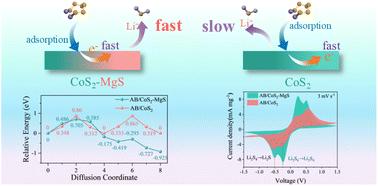
The ultra-high theoretical specific capacity of sulfur (1672 mA h g−1) has attracted researchers to intensely explore lithium–sulfur batteries. However, the shuttle effect of polysulfides and the slow conversion kinetics of sulfur have hindered its advancement. Herein, we synthesized CoS2–MgS heterostructure catalysts deposited on acetylene black nanoparticles, which were used as separator coatings to improve the performance of lithium–sulfur batteries. Various experiments, such as XPS, Tafel curves, Li2S6 symmetric cells, Li2S deposition, and DFT calculations, identified the advantages of the CoS2–MgS heterostructure: rapid polar adsorption of CoS2 to polysulfides through partial oxidation of Co2+ to Co3+ and fast lithium-ion migration in MgS. The coin cells delivered an initial discharge capacity of 573.4 mA h g−1 and cycled stably for 600 cycles at 5C with a capacity decay rate of 0.08% per cycle. The battery retained a specific capacity of 545.5 mA h g−1 (4.3 mA h cm−2) after 100 cycles at 0.1C with a sulfur loading of 7.87 mg cm−2. In addition, laminated pouch cells with a sulfur content of 311.5 mg exhibited excellent cycle stability, maintaining 768.3 mA h g−1 (239 mA h) after 80 cycles. This work provides ideas for finding novel composites that have both fast lithium-ion migration and strong polar adsorption for sulfur conversion while providing a reference for pouch battery research.
期刊介绍:
The Journal of Materials Chemistry A, B & C covers a wide range of high-quality studies in the field of materials chemistry, with each section focusing on specific applications of the materials studied. Journal of Materials Chemistry A emphasizes applications in energy and sustainability, including topics such as artificial photosynthesis, batteries, and fuel cells. Journal of Materials Chemistry B focuses on applications in biology and medicine, while Journal of Materials Chemistry C covers applications in optical, magnetic, and electronic devices. Example topic areas within the scope of Journal of Materials Chemistry A include catalysis, green/sustainable materials, sensors, and water treatment, among others.




 京公网安备 11010802042870号
京ICP备2023020795号-1
京公网安备 11010802042870号
京ICP备2023020795号-1

 分享
分享
 求助内容:
求助内容: 应助结果提醒方式:
 扫码关注我们
