Xin Zhao, Yajun Zhao, Yuan-Peng Li, Pengbo Lyu, Chunying Chen, Zong-Wen Mo, Chao Peng, Jiewei Liu and Li Zhang
{"title":"通过化学键调控策略调节 II 型到 Z 型的电荷转移,设计一种芘 MOF 复合光催化剂,以形成二氧化碳自由基阴离子","authors":"Xin Zhao, Yajun Zhao, Yuan-Peng Li, Pengbo Lyu, Chunying Chen, Zong-Wen Mo, Chao Peng, Jiewei Liu and Li Zhang","doi":"10.1039/D4QI02072C","DOIUrl":null,"url":null,"abstract":"<p >The CO<small><sub>2</sub></small> radical anion (˙CO<small><sub>2</sub></small><small><sup>−</sup></small>) is a powerful single electron reductant and an important intermediate in CO<small><sub>2</sub></small> involved reactions. Herein, we report an approach to engineer a pyrene MOF composite photocatalyst toward the formation of ˙CO<small><sub>2</sub></small><small><sup>−</sup></small> through regulating the charge transfer from type II to Z scheme <em>via</em> a chemical bond-modulated strategy. Through a post-synthetic modification, cysteamine (Cys) was rationally anchored onto the unsaturated Cd clusters of a pyrene-based MOF (namely WYU-11) <em>via</em> chemical bonds, giving rise to a modified MOF of WYU-11-Cys. This modification induced the growth of CdS nanoparticles (NPs) on the surfaces of WYU-11-Cys <em>via</em> the chemical bonds between CdS and Cys, resulting in the formation of a MOF composite of CdS@WYU-11-Cys. The introduction of Cys could regulate the charge transfer between CdS and WYU-11, leading to the conversion from type II to Z scheme with a high redox potential of −1.93 V <em>vs.</em> a normal hydrogen electrode. CdS@WYU-11-Cys could reduce CO<small><sub>2</sub></small> to ˙CO<small><sub>2</sub></small><small><sup>−</sup></small>, which was confirmed by an electron paramagnetic resonance (EPR) experiment, and promote the photocatalytic cyclization of CO<small><sub>2</sub></small> and propargylic amines. This work provides useful inspirations for the rational design of Z-scheme MOF composites for CO<small><sub>2</sub></small> conversion.</p>","PeriodicalId":79,"journal":{"name":"Inorganic Chemistry Frontiers","volume":" 23","pages":" 8489-8501"},"PeriodicalIF":6.4000,"publicationDate":"2024-10-22","publicationTypes":"Journal Article","fieldsOfStudy":null,"isOpenAccess":false,"openAccessPdf":"","citationCount":"0","resultStr":"{\"title\":\"Engineering a pyrene MOF composite photocatalyst toward the formation of carbon dioxide radical anions through regulating the charge transfer from type II to Z scheme via a chemical bond-modulated strategy†\",\"authors\":\"Xin Zhao, Yajun Zhao, Yuan-Peng Li, Pengbo Lyu, Chunying Chen, Zong-Wen Mo, Chao Peng, Jiewei Liu and Li Zhang\",\"doi\":\"10.1039/D4QI02072C\",\"DOIUrl\":null,\"url\":null,\"abstract\":\"<p >The CO<small><sub>2</sub></small> radical anion (˙CO<small><sub>2</sub></small><small><sup>−</sup></small>) is a powerful single electron reductant and an important intermediate in CO<small><sub>2</sub></small> involved reactions. Herein, we report an approach to engineer a pyrene MOF composite photocatalyst toward the formation of ˙CO<small><sub>2</sub></small><small><sup>−</sup></small> through regulating the charge transfer from type II to Z scheme <em>via</em> a chemical bond-modulated strategy. Through a post-synthetic modification, cysteamine (Cys) was rationally anchored onto the unsaturated Cd clusters of a pyrene-based MOF (namely WYU-11) <em>via</em> chemical bonds, giving rise to a modified MOF of WYU-11-Cys. This modification induced the growth of CdS nanoparticles (NPs) on the surfaces of WYU-11-Cys <em>via</em> the chemical bonds between CdS and Cys, resulting in the formation of a MOF composite of CdS@WYU-11-Cys. The introduction of Cys could regulate the charge transfer between CdS and WYU-11, leading to the conversion from type II to Z scheme with a high redox potential of −1.93 V <em>vs.</em> a normal hydrogen electrode. CdS@WYU-11-Cys could reduce CO<small><sub>2</sub></small> to ˙CO<small><sub>2</sub></small><small><sup>−</sup></small>, which was confirmed by an electron paramagnetic resonance (EPR) experiment, and promote the photocatalytic cyclization of CO<small><sub>2</sub></small> and propargylic amines. This work provides useful inspirations for the rational design of Z-scheme MOF composites for CO<small><sub>2</sub></small> conversion.</p>\",\"PeriodicalId\":79,\"journal\":{\"name\":\"Inorganic Chemistry Frontiers\",\"volume\":\" 23\",\"pages\":\" 8489-8501\"},\"PeriodicalIF\":6.4000,\"publicationDate\":\"2024-10-22\",\"publicationTypes\":\"Journal Article\",\"fieldsOfStudy\":null,\"isOpenAccess\":false,\"openAccessPdf\":\"\",\"citationCount\":\"0\",\"resultStr\":null,\"platform\":\"Semanticscholar\",\"paperid\":null,\"PeriodicalName\":\"Inorganic Chemistry Frontiers\",\"FirstCategoryId\":\"92\",\"ListUrlMain\":\"https://pubs.rsc.org/en/content/articlelanding/2024/qi/d4qi02072c\",\"RegionNum\":1,\"RegionCategory\":\"化学\",\"ArticlePicture\":[],\"TitleCN\":null,\"AbstractTextCN\":null,\"PMCID\":null,\"EPubDate\":\"\",\"PubModel\":\"\",\"JCR\":\"Q1\",\"JCRName\":\"CHEMISTRY, INORGANIC & NUCLEAR\",\"Score\":null,\"Total\":0}","platform":"Semanticscholar","paperid":null,"PeriodicalName":"Inorganic Chemistry Frontiers","FirstCategoryId":"92","ListUrlMain":"https://pubs.rsc.org/en/content/articlelanding/2024/qi/d4qi02072c","RegionNum":1,"RegionCategory":"化学","ArticlePicture":[],"TitleCN":null,"AbstractTextCN":null,"PMCID":null,"EPubDate":"","PubModel":"","JCR":"Q1","JCRName":"CHEMISTRY, INORGANIC & NUCLEAR","Score":null,"Total":0}
引用次数: 0
摘要
二氧化碳自由基阴离子(CO2-)是一种强大的单电子还原剂,也是涉及二氧化碳反应的重要中间体。在此,我们报告了一种通过化学键调控策略调节电荷从 II 型向 Z 型转移,从而设计出一种芘 MOF 复合光催化剂以形成 CO2- 的方法。通过后合成修饰,半胱胺(Cys)被合理地通过化学键锚定到芘基MOF(即WYU-11)的不饱和镉簇上,从而产生了WYU-11-Cys修饰MOF。这种修饰通过 CdS 与 Cys 之间的化学键,诱导 CdS 纳米颗粒(NPs)在 WYU-11-Cys 表面生长,从而形成 CdS@WYU-11-Cys 的 MOF 复合材料。Cys 的引入可以调节 CdS 与 WYU-11 之间的电荷转移,从而实现从 II 型到 Z 型的转换,与普通氢电极相比,其氧化还原电位高达 -1.93 V。电子顺磁共振(EPR)实验证实,CdS@WYU-11-Cys 可将 CO2 还原为 CO2- 并促进 CO2 与丙炔胺的光催化环化。这项工作为合理设计用于二氧化碳转化的 Z 型 MOF 复合材料提供了有益的启示。
Engineering a pyrene MOF composite photocatalyst toward the formation of carbon dioxide radical anions through regulating the charge transfer from type II to Z scheme via a chemical bond-modulated strategy†
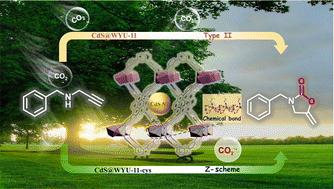
The CO2 radical anion (˙CO2−) is a powerful single electron reductant and an important intermediate in CO2 involved reactions. Herein, we report an approach to engineer a pyrene MOF composite photocatalyst toward the formation of ˙CO2− through regulating the charge transfer from type II to Z scheme via a chemical bond-modulated strategy. Through a post-synthetic modification, cysteamine (Cys) was rationally anchored onto the unsaturated Cd clusters of a pyrene-based MOF (namely WYU-11) via chemical bonds, giving rise to a modified MOF of WYU-11-Cys. This modification induced the growth of CdS nanoparticles (NPs) on the surfaces of WYU-11-Cys via the chemical bonds between CdS and Cys, resulting in the formation of a MOF composite of CdS@WYU-11-Cys. The introduction of Cys could regulate the charge transfer between CdS and WYU-11, leading to the conversion from type II to Z scheme with a high redox potential of −1.93 V vs. a normal hydrogen electrode. CdS@WYU-11-Cys could reduce CO2 to ˙CO2−, which was confirmed by an electron paramagnetic resonance (EPR) experiment, and promote the photocatalytic cyclization of CO2 and propargylic amines. This work provides useful inspirations for the rational design of Z-scheme MOF composites for CO2 conversion.





 京公网安备 11010802042870号
京ICP备2023020795号-1
京公网安备 11010802042870号
京ICP备2023020795号-1

 分享
分享
 求助内容:
求助内容: 应助结果提醒方式:
 扫码关注我们
