Yinuo Qiao, Xiaoyan Wang, Xuning Kang, Yuzhu Song, Jinyang Zhang and Qinqin Han
{"title":"基于 CRISPR-HCR 技术的化学发光传感器,用于结核分枝杆菌的超敏检测。","authors":"Yinuo Qiao, Xiaoyan Wang, Xuning Kang, Yuzhu Song, Jinyang Zhang and Qinqin Han","doi":"10.1039/D4AY01517G","DOIUrl":null,"url":null,"abstract":"<p >Tuberculosis is a highly infectious bacterial disease caused by <em>Mycobacterium tuberculosis</em>. The spread of this agent has caused serious health problems worldwide, and the rapid and accurate detection of <em>M. tuberculosis</em> is essential for controlling the spread of infection and for preventing the emergence of multidrug-resistant strains. In this study, the <em>trans</em> cleavage ability of CRISPR-Cas12a against single-stranded DNA was combined with hybridization chain reaction and chemiluminescent signal to establish an imaging sensor for the hypersensitive detection of <em>M. tuberculosis</em> DNA. We observed linear relationships between the concentration of <em>M. tuberculosis</em> DNA and the output signal over the ranges of 10 to 200 pM and 200 to 800 pM DNA. The equations of the standard curves were <em>y</em> = 56.08<em>x</em> + 3303, with <em>R</em><small><sup>2</sup></small> = 0.9916 for the lower range and <em>y</em> = 15.69<em>x</em> + 10 685, with <em>R</em><small><sup>2</sup></small> = 0.9929 for the higher range. The limit of detection was as low as 0.83 pM for genomic DNA, and a plasmid containing an <em>M. tuberculosis</em>-specific sequence was detected at 1 copy per μL. A detection accuracy of 100% was achieved in the analysis of DNA isolated from sputum of hospitalized tuberculosis patients. The sensitivity and specificity of the proposed sensor is combined with a long shelf-life and a low cost of materials. This study introduces a new method for tuberculosis detection and broadens the application of CRISPR-Cas12a-based sensors in clinical diagnosis.</p>","PeriodicalId":64,"journal":{"name":"Analytical Methods","volume":" 46","pages":" 7927-7939"},"PeriodicalIF":2.6000,"publicationDate":"2024-09-25","publicationTypes":"Journal Article","fieldsOfStudy":null,"isOpenAccess":false,"openAccessPdf":"","citationCount":"0","resultStr":"{\"title\":\"A chemiluminescent sensor based on CRISPR-HCR technology for the hypersensitive detection of Mycobacterium tuberculosis\",\"authors\":\"Yinuo Qiao, Xiaoyan Wang, Xuning Kang, Yuzhu Song, Jinyang Zhang and Qinqin Han\",\"doi\":\"10.1039/D4AY01517G\",\"DOIUrl\":null,\"url\":null,\"abstract\":\"<p >Tuberculosis is a highly infectious bacterial disease caused by <em>Mycobacterium tuberculosis</em>. The spread of this agent has caused serious health problems worldwide, and the rapid and accurate detection of <em>M. tuberculosis</em> is essential for controlling the spread of infection and for preventing the emergence of multidrug-resistant strains. In this study, the <em>trans</em> cleavage ability of CRISPR-Cas12a against single-stranded DNA was combined with hybridization chain reaction and chemiluminescent signal to establish an imaging sensor for the hypersensitive detection of <em>M. tuberculosis</em> DNA. We observed linear relationships between the concentration of <em>M. tuberculosis</em> DNA and the output signal over the ranges of 10 to 200 pM and 200 to 800 pM DNA. The equations of the standard curves were <em>y</em> = 56.08<em>x</em> + 3303, with <em>R</em><small><sup>2</sup></small> = 0.9916 for the lower range and <em>y</em> = 15.69<em>x</em> + 10 685, with <em>R</em><small><sup>2</sup></small> = 0.9929 for the higher range. The limit of detection was as low as 0.83 pM for genomic DNA, and a plasmid containing an <em>M. tuberculosis</em>-specific sequence was detected at 1 copy per μL. A detection accuracy of 100% was achieved in the analysis of DNA isolated from sputum of hospitalized tuberculosis patients. The sensitivity and specificity of the proposed sensor is combined with a long shelf-life and a low cost of materials. This study introduces a new method for tuberculosis detection and broadens the application of CRISPR-Cas12a-based sensors in clinical diagnosis.</p>\",\"PeriodicalId\":64,\"journal\":{\"name\":\"Analytical Methods\",\"volume\":\" 46\",\"pages\":\" 7927-7939\"},\"PeriodicalIF\":2.6000,\"publicationDate\":\"2024-09-25\",\"publicationTypes\":\"Journal Article\",\"fieldsOfStudy\":null,\"isOpenAccess\":false,\"openAccessPdf\":\"\",\"citationCount\":\"0\",\"resultStr\":null,\"platform\":\"Semanticscholar\",\"paperid\":null,\"PeriodicalName\":\"Analytical Methods\",\"FirstCategoryId\":\"92\",\"ListUrlMain\":\"https://pubs.rsc.org/en/content/articlelanding/2024/ay/d4ay01517g\",\"RegionNum\":3,\"RegionCategory\":\"化学\",\"ArticlePicture\":[],\"TitleCN\":null,\"AbstractTextCN\":null,\"PMCID\":null,\"EPubDate\":\"\",\"PubModel\":\"\",\"JCR\":\"Q2\",\"JCRName\":\"CHEMISTRY, ANALYTICAL\",\"Score\":null,\"Total\":0}","platform":"Semanticscholar","paperid":null,"PeriodicalName":"Analytical Methods","FirstCategoryId":"92","ListUrlMain":"https://pubs.rsc.org/en/content/articlelanding/2024/ay/d4ay01517g","RegionNum":3,"RegionCategory":"化学","ArticlePicture":[],"TitleCN":null,"AbstractTextCN":null,"PMCID":null,"EPubDate":"","PubModel":"","JCR":"Q2","JCRName":"CHEMISTRY, ANALYTICAL","Score":null,"Total":0}
引用次数: 0
摘要
结核病是一种由结核分枝杆菌引起的高度传染性细菌疾病。该病原体的传播已在全球范围内造成严重的健康问题,快速准确地检测结核分枝杆菌对于控制感染传播和防止出现耐多药菌株至关重要。本研究将 CRISPR-Cas12a 对单链 DNA 的反式裂解能力与杂交链反应和化学发光信号相结合,建立了一种用于高灵敏度检测结核杆菌 DNA 的成像传感器。我们观察到,在 10 至 200 pM 和 200 至 800 pM DNA 范围内,结核杆菌 DNA 的浓度与输出信号之间呈线性关系。低范围的标准曲线方程为 y = 56.08x + 3303,R2 = 0.9916;高范围的标准曲线方程为 y = 15.69x + 10 685,R2 = 0.9929。基因组 DNA 的检测限低至 0.83 pM,而含有结核杆菌特异性序列的质粒的检测限为每微升 1 个拷贝。在分析从住院结核病患者痰液中分离出的 DNA 时,检测准确率达到了 100%。该传感器灵敏度高、特异性强、保存期长、材料成本低。这项研究为结核病检测引入了一种新方法,并拓宽了基于 CRISPR-Cas12a 的传感器在临床诊断中的应用。
A chemiluminescent sensor based on CRISPR-HCR technology for the hypersensitive detection of Mycobacterium tuberculosis
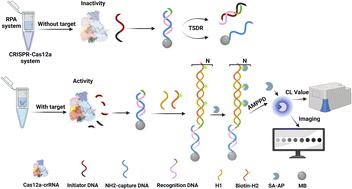
Tuberculosis is a highly infectious bacterial disease caused by Mycobacterium tuberculosis. The spread of this agent has caused serious health problems worldwide, and the rapid and accurate detection of M. tuberculosis is essential for controlling the spread of infection and for preventing the emergence of multidrug-resistant strains. In this study, the trans cleavage ability of CRISPR-Cas12a against single-stranded DNA was combined with hybridization chain reaction and chemiluminescent signal to establish an imaging sensor for the hypersensitive detection of M. tuberculosis DNA. We observed linear relationships between the concentration of M. tuberculosis DNA and the output signal over the ranges of 10 to 200 pM and 200 to 800 pM DNA. The equations of the standard curves were y = 56.08x + 3303, with R2 = 0.9916 for the lower range and y = 15.69x + 10 685, with R2 = 0.9929 for the higher range. The limit of detection was as low as 0.83 pM for genomic DNA, and a plasmid containing an M. tuberculosis-specific sequence was detected at 1 copy per μL. A detection accuracy of 100% was achieved in the analysis of DNA isolated from sputum of hospitalized tuberculosis patients. The sensitivity and specificity of the proposed sensor is combined with a long shelf-life and a low cost of materials. This study introduces a new method for tuberculosis detection and broadens the application of CRISPR-Cas12a-based sensors in clinical diagnosis.




 京公网安备 11010802042870号
京ICP备2023020795号-1
京公网安备 11010802042870号
京ICP备2023020795号-1

 分享
分享
 求助内容:
求助内容: 应助结果提醒方式:
 扫码关注我们
