D. A. Mitkovskiy, A. A. Lazutin, A. L. Talis and V. V. Vasilevskaya
{"title":"接枝到球形纳米粒子上的两亲均聚物的自组装:完整的嵌入式最小表面及其识别机器学习算法。","authors":"D. A. Mitkovskiy, A. A. Lazutin, A. L. Talis and V. V. Vasilevskaya","doi":"10.1039/D4SM00616J","DOIUrl":null,"url":null,"abstract":"<p >By means of computer modelling, the self-assembly of amphiphilic A-<em>graft</em>-B macromolecules, grafted onto a spherical nanoparticle, is studied. In a solvent, that is poor for side pendants, the macromolecules self-assemble into thin membrane-like ABBA bilayers deviated from spherical nanoparticles. The bilayers form morphological structures that depend on the grafting density and macromolecular polymerization degree and can be referred to as the classical family of complete embedded minimal surfaces. The plane disk, catenoid, helicoid, Costa and Enneper surfaces as well as “double” helicoid and “complex minimal surface” were identified, and the fields of their stability were defined. The surfaces can be grouped according to the sequences of conformal transformations that transform them into each other. These surfaces arise in different experiments situationally. Results are summarized in a pie diagram constructed using a machine learning algorithm based on matching grafting points with a specially created planar graphic image.</p>","PeriodicalId":103,"journal":{"name":"Soft Matter","volume":" 42","pages":" 8385-8394"},"PeriodicalIF":2.8000,"publicationDate":"2024-10-10","publicationTypes":"Journal Article","fieldsOfStudy":null,"isOpenAccess":false,"openAccessPdf":"","citationCount":"0","resultStr":"{\"title\":\"Self-assembly of amphiphilic homopolymers grafted onto spherical nanoparticles: complete embedded minimal surfaces and a machine learning algorithm for their recognition†\",\"authors\":\"D. A. Mitkovskiy, A. A. Lazutin, A. L. Talis and V. V. Vasilevskaya\",\"doi\":\"10.1039/D4SM00616J\",\"DOIUrl\":null,\"url\":null,\"abstract\":\"<p >By means of computer modelling, the self-assembly of amphiphilic A-<em>graft</em>-B macromolecules, grafted onto a spherical nanoparticle, is studied. In a solvent, that is poor for side pendants, the macromolecules self-assemble into thin membrane-like ABBA bilayers deviated from spherical nanoparticles. The bilayers form morphological structures that depend on the grafting density and macromolecular polymerization degree and can be referred to as the classical family of complete embedded minimal surfaces. The plane disk, catenoid, helicoid, Costa and Enneper surfaces as well as “double” helicoid and “complex minimal surface” were identified, and the fields of their stability were defined. The surfaces can be grouped according to the sequences of conformal transformations that transform them into each other. These surfaces arise in different experiments situationally. Results are summarized in a pie diagram constructed using a machine learning algorithm based on matching grafting points with a specially created planar graphic image.</p>\",\"PeriodicalId\":103,\"journal\":{\"name\":\"Soft Matter\",\"volume\":\" 42\",\"pages\":\" 8385-8394\"},\"PeriodicalIF\":2.8000,\"publicationDate\":\"2024-10-10\",\"publicationTypes\":\"Journal Article\",\"fieldsOfStudy\":null,\"isOpenAccess\":false,\"openAccessPdf\":\"\",\"citationCount\":\"0\",\"resultStr\":null,\"platform\":\"Semanticscholar\",\"paperid\":null,\"PeriodicalName\":\"Soft Matter\",\"FirstCategoryId\":\"92\",\"ListUrlMain\":\"https://pubs.rsc.org/en/content/articlelanding/2024/sm/d4sm00616j\",\"RegionNum\":3,\"RegionCategory\":\"化学\",\"ArticlePicture\":[],\"TitleCN\":null,\"AbstractTextCN\":null,\"PMCID\":null,\"EPubDate\":\"\",\"PubModel\":\"\",\"JCR\":\"Q3\",\"JCRName\":\"CHEMISTRY, PHYSICAL\",\"Score\":null,\"Total\":0}","platform":"Semanticscholar","paperid":null,"PeriodicalName":"Soft Matter","FirstCategoryId":"92","ListUrlMain":"https://pubs.rsc.org/en/content/articlelanding/2024/sm/d4sm00616j","RegionNum":3,"RegionCategory":"化学","ArticlePicture":[],"TitleCN":null,"AbstractTextCN":null,"PMCID":null,"EPubDate":"","PubModel":"","JCR":"Q3","JCRName":"CHEMISTRY, PHYSICAL","Score":null,"Total":0}
Self-assembly of amphiphilic homopolymers grafted onto spherical nanoparticles: complete embedded minimal surfaces and a machine learning algorithm for their recognition†
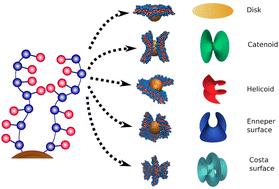
By means of computer modelling, the self-assembly of amphiphilic A-graft-B macromolecules, grafted onto a spherical nanoparticle, is studied. In a solvent, that is poor for side pendants, the macromolecules self-assemble into thin membrane-like ABBA bilayers deviated from spherical nanoparticles. The bilayers form morphological structures that depend on the grafting density and macromolecular polymerization degree and can be referred to as the classical family of complete embedded minimal surfaces. The plane disk, catenoid, helicoid, Costa and Enneper surfaces as well as “double” helicoid and “complex minimal surface” were identified, and the fields of their stability were defined. The surfaces can be grouped according to the sequences of conformal transformations that transform them into each other. These surfaces arise in different experiments situationally. Results are summarized in a pie diagram constructed using a machine learning algorithm based on matching grafting points with a specially created planar graphic image.
期刊介绍:
Soft Matter is an international journal published by the Royal Society of Chemistry using Engineering-Materials Science: A Synthesis as its research focus. It publishes original research articles, review articles, and synthesis articles related to this field, reporting the latest discoveries in the relevant theoretical, practical, and applied disciplines in a timely manner, and aims to promote the rapid exchange of scientific information in this subject area. The journal is an open access journal. The journal is an open access journal and has not been placed on the alert list in the last three years.




 京公网安备 11010802042870号
京ICP备2023020795号-1
京公网安备 11010802042870号
京ICP备2023020795号-1

 分享
分享
 求助内容:
求助内容: 应助结果提醒方式:
 扫码关注我们
