Xuli Hu, Dr. Junchen Xu, Yunchen Gao, Zhenyao Li, Dr. Jun Shen, Wei Wei, Yangshun Hu, Dr. Yushan Wu, Prof. Yao Wang, Prof. Mingyue Ding
{"title":"建立非均衡 Ti4O7 辅助不对称 C-C 偶联,实现一氧化碳的高能效电还原。","authors":"Xuli Hu, Dr. Junchen Xu, Yunchen Gao, Zhenyao Li, Dr. Jun Shen, Wei Wei, Yangshun Hu, Dr. Yushan Wu, Prof. Yao Wang, Prof. Mingyue Ding","doi":"10.1002/anie.202414416","DOIUrl":null,"url":null,"abstract":"<p>Exploring an appropriate support material for Cu-based electrocatalyst is conducive for stably producing multi-carbon chemicals from electroreduction of carbon monoxide. However, the insufficient metal-support adaptability and low conductivity of the support would hinder the C−C coupling capacity and energy efficiency. Herein, non-stoichiometric Ti<sub>4</sub>O<sub>7</sub> was incorporated into Cu electrocatalysts (Cu−Ti<sub>4</sub>O<sub>7</sub>), and served as a highly conductive and stable support for highly energy-efficient electrochemical conversion of CO. The abundant oxygen vacancies originated from ordered lattice defects in Ti<sub>4</sub>O<sub>7</sub> facilitate the water dissociation and the CO adsorption to accelerate the hydrogenation to *COH. The highly adaptable metal-support interface of Cu−Ti<sub>4</sub>O<sub>7</sub> enables a direct asymmetrical C−C coupling between *CO on Cu and *COH on Ti<sub>4</sub>O<sub>7</sub>, which significantly lowers the reaction energy barrier for C<sub>2+</sub> products formation. Additionally, the excellent electroconductivity of Ti<sub>4</sub>O<sub>7</sub> benefits the reaction charge transfer through robust Cu/Ti<sub>4</sub>O<sub>7</sub> interface for minimizing the energy loss. Thus, the optimized 20Cu−Ti<sub>4</sub>O<sub>7</sub> catalyst exhibits an impressive selectivity of 96.4 % and ultrahigh energy efficiency of 45.1 % for multi-carbon products, along with a remarkable partial current density of 432.6 mA cm<sup>−2</sup>. Our study underscores a novel C−C coupling strategy between Cu and the support material, advancing the development of Cu-supported catalysts for highly efficient electroreduction of carbon monoxide.</p>","PeriodicalId":125,"journal":{"name":"Angewandte Chemie International Edition","volume":"64 2","pages":""},"PeriodicalIF":16.9000,"publicationDate":"2024-10-22","publicationTypes":"Journal Article","fieldsOfStudy":null,"isOpenAccess":false,"openAccessPdf":"","citationCount":"0","resultStr":"{\"title\":\"Establishing Non-Stoichiometric Ti4O7 Assisted Asymmetrical C−C Coupling for Highly Energy-Efficient Electroreduction of Carbon Monoxide\",\"authors\":\"Xuli Hu, Dr. Junchen Xu, Yunchen Gao, Zhenyao Li, Dr. Jun Shen, Wei Wei, Yangshun Hu, Dr. Yushan Wu, Prof. Yao Wang, Prof. Mingyue Ding\",\"doi\":\"10.1002/anie.202414416\",\"DOIUrl\":null,\"url\":null,\"abstract\":\"<p>Exploring an appropriate support material for Cu-based electrocatalyst is conducive for stably producing multi-carbon chemicals from electroreduction of carbon monoxide. However, the insufficient metal-support adaptability and low conductivity of the support would hinder the C−C coupling capacity and energy efficiency. Herein, non-stoichiometric Ti<sub>4</sub>O<sub>7</sub> was incorporated into Cu electrocatalysts (Cu−Ti<sub>4</sub>O<sub>7</sub>), and served as a highly conductive and stable support for highly energy-efficient electrochemical conversion of CO. The abundant oxygen vacancies originated from ordered lattice defects in Ti<sub>4</sub>O<sub>7</sub> facilitate the water dissociation and the CO adsorption to accelerate the hydrogenation to *COH. The highly adaptable metal-support interface of Cu−Ti<sub>4</sub>O<sub>7</sub> enables a direct asymmetrical C−C coupling between *CO on Cu and *COH on Ti<sub>4</sub>O<sub>7</sub>, which significantly lowers the reaction energy barrier for C<sub>2+</sub> products formation. Additionally, the excellent electroconductivity of Ti<sub>4</sub>O<sub>7</sub> benefits the reaction charge transfer through robust Cu/Ti<sub>4</sub>O<sub>7</sub> interface for minimizing the energy loss. Thus, the optimized 20Cu−Ti<sub>4</sub>O<sub>7</sub> catalyst exhibits an impressive selectivity of 96.4 % and ultrahigh energy efficiency of 45.1 % for multi-carbon products, along with a remarkable partial current density of 432.6 mA cm<sup>−2</sup>. Our study underscores a novel C−C coupling strategy between Cu and the support material, advancing the development of Cu-supported catalysts for highly efficient electroreduction of carbon monoxide.</p>\",\"PeriodicalId\":125,\"journal\":{\"name\":\"Angewandte Chemie International Edition\",\"volume\":\"64 2\",\"pages\":\"\"},\"PeriodicalIF\":16.9000,\"publicationDate\":\"2024-10-22\",\"publicationTypes\":\"Journal Article\",\"fieldsOfStudy\":null,\"isOpenAccess\":false,\"openAccessPdf\":\"\",\"citationCount\":\"0\",\"resultStr\":null,\"platform\":\"Semanticscholar\",\"paperid\":null,\"PeriodicalName\":\"Angewandte Chemie International Edition\",\"FirstCategoryId\":\"92\",\"ListUrlMain\":\"https://onlinelibrary.wiley.com/doi/10.1002/anie.202414416\",\"RegionNum\":1,\"RegionCategory\":\"化学\",\"ArticlePicture\":[],\"TitleCN\":null,\"AbstractTextCN\":null,\"PMCID\":null,\"EPubDate\":\"\",\"PubModel\":\"\",\"JCR\":\"Q1\",\"JCRName\":\"CHEMISTRY, MULTIDISCIPLINARY\",\"Score\":null,\"Total\":0}","platform":"Semanticscholar","paperid":null,"PeriodicalName":"Angewandte Chemie International Edition","FirstCategoryId":"92","ListUrlMain":"https://onlinelibrary.wiley.com/doi/10.1002/anie.202414416","RegionNum":1,"RegionCategory":"化学","ArticlePicture":[],"TitleCN":null,"AbstractTextCN":null,"PMCID":null,"EPubDate":"","PubModel":"","JCR":"Q1","JCRName":"CHEMISTRY, MULTIDISCIPLINARY","Score":null,"Total":0}
Establishing Non-Stoichiometric Ti4O7 Assisted Asymmetrical C−C Coupling for Highly Energy-Efficient Electroreduction of Carbon Monoxide
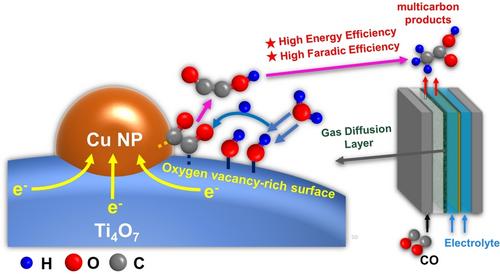
Exploring an appropriate support material for Cu-based electrocatalyst is conducive for stably producing multi-carbon chemicals from electroreduction of carbon monoxide. However, the insufficient metal-support adaptability and low conductivity of the support would hinder the C−C coupling capacity and energy efficiency. Herein, non-stoichiometric Ti4O7 was incorporated into Cu electrocatalysts (Cu−Ti4O7), and served as a highly conductive and stable support for highly energy-efficient electrochemical conversion of CO. The abundant oxygen vacancies originated from ordered lattice defects in Ti4O7 facilitate the water dissociation and the CO adsorption to accelerate the hydrogenation to *COH. The highly adaptable metal-support interface of Cu−Ti4O7 enables a direct asymmetrical C−C coupling between *CO on Cu and *COH on Ti4O7, which significantly lowers the reaction energy barrier for C2+ products formation. Additionally, the excellent electroconductivity of Ti4O7 benefits the reaction charge transfer through robust Cu/Ti4O7 interface for minimizing the energy loss. Thus, the optimized 20Cu−Ti4O7 catalyst exhibits an impressive selectivity of 96.4 % and ultrahigh energy efficiency of 45.1 % for multi-carbon products, along with a remarkable partial current density of 432.6 mA cm−2. Our study underscores a novel C−C coupling strategy between Cu and the support material, advancing the development of Cu-supported catalysts for highly efficient electroreduction of carbon monoxide.
期刊介绍:
Angewandte Chemie, a journal of the German Chemical Society (GDCh), maintains a leading position among scholarly journals in general chemistry with an impressive Impact Factor of 16.6 (2022 Journal Citation Reports, Clarivate, 2023). Published weekly in a reader-friendly format, it features new articles almost every day. Established in 1887, Angewandte Chemie is a prominent chemistry journal, offering a dynamic blend of Review-type articles, Highlights, Communications, and Research Articles on a weekly basis, making it unique in the field.




 京公网安备 11010802042870号
京ICP备2023020795号-1
京公网安备 11010802042870号
京ICP备2023020795号-1

 分享
分享
 求助内容:
求助内容: 应助结果提醒方式:
 扫码关注我们
