Giedrė Gurevičienė, Jurgita Matulionė, Lina Poškienė, Skaidrius Miliauskas, Marius Žemaitis
{"title":"在切除的早期非小细胞肺癌患者中,PD-L1+淋巴细胞与CD4+、Foxp3+CD4+、IL17+CD4+ T细胞和巨噬细胞亚型相关。","authors":"Giedrė Gurevičienė, Jurgita Matulionė, Lina Poškienė, Skaidrius Miliauskas, Marius Žemaitis","doi":"10.3390/ijms251910827","DOIUrl":null,"url":null,"abstract":"<p><p>The non-canonical PD-L1 pathway revealed that programmed-death ligand 1 (PD-L1) expression in immune cells also plays a crucial role in immune response. Moreover, immune cell distribution in a tumour microenvironment (TME) is pivotal for tumour genesis. However, the results remain controversial and further research is needed. Distribution of PD-L1-positive (PD-L1<sup>+</sup>) tumour-infiltrating lymphocytes in the context of TME was assessed in 72 archival I-III stage surgically resected NSCLC tumour specimens. Predominant PD-L1<sup>+</sup> lymphocyte distribution in the tumour stroma, compared to islets, was found (<i>p</i> = 0.01). Higher PD-L1<sup>+</sup> lymphocyte infiltration was detected in smokers due to their predominance in the stroma. High PD-L1<sup>+</sup> lymphocyte infiltration in tumour stroma was more common in tumours with higher CD4<sup>+</sup> T cell infiltration in islets and stroma, Foxp3<sup>+</sup>CD4<sup>+</sup> T cell infiltration in islets and lover M1 macrophage infiltration in the stroma (<i>p</i> = 0.034, <i>p</i> = 0.034, <i>p</i> = 0.005 and <i>p</i> = 0.034 respectively). Meanwhile, high PD-L1<sup>+</sup> lymphocyte infiltration in islets was predominantly found in tumours with high levels of IL-17A<sup>+</sup>CD4<sup>+</sup> T cells in islets and Foxp3<sup>+</sup>CD4<sup>+</sup> T cells in islets and stroma (<i>p</i> = 0.032, <i>p</i> = 0.009 and <i>p</i> = 0.034, respectively). Significant correlations between PD-L1<sup>+</sup> lymphocytes and tumour-infiltrating CD4<sup>+</sup>, Foxp3<sup>+</sup>CD4<sup>+</sup>, IL-17A<sup>+</sup>CD4<sup>+</sup> T cells and M2 macrophages were found. An analysis of the tumour-immune phenotype revealed a significant association between PD-L1 expression and IL17<sup>+</sup>CD4<sup>+</sup> and Foxp3<sup>+</sup>CD4<sup>+</sup> immune phenotypes. PD-L1<sup>+</sup> lymphocytes are associated with the distribution of CD4<sup>+</sup>, Foxp3<sup>+</sup>CD4<sup>+</sup>, IL17A<sup>+</sup>CD4<sup>+</sup> T cells, M1 and M2 macrophages in TME of resected NSCLC.</p>","PeriodicalId":14156,"journal":{"name":"International Journal of Molecular Sciences","volume":"25 19","pages":""},"PeriodicalIF":4.9000,"publicationDate":"2024-10-09","publicationTypes":"Journal Article","fieldsOfStudy":null,"isOpenAccess":false,"openAccessPdf":"https://www.ncbi.nlm.nih.gov/pmc/articles/PMC11477418/pdf/","citationCount":"0","resultStr":"{\"title\":\"PD-L1<sup>+</sup> Lymphocytes Are Associated with CD4<sup>+</sup>, Foxp3<sup>+</sup>CD4<sup>+</sup>, IL17<sup>+</sup>CD4<sup>+</sup> T Cells and Subtypes of Macrophages in Resected Early-Stage Non-Small Cell Lung Cancer.\",\"authors\":\"Giedrė Gurevičienė, Jurgita Matulionė, Lina Poškienė, Skaidrius Miliauskas, Marius Žemaitis\",\"doi\":\"10.3390/ijms251910827\",\"DOIUrl\":null,\"url\":null,\"abstract\":\"<p><p>The non-canonical PD-L1 pathway revealed that programmed-death ligand 1 (PD-L1) expression in immune cells also plays a crucial role in immune response. Moreover, immune cell distribution in a tumour microenvironment (TME) is pivotal for tumour genesis. However, the results remain controversial and further research is needed. Distribution of PD-L1-positive (PD-L1<sup>+</sup>) tumour-infiltrating lymphocytes in the context of TME was assessed in 72 archival I-III stage surgically resected NSCLC tumour specimens. Predominant PD-L1<sup>+</sup> lymphocyte distribution in the tumour stroma, compared to islets, was found (<i>p</i> = 0.01). Higher PD-L1<sup>+</sup> lymphocyte infiltration was detected in smokers due to their predominance in the stroma. High PD-L1<sup>+</sup> lymphocyte infiltration in tumour stroma was more common in tumours with higher CD4<sup>+</sup> T cell infiltration in islets and stroma, Foxp3<sup>+</sup>CD4<sup>+</sup> T cell infiltration in islets and lover M1 macrophage infiltration in the stroma (<i>p</i> = 0.034, <i>p</i> = 0.034, <i>p</i> = 0.005 and <i>p</i> = 0.034 respectively). Meanwhile, high PD-L1<sup>+</sup> lymphocyte infiltration in islets was predominantly found in tumours with high levels of IL-17A<sup>+</sup>CD4<sup>+</sup> T cells in islets and Foxp3<sup>+</sup>CD4<sup>+</sup> T cells in islets and stroma (<i>p</i> = 0.032, <i>p</i> = 0.009 and <i>p</i> = 0.034, respectively). Significant correlations between PD-L1<sup>+</sup> lymphocytes and tumour-infiltrating CD4<sup>+</sup>, Foxp3<sup>+</sup>CD4<sup>+</sup>, IL-17A<sup>+</sup>CD4<sup>+</sup> T cells and M2 macrophages were found. An analysis of the tumour-immune phenotype revealed a significant association between PD-L1 expression and IL17<sup>+</sup>CD4<sup>+</sup> and Foxp3<sup>+</sup>CD4<sup>+</sup> immune phenotypes. PD-L1<sup>+</sup> lymphocytes are associated with the distribution of CD4<sup>+</sup>, Foxp3<sup>+</sup>CD4<sup>+</sup>, IL17A<sup>+</sup>CD4<sup>+</sup> T cells, M1 and M2 macrophages in TME of resected NSCLC.</p>\",\"PeriodicalId\":14156,\"journal\":{\"name\":\"International Journal of Molecular Sciences\",\"volume\":\"25 19\",\"pages\":\"\"},\"PeriodicalIF\":4.9000,\"publicationDate\":\"2024-10-09\",\"publicationTypes\":\"Journal Article\",\"fieldsOfStudy\":null,\"isOpenAccess\":false,\"openAccessPdf\":\"https://www.ncbi.nlm.nih.gov/pmc/articles/PMC11477418/pdf/\",\"citationCount\":\"0\",\"resultStr\":null,\"platform\":\"Semanticscholar\",\"paperid\":null,\"PeriodicalName\":\"International Journal of Molecular Sciences\",\"FirstCategoryId\":\"99\",\"ListUrlMain\":\"https://doi.org/10.3390/ijms251910827\",\"RegionNum\":2,\"RegionCategory\":\"生物学\",\"ArticlePicture\":[],\"TitleCN\":null,\"AbstractTextCN\":null,\"PMCID\":null,\"EPubDate\":\"\",\"PubModel\":\"\",\"JCR\":\"\",\"JCRName\":\"\",\"Score\":null,\"Total\":0}","platform":"Semanticscholar","paperid":null,"PeriodicalName":"International Journal of Molecular Sciences","FirstCategoryId":"99","ListUrlMain":"https://doi.org/10.3390/ijms251910827","RegionNum":2,"RegionCategory":"生物学","ArticlePicture":[],"TitleCN":null,"AbstractTextCN":null,"PMCID":null,"EPubDate":"","PubModel":"","JCR":"","JCRName":"","Score":null,"Total":0}
引用次数: 0
摘要
非经典 PD-L1 通路揭示了免疫细胞中程序性死亡配体 1(PD-L1)的表达在免疫反应中也起着至关重要的作用。此外,免疫细胞在肿瘤微环境(TME)中的分布对肿瘤发生至关重要。然而,这些结果仍存在争议,需要进一步研究。我们在 72 例 I-III 期手术切除的 NSCLC 肿瘤标本中评估了肿瘤微环境中 PD-L1 阳性(PD-L1+)肿瘤浸润淋巴细胞的分布情况。结果发现,PD-L1+淋巴细胞主要分布在肿瘤基质,而非肿瘤小体(p = 0.01)。由于PD-L1+淋巴细胞主要分布在基质中,因此吸烟者的PD-L1+淋巴细胞浸润程度更高。肿瘤基质中的高 PD-L1+ 淋巴细胞浸润在胰岛和基质中 CD4+ T 细胞浸润较高、胰岛中 Foxp3+CD4+ T 细胞浸润较高和基质中 M1 巨噬细胞浸润较高的肿瘤中更为常见(分别为 p = 0.034、p = 0.034、p = 0.005 和 p = 0.034)。同时,胰岛中的高PD-L1+淋巴细胞浸润主要出现在胰岛中含有高水平IL-17A+CD4+ T细胞以及胰岛和基质中含有高水平Foxp3+CD4+ T细胞的肿瘤中(分别为p = 0.032、p = 0.009和p = 0.034)。PD-L1+ 淋巴细胞与肿瘤浸润的 CD4+、Foxp3+CD4+、IL-17A+CD4+ T 细胞和 M2 巨噬细胞之间存在显著相关性。对肿瘤免疫表型的分析表明,PD-L1表达与IL17+CD4+和Foxp3+CD4+免疫表型之间存在显著关联。PD-L1+淋巴细胞与切除的NSCLC的TME中CD4+、Foxp3+CD4+、IL17A+CD4+ T细胞、M1和M2巨噬细胞的分布有关。
PD-L1+ Lymphocytes Are Associated with CD4+, Foxp3+CD4+, IL17+CD4+ T Cells and Subtypes of Macrophages in Resected Early-Stage Non-Small Cell Lung Cancer.
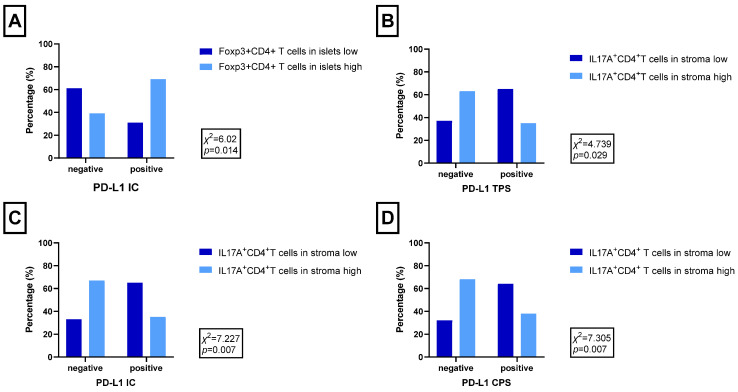
The non-canonical PD-L1 pathway revealed that programmed-death ligand 1 (PD-L1) expression in immune cells also plays a crucial role in immune response. Moreover, immune cell distribution in a tumour microenvironment (TME) is pivotal for tumour genesis. However, the results remain controversial and further research is needed. Distribution of PD-L1-positive (PD-L1+) tumour-infiltrating lymphocytes in the context of TME was assessed in 72 archival I-III stage surgically resected NSCLC tumour specimens. Predominant PD-L1+ lymphocyte distribution in the tumour stroma, compared to islets, was found (p = 0.01). Higher PD-L1+ lymphocyte infiltration was detected in smokers due to their predominance in the stroma. High PD-L1+ lymphocyte infiltration in tumour stroma was more common in tumours with higher CD4+ T cell infiltration in islets and stroma, Foxp3+CD4+ T cell infiltration in islets and lover M1 macrophage infiltration in the stroma (p = 0.034, p = 0.034, p = 0.005 and p = 0.034 respectively). Meanwhile, high PD-L1+ lymphocyte infiltration in islets was predominantly found in tumours with high levels of IL-17A+CD4+ T cells in islets and Foxp3+CD4+ T cells in islets and stroma (p = 0.032, p = 0.009 and p = 0.034, respectively). Significant correlations between PD-L1+ lymphocytes and tumour-infiltrating CD4+, Foxp3+CD4+, IL-17A+CD4+ T cells and M2 macrophages were found. An analysis of the tumour-immune phenotype revealed a significant association between PD-L1 expression and IL17+CD4+ and Foxp3+CD4+ immune phenotypes. PD-L1+ lymphocytes are associated with the distribution of CD4+, Foxp3+CD4+, IL17A+CD4+ T cells, M1 and M2 macrophages in TME of resected NSCLC.
期刊介绍:
The International Journal of Molecular Sciences (ISSN 1422-0067) provides an advanced forum for chemistry, molecular physics (chemical physics and physical chemistry) and molecular biology. It publishes research articles, reviews, communications and short notes. Our aim is to encourage scientists to publish their theoretical and experimental results in as much detail as possible. Therefore, there is no restriction on the length of the papers or the number of electronics supplementary files. For articles with computational results, the full experimental details must be provided so that the results can be reproduced. Electronic files regarding the full details of the calculation and experimental procedure, if unable to be published in a normal way, can be deposited as supplementary material (including animated pictures, videos, interactive Excel sheets, software executables and others).






 京公网安备 11010802042870号
京ICP备2023020795号-1
京公网安备 11010802042870号
京ICP备2023020795号-1

 分享
分享
 求助内容:
求助内容: 应助结果提醒方式:
 扫码关注我们
