Gauthier Marchand MD, Florian Chatelet MD, Sarah Atallah MD, PhD, Charlotte Célérier MD, Nicolas Leboulanger MD, PhD, Vincent Couloigner MD, PhD, Natalie Loundon MD, Erea-Noël Garabédian MD, Françoise Denoyelle MD, PhD, François Simon MD, PhD
{"title":"EAONO/JOS、STAMCO、ChOLE 和 Potsic 对 271 例小儿胆脂瘤进行分期:基于证据的 Mod-Pot 分期系统。","authors":"Gauthier Marchand MD, Florian Chatelet MD, Sarah Atallah MD, PhD, Charlotte Célérier MD, Nicolas Leboulanger MD, PhD, Vincent Couloigner MD, PhD, Natalie Loundon MD, Erea-Noël Garabédian MD, Françoise Denoyelle MD, PhD, François Simon MD, PhD","doi":"10.1002/lary.31837","DOIUrl":null,"url":null,"abstract":"<div>\n \n <section>\n \n <h3> Objective</h3>\n \n <p>The objective was to assess Potsic, EAONO/JOS, STAMCO, and ChOLE cholesteatoma staging systems in a large homogenous pediatric cohort with long-term follow-up and propose an evidence-based improved version.</p>\n </section>\n \n <section>\n \n <h3> Study design</h3>\n \n <p>Cohort study.</p>\n </section>\n \n <section>\n \n <h3> Setting</h3>\n \n <p>Retrospective study in a tertiary referral center.</p>\n </section>\n \n <section>\n \n <h3> Methods</h3>\n \n <p>Children with congenital or acquired cholesteatoma who underwent surgery between 2008 and 2015 and had a minimum of five years follow-up were included. ROC areas under curve (AUCs) were performed for the residual disease proportion, total number of surgeries, hearing, and C-index for recurrence proportion at the last follow-up.</p>\n </section>\n \n <section>\n \n <h3> Results</h3>\n \n <p>Data from 271 ears with cholesteatoma were collected. Mean age at diagnosis was 7.9 years and 77 (28%) were congenital. Almost all patients (99%) had a canal wall up approach. The mean follow-up was 97.8 months. The Potsic classification, initially designed for congenital cholesteatoma, had the highest AUCs for residual disease rate and for number of surgeries outcomes (respectively 0.73 [0.67–0.78] and 0.71 [0.66–0.77]). For recurrence rate, all the classifications' C-index were low (<0.7). For postoperative hearing, STAMCO ossicular subscore had the highest AUC (0.73 [0.67–0.79]). The Mod-Pot staging system (modified Potsic), including stapes superstructure status and anterior epitympanum or supratubal involvement, improved the Potsic performance especially for postoperative hearing with AUC 0.73 [0.67–0.80], <i>p</i> < 0.001.</p>\n </section>\n \n <section>\n \n <h3> Conclusion</h3>\n \n <p>The Potsic, ChOLE, EAONO/JOS, and STAMCO cholesteatoma classifications may be used in children, but in this specific population, their contribution remains limited to predict outcome. The Mod-Pot classification improved the performance of pediatric cholesteatoma classification while remaining simple and intuitive.</p>\n </section>\n \n <section>\n \n <h3> Level of Evidence</h3>\n \n <p>3 <i>Laryngoscope</i>, 135:908–919, 2025</p>\n </section>\n </div>","PeriodicalId":49921,"journal":{"name":"Laryngoscope","volume":"135 2","pages":"908-919"},"PeriodicalIF":2.0000,"publicationDate":"2024-10-10","publicationTypes":"Journal Article","fieldsOfStudy":null,"isOpenAccess":false,"openAccessPdf":"https://www.ncbi.nlm.nih.gov/pmc/articles/PMC11725683/pdf/","citationCount":"0","resultStr":"{\"title\":\"EAONO/JOS, STAMCO, ChOLE & Potsic Staging of 271 Pediatric Cholesteatoma: Evidence-Based Mod-Pot Staging System\",\"authors\":\"Gauthier Marchand MD, Florian Chatelet MD, Sarah Atallah MD, PhD, Charlotte Célérier MD, Nicolas Leboulanger MD, PhD, Vincent Couloigner MD, PhD, Natalie Loundon MD, Erea-Noël Garabédian MD, Françoise Denoyelle MD, PhD, François Simon MD, PhD\",\"doi\":\"10.1002/lary.31837\",\"DOIUrl\":null,\"url\":null,\"abstract\":\"<div>\\n \\n <section>\\n \\n <h3> Objective</h3>\\n \\n <p>The objective was to assess Potsic, EAONO/JOS, STAMCO, and ChOLE cholesteatoma staging systems in a large homogenous pediatric cohort with long-term follow-up and propose an evidence-based improved version.</p>\\n </section>\\n \\n <section>\\n \\n <h3> Study design</h3>\\n \\n <p>Cohort study.</p>\\n </section>\\n \\n <section>\\n \\n <h3> Setting</h3>\\n \\n <p>Retrospective study in a tertiary referral center.</p>\\n </section>\\n \\n <section>\\n \\n <h3> Methods</h3>\\n \\n <p>Children with congenital or acquired cholesteatoma who underwent surgery between 2008 and 2015 and had a minimum of five years follow-up were included. ROC areas under curve (AUCs) were performed for the residual disease proportion, total number of surgeries, hearing, and C-index for recurrence proportion at the last follow-up.</p>\\n </section>\\n \\n <section>\\n \\n <h3> Results</h3>\\n \\n <p>Data from 271 ears with cholesteatoma were collected. Mean age at diagnosis was 7.9 years and 77 (28%) were congenital. Almost all patients (99%) had a canal wall up approach. The mean follow-up was 97.8 months. The Potsic classification, initially designed for congenital cholesteatoma, had the highest AUCs for residual disease rate and for number of surgeries outcomes (respectively 0.73 [0.67–0.78] and 0.71 [0.66–0.77]). For recurrence rate, all the classifications' C-index were low (<0.7). For postoperative hearing, STAMCO ossicular subscore had the highest AUC (0.73 [0.67–0.79]). The Mod-Pot staging system (modified Potsic), including stapes superstructure status and anterior epitympanum or supratubal involvement, improved the Potsic performance especially for postoperative hearing with AUC 0.73 [0.67–0.80], <i>p</i> < 0.001.</p>\\n </section>\\n \\n <section>\\n \\n <h3> Conclusion</h3>\\n \\n <p>The Potsic, ChOLE, EAONO/JOS, and STAMCO cholesteatoma classifications may be used in children, but in this specific population, their contribution remains limited to predict outcome. The Mod-Pot classification improved the performance of pediatric cholesteatoma classification while remaining simple and intuitive.</p>\\n </section>\\n \\n <section>\\n \\n <h3> Level of Evidence</h3>\\n \\n <p>3 <i>Laryngoscope</i>, 135:908–919, 2025</p>\\n </section>\\n </div>\",\"PeriodicalId\":49921,\"journal\":{\"name\":\"Laryngoscope\",\"volume\":\"135 2\",\"pages\":\"908-919\"},\"PeriodicalIF\":2.0000,\"publicationDate\":\"2024-10-10\",\"publicationTypes\":\"Journal Article\",\"fieldsOfStudy\":null,\"isOpenAccess\":false,\"openAccessPdf\":\"https://www.ncbi.nlm.nih.gov/pmc/articles/PMC11725683/pdf/\",\"citationCount\":\"0\",\"resultStr\":null,\"platform\":\"Semanticscholar\",\"paperid\":null,\"PeriodicalName\":\"Laryngoscope\",\"FirstCategoryId\":\"3\",\"ListUrlMain\":\"https://onlinelibrary.wiley.com/doi/10.1002/lary.31837\",\"RegionNum\":3,\"RegionCategory\":\"医学\",\"ArticlePicture\":[],\"TitleCN\":null,\"AbstractTextCN\":null,\"PMCID\":null,\"EPubDate\":\"\",\"PubModel\":\"\",\"JCR\":\"Q3\",\"JCRName\":\"MEDICINE, RESEARCH & EXPERIMENTAL\",\"Score\":null,\"Total\":0}","platform":"Semanticscholar","paperid":null,"PeriodicalName":"Laryngoscope","FirstCategoryId":"3","ListUrlMain":"https://onlinelibrary.wiley.com/doi/10.1002/lary.31837","RegionNum":3,"RegionCategory":"医学","ArticlePicture":[],"TitleCN":null,"AbstractTextCN":null,"PMCID":null,"EPubDate":"","PubModel":"","JCR":"Q3","JCRName":"MEDICINE, RESEARCH & EXPERIMENTAL","Score":null,"Total":0}
EAONO/JOS, STAMCO, ChOLE & Potsic Staging of 271 Pediatric Cholesteatoma: Evidence-Based Mod-Pot Staging System
Objective
The objective was to assess Potsic, EAONO/JOS, STAMCO, and ChOLE cholesteatoma staging systems in a large homogenous pediatric cohort with long-term follow-up and propose an evidence-based improved version.
Study design
Cohort study.
Setting
Retrospective study in a tertiary referral center.
Methods
Children with congenital or acquired cholesteatoma who underwent surgery between 2008 and 2015 and had a minimum of five years follow-up were included. ROC areas under curve (AUCs) were performed for the residual disease proportion, total number of surgeries, hearing, and C-index for recurrence proportion at the last follow-up.
Results
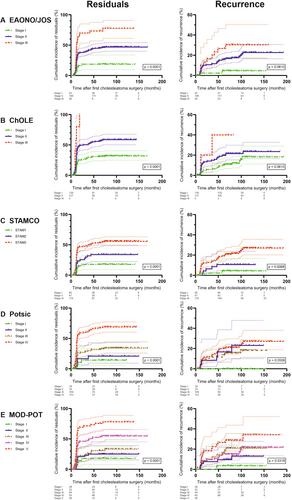
Data from 271 ears with cholesteatoma were collected. Mean age at diagnosis was 7.9 years and 77 (28%) were congenital. Almost all patients (99%) had a canal wall up approach. The mean follow-up was 97.8 months. The Potsic classification, initially designed for congenital cholesteatoma, had the highest AUCs for residual disease rate and for number of surgeries outcomes (respectively 0.73 [0.67–0.78] and 0.71 [0.66–0.77]). For recurrence rate, all the classifications' C-index were low (<0.7). For postoperative hearing, STAMCO ossicular subscore had the highest AUC (0.73 [0.67–0.79]). The Mod-Pot staging system (modified Potsic), including stapes superstructure status and anterior epitympanum or supratubal involvement, improved the Potsic performance especially for postoperative hearing with AUC 0.73 [0.67–0.80], p < 0.001.
Conclusion
The Potsic, ChOLE, EAONO/JOS, and STAMCO cholesteatoma classifications may be used in children, but in this specific population, their contribution remains limited to predict outcome. The Mod-Pot classification improved the performance of pediatric cholesteatoma classification while remaining simple and intuitive.
期刊介绍:
The Laryngoscope has been the leading source of information on advances in the diagnosis and treatment of head and neck disorders since 1890. The Laryngoscope is the first choice among otolaryngologists for publication of their important findings and techniques. Each monthly issue of The Laryngoscope features peer-reviewed medical, clinical, and research contributions in general otolaryngology, allergy/rhinology, otology/neurotology, laryngology/bronchoesophagology, head and neck surgery, sleep medicine, pediatric otolaryngology, facial plastics and reconstructive surgery, oncology, and communicative disorders. Contributions include papers and posters presented at the Annual and Section Meetings of the Triological Society, as well as independent papers, "How I Do It", "Triological Best Practice" articles, and contemporary reviews. Theses authored by the Triological Society’s new Fellows as well as papers presented at meetings of the American Laryngological Association are published in The Laryngoscope.
• Broncho-esophagology
• Communicative disorders
• Head and neck surgery
• Plastic and reconstructive facial surgery
• Oncology
• Speech and hearing defects





 京公网安备 11010802042870号
京ICP备2023020795号-1
京公网安备 11010802042870号
京ICP备2023020795号-1

 分享
分享
 求助内容:
求助内容: 应助结果提醒方式:
 扫码关注我们
