{"title":"四甲基吡嗪衍生聚氨酯,用于改善血液相容性和快速内皮化。","authors":"Baoliu Qu, Zhenzhen Hu, Weilong Tan, Bingyan Li, Yue Xin, Jinpeng Mo, Meilin Huang, Qinghua Wu, Yangling Li and Yingzhu Wu","doi":"10.1039/D4TB01478B","DOIUrl":null,"url":null,"abstract":"<p >Thrombosis and intimal hyperplasia (IH) are the main factors affecting the long-term patency of small-diameter vascular grafts (SDVGs). Fabricating a confluent endothelial cell (EC) layer on surfaces with physiological elasticity to mimic vascular endothelium should be an effective strategy to prevent restenosis that is caused by thrombosis and IH. However, the vascular endothelialization process is time-consuming and always constrained by hemocompatibility of the vascular grafts, since excellent hemocompatibility could guarantee a sufficient time window for the endothelialization process. Tetramethylpyrazine (TMP)-derived polyurethane (PU) with improved hemocompatibility and accelerated endothelialization ability is synthesized by incorporating TMP moieties into PU backbones. Results show that TMP-contained PU films possess improved hemocompatibility by down-regulating platelet adhesion/activation and increasing the clotting time. Furthermore, the <em>in vitro</em> human umbilical vein endothelial cell (HUVEC) test demonstrates that the introduction of TMP can significantly promote HUVEC adhesion and proliferation, and thus accelerate luminal endothelialization of vascular grafts. Moreover, the TMP-containing PU films exhibit excellent biocompatibility especially for HUVECs, and their excellent, adjustable elasticity (1123%) guarantees compliance accommodation of vascular grafts. This newly synthesized TMP-containing material with multiple biological functions is expected to make up for the shortcomings of available SDVGs in clinical practice, and has significant potential in improving the long-term patency of SDVGs.</p>","PeriodicalId":83,"journal":{"name":"Journal of Materials Chemistry B","volume":" 45","pages":" 11810-11816"},"PeriodicalIF":6.2000,"publicationDate":"2024-10-12","publicationTypes":"Journal Article","fieldsOfStudy":null,"isOpenAccess":false,"openAccessPdf":"","citationCount":"0","resultStr":"{\"title\":\"Tetramethylpyrazine-derived polyurethane for improved hemocompatibility and rapid endothelialization\",\"authors\":\"Baoliu Qu, Zhenzhen Hu, Weilong Tan, Bingyan Li, Yue Xin, Jinpeng Mo, Meilin Huang, Qinghua Wu, Yangling Li and Yingzhu Wu\",\"doi\":\"10.1039/D4TB01478B\",\"DOIUrl\":null,\"url\":null,\"abstract\":\"<p >Thrombosis and intimal hyperplasia (IH) are the main factors affecting the long-term patency of small-diameter vascular grafts (SDVGs). Fabricating a confluent endothelial cell (EC) layer on surfaces with physiological elasticity to mimic vascular endothelium should be an effective strategy to prevent restenosis that is caused by thrombosis and IH. However, the vascular endothelialization process is time-consuming and always constrained by hemocompatibility of the vascular grafts, since excellent hemocompatibility could guarantee a sufficient time window for the endothelialization process. Tetramethylpyrazine (TMP)-derived polyurethane (PU) with improved hemocompatibility and accelerated endothelialization ability is synthesized by incorporating TMP moieties into PU backbones. Results show that TMP-contained PU films possess improved hemocompatibility by down-regulating platelet adhesion/activation and increasing the clotting time. Furthermore, the <em>in vitro</em> human umbilical vein endothelial cell (HUVEC) test demonstrates that the introduction of TMP can significantly promote HUVEC adhesion and proliferation, and thus accelerate luminal endothelialization of vascular grafts. Moreover, the TMP-containing PU films exhibit excellent biocompatibility especially for HUVECs, and their excellent, adjustable elasticity (1123%) guarantees compliance accommodation of vascular grafts. This newly synthesized TMP-containing material with multiple biological functions is expected to make up for the shortcomings of available SDVGs in clinical practice, and has significant potential in improving the long-term patency of SDVGs.</p>\",\"PeriodicalId\":83,\"journal\":{\"name\":\"Journal of Materials Chemistry B\",\"volume\":\" 45\",\"pages\":\" 11810-11816\"},\"PeriodicalIF\":6.2000,\"publicationDate\":\"2024-10-12\",\"publicationTypes\":\"Journal Article\",\"fieldsOfStudy\":null,\"isOpenAccess\":false,\"openAccessPdf\":\"\",\"citationCount\":\"0\",\"resultStr\":null,\"platform\":\"Semanticscholar\",\"paperid\":null,\"PeriodicalName\":\"Journal of Materials Chemistry B\",\"FirstCategoryId\":\"1\",\"ListUrlMain\":\"https://pubs.rsc.org/en/content/articlelanding/2024/tb/d4tb01478b\",\"RegionNum\":3,\"RegionCategory\":\"医学\",\"ArticlePicture\":[],\"TitleCN\":null,\"AbstractTextCN\":null,\"PMCID\":null,\"EPubDate\":\"\",\"PubModel\":\"\",\"JCR\":\"Q1\",\"JCRName\":\"MATERIALS SCIENCE, BIOMATERIALS\",\"Score\":null,\"Total\":0}","platform":"Semanticscholar","paperid":null,"PeriodicalName":"Journal of Materials Chemistry B","FirstCategoryId":"1","ListUrlMain":"https://pubs.rsc.org/en/content/articlelanding/2024/tb/d4tb01478b","RegionNum":3,"RegionCategory":"医学","ArticlePicture":[],"TitleCN":null,"AbstractTextCN":null,"PMCID":null,"EPubDate":"","PubModel":"","JCR":"Q1","JCRName":"MATERIALS SCIENCE, BIOMATERIALS","Score":null,"Total":0}
Tetramethylpyrazine-derived polyurethane for improved hemocompatibility and rapid endothelialization
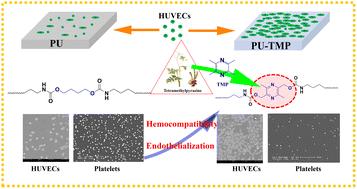
Thrombosis and intimal hyperplasia (IH) are the main factors affecting the long-term patency of small-diameter vascular grafts (SDVGs). Fabricating a confluent endothelial cell (EC) layer on surfaces with physiological elasticity to mimic vascular endothelium should be an effective strategy to prevent restenosis that is caused by thrombosis and IH. However, the vascular endothelialization process is time-consuming and always constrained by hemocompatibility of the vascular grafts, since excellent hemocompatibility could guarantee a sufficient time window for the endothelialization process. Tetramethylpyrazine (TMP)-derived polyurethane (PU) with improved hemocompatibility and accelerated endothelialization ability is synthesized by incorporating TMP moieties into PU backbones. Results show that TMP-contained PU films possess improved hemocompatibility by down-regulating platelet adhesion/activation and increasing the clotting time. Furthermore, the in vitro human umbilical vein endothelial cell (HUVEC) test demonstrates that the introduction of TMP can significantly promote HUVEC adhesion and proliferation, and thus accelerate luminal endothelialization of vascular grafts. Moreover, the TMP-containing PU films exhibit excellent biocompatibility especially for HUVECs, and their excellent, adjustable elasticity (1123%) guarantees compliance accommodation of vascular grafts. This newly synthesized TMP-containing material with multiple biological functions is expected to make up for the shortcomings of available SDVGs in clinical practice, and has significant potential in improving the long-term patency of SDVGs.
期刊介绍:
Journal of Materials Chemistry A, B & C cover high quality studies across all fields of materials chemistry. The journals focus on those theoretical or experimental studies that report new understanding, applications, properties and synthesis of materials. Journal of Materials Chemistry A, B & C are separated by the intended application of the material studied. Broadly, applications in energy and sustainability are of interest to Journal of Materials Chemistry A, applications in biology and medicine are of interest to Journal of Materials Chemistry B, and applications in optical, magnetic and electronic devices are of interest to Journal of Materials Chemistry C.Journal of Materials Chemistry B is a Transformative Journal and Plan S compliant. Example topic areas within the scope of Journal of Materials Chemistry B are listed below. This list is neither exhaustive nor exclusive:
Antifouling coatings
Biocompatible materials
Bioelectronics
Bioimaging
Biomimetics
Biomineralisation
Bionics
Biosensors
Diagnostics
Drug delivery
Gene delivery
Immunobiology
Nanomedicine
Regenerative medicine & Tissue engineering
Scaffolds
Soft robotics
Stem cells
Therapeutic devices




 京公网安备 11010802042870号
京ICP备2023020795号-1
京公网安备 11010802042870号
京ICP备2023020795号-1

 分享
分享
 求助内容:
求助内容: 应助结果提醒方式:
 扫码关注我们
