Larisa R. Latypova, Irina N. Gracheva, Darya V. Shurtakova, Fadis F. Murzakhanov, Margarita A. Sadovnikova, Georgy V. Mamin, Marat R. Gafurov
{"title":"同位素纯化的 6H-28SiC 晶体中 NV 缺陷的电子核相互作用","authors":"Larisa R. Latypova, Irina N. Gracheva, Darya V. Shurtakova, Fadis F. Murzakhanov, Margarita A. Sadovnikova, Georgy V. Mamin, Marat R. Gafurov","doi":"10.1021/acs.jpcc.4c05167","DOIUrl":null,"url":null,"abstract":"NV<sup>–</sup> defects in silicon carbide (SiC) are emerging as a competitive alternative to NV<sup>–</sup> centers in diamond due to advanced industrial-scale SiC production methods. We present a study of the ground-state electron–nuclear coupling of negatively charged nitrogen-vacancy NV<sup>–</sup> centers in a 6<i>H</i>-SiC crystal by electron paramagnetic resonance and electron–nuclear double resonance techniques. The hyperfine and nuclear quadrupole interaction tensors have been precisely determined. The hyperfine coupling is found to be predominantly characterized by an isotropic contact Fermi part <i>a</i><sub><i>iso</i></sub> = −1.125(2) MHz and a negligibly small dipole–dipole part <i>b</i> < 50 kHz. The nuclear quadrupole interaction is characterized by a coupling constant <i>C</i><sub>q</sub> = 2.530(3) MHz. The spin density distribution of the NV<sub><i>k</i>2<i>k</i>1</sub><sup>–</sup> center was calculated using density functional theory, and the theoretical electron–nuclear interaction values align well with experimental results. All established parameters are crucial for implementing NV<sup>–</sup> defects in SiC for quantum magnetometry, other sensing applications, and as robust qubits.","PeriodicalId":61,"journal":{"name":"The Journal of Physical Chemistry C","volume":"15 1","pages":""},"PeriodicalIF":3.2000,"publicationDate":"2024-10-22","publicationTypes":"Journal Article","fieldsOfStudy":null,"isOpenAccess":false,"openAccessPdf":"","citationCount":"0","resultStr":"{\"title\":\"Electron–Nuclear Interactions of NV Defects in an Isotopically Purified 6H-28SiC Crystal\",\"authors\":\"Larisa R. Latypova, Irina N. Gracheva, Darya V. Shurtakova, Fadis F. Murzakhanov, Margarita A. Sadovnikova, Georgy V. Mamin, Marat R. Gafurov\",\"doi\":\"10.1021/acs.jpcc.4c05167\",\"DOIUrl\":null,\"url\":null,\"abstract\":\"NV<sup>–</sup> defects in silicon carbide (SiC) are emerging as a competitive alternative to NV<sup>–</sup> centers in diamond due to advanced industrial-scale SiC production methods. We present a study of the ground-state electron–nuclear coupling of negatively charged nitrogen-vacancy NV<sup>–</sup> centers in a 6<i>H</i>-SiC crystal by electron paramagnetic resonance and electron–nuclear double resonance techniques. The hyperfine and nuclear quadrupole interaction tensors have been precisely determined. The hyperfine coupling is found to be predominantly characterized by an isotropic contact Fermi part <i>a</i><sub><i>iso</i></sub> = −1.125(2) MHz and a negligibly small dipole–dipole part <i>b</i> < 50 kHz. The nuclear quadrupole interaction is characterized by a coupling constant <i>C</i><sub>q</sub> = 2.530(3) MHz. The spin density distribution of the NV<sub><i>k</i>2<i>k</i>1</sub><sup>–</sup> center was calculated using density functional theory, and the theoretical electron–nuclear interaction values align well with experimental results. All established parameters are crucial for implementing NV<sup>–</sup> defects in SiC for quantum magnetometry, other sensing applications, and as robust qubits.\",\"PeriodicalId\":61,\"journal\":{\"name\":\"The Journal of Physical Chemistry C\",\"volume\":\"15 1\",\"pages\":\"\"},\"PeriodicalIF\":3.2000,\"publicationDate\":\"2024-10-22\",\"publicationTypes\":\"Journal Article\",\"fieldsOfStudy\":null,\"isOpenAccess\":false,\"openAccessPdf\":\"\",\"citationCount\":\"0\",\"resultStr\":null,\"platform\":\"Semanticscholar\",\"paperid\":null,\"PeriodicalName\":\"The Journal of Physical Chemistry C\",\"FirstCategoryId\":\"1\",\"ListUrlMain\":\"https://doi.org/10.1021/acs.jpcc.4c05167\",\"RegionNum\":3,\"RegionCategory\":\"化学\",\"ArticlePicture\":[],\"TitleCN\":null,\"AbstractTextCN\":null,\"PMCID\":null,\"EPubDate\":\"\",\"PubModel\":\"\",\"JCR\":\"Q2\",\"JCRName\":\"CHEMISTRY, PHYSICAL\",\"Score\":null,\"Total\":0}","platform":"Semanticscholar","paperid":null,"PeriodicalName":"The Journal of Physical Chemistry C","FirstCategoryId":"1","ListUrlMain":"https://doi.org/10.1021/acs.jpcc.4c05167","RegionNum":3,"RegionCategory":"化学","ArticlePicture":[],"TitleCN":null,"AbstractTextCN":null,"PMCID":null,"EPubDate":"","PubModel":"","JCR":"Q2","JCRName":"CHEMISTRY, PHYSICAL","Score":null,"Total":0}
Electron–Nuclear Interactions of NV Defects in an Isotopically Purified 6H-28SiC Crystal
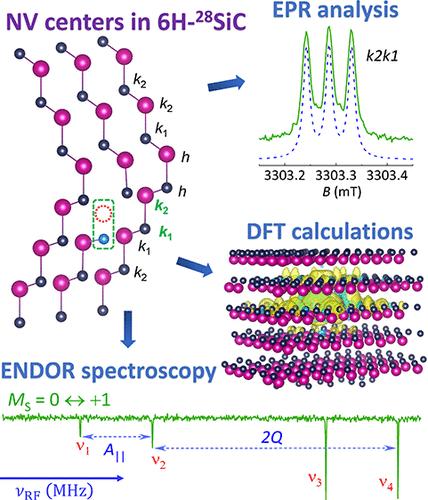
NV– defects in silicon carbide (SiC) are emerging as a competitive alternative to NV– centers in diamond due to advanced industrial-scale SiC production methods. We present a study of the ground-state electron–nuclear coupling of negatively charged nitrogen-vacancy NV– centers in a 6H-SiC crystal by electron paramagnetic resonance and electron–nuclear double resonance techniques. The hyperfine and nuclear quadrupole interaction tensors have been precisely determined. The hyperfine coupling is found to be predominantly characterized by an isotropic contact Fermi part aiso = −1.125(2) MHz and a negligibly small dipole–dipole part b < 50 kHz. The nuclear quadrupole interaction is characterized by a coupling constant Cq = 2.530(3) MHz. The spin density distribution of the NVk2k1– center was calculated using density functional theory, and the theoretical electron–nuclear interaction values align well with experimental results. All established parameters are crucial for implementing NV– defects in SiC for quantum magnetometry, other sensing applications, and as robust qubits.
期刊介绍:
The Journal of Physical Chemistry A/B/C is devoted to reporting new and original experimental and theoretical basic research of interest to physical chemists, biophysical chemists, and chemical physicists.




 京公网安备 11010802042870号
京ICP备2023020795号-1
京公网安备 11010802042870号
京ICP备2023020795号-1

 分享
分享
 求助内容:
求助内容: 应助结果提醒方式:
 扫码关注我们
