{"title":"设计具有内置肿瘤靶向能力的小鼠双敏 2 蛋白分解靶向嵌合体降解器","authors":"Zhuqian Wang, Siran Yue, Xinxin Chen, Jin Li, Peixi Zhu, Hongzhen Chen, Fang Qiu, Duoli Xie, Yiying Liang, Defang Li, Aiping Lu, Chao Liang","doi":"10.1021/acs.jmedchem.4c01228","DOIUrl":null,"url":null,"abstract":"Proteolysis targeting chimeras (PROTACs) are heterobifunctional molecules to induce the proteasomal degradation of target proteins. Currently, there are no tumor-targeting PROTACs for modulating oncogenic murine double minute 2 (MDM2). AS1411 is a tumor-targeting aptamer that specifically recognizes nucleolin (NCL) overexpressed on the surface of tumor cells. We recently repurposed AS1411 as an MDM2 recruiter since it could form an NCL-bridged ternary complex with MDM2. In this study, we design a PROTAC molecule AS1411-VH032 via conjugating AS1411 with a recruiter of von Hippel-Lindau (VHL) ligase VH032. AS1411-VH032 facilitates tumor-selective degradation of MDM2, leading to tumor shrinkage with no detectable toxicity. Besides being a molecular target, MDM2 also serves as an E3 ligase harnessed by PROTACs. Thus, we developed an AS1411-based homo-PROTAC homoAS1411, which induces tumor-specific suicide degradation of MDM2 and prevents tumor progression without causing side effects. Both AS1411-VH032 and homoAS1411 are promising MDM2 degraders with built-in tumor-targeting ability, which balances the antitumor efficacy with a favorable safety profile.","PeriodicalId":46,"journal":{"name":"Journal of Medicinal Chemistry","volume":"34 1","pages":""},"PeriodicalIF":6.8000,"publicationDate":"2024-10-22","publicationTypes":"Journal Article","fieldsOfStudy":null,"isOpenAccess":false,"openAccessPdf":"","citationCount":"0","resultStr":"{\"title\":\"Design of Murine Double Minute 2 Proteolysis Targeting Chimera Degraders with a Built-In Tumor-Targeting Ability\",\"authors\":\"Zhuqian Wang, Siran Yue, Xinxin Chen, Jin Li, Peixi Zhu, Hongzhen Chen, Fang Qiu, Duoli Xie, Yiying Liang, Defang Li, Aiping Lu, Chao Liang\",\"doi\":\"10.1021/acs.jmedchem.4c01228\",\"DOIUrl\":null,\"url\":null,\"abstract\":\"Proteolysis targeting chimeras (PROTACs) are heterobifunctional molecules to induce the proteasomal degradation of target proteins. Currently, there are no tumor-targeting PROTACs for modulating oncogenic murine double minute 2 (MDM2). AS1411 is a tumor-targeting aptamer that specifically recognizes nucleolin (NCL) overexpressed on the surface of tumor cells. We recently repurposed AS1411 as an MDM2 recruiter since it could form an NCL-bridged ternary complex with MDM2. In this study, we design a PROTAC molecule AS1411-VH032 via conjugating AS1411 with a recruiter of von Hippel-Lindau (VHL) ligase VH032. AS1411-VH032 facilitates tumor-selective degradation of MDM2, leading to tumor shrinkage with no detectable toxicity. Besides being a molecular target, MDM2 also serves as an E3 ligase harnessed by PROTACs. Thus, we developed an AS1411-based homo-PROTAC homoAS1411, which induces tumor-specific suicide degradation of MDM2 and prevents tumor progression without causing side effects. Both AS1411-VH032 and homoAS1411 are promising MDM2 degraders with built-in tumor-targeting ability, which balances the antitumor efficacy with a favorable safety profile.\",\"PeriodicalId\":46,\"journal\":{\"name\":\"Journal of Medicinal Chemistry\",\"volume\":\"34 1\",\"pages\":\"\"},\"PeriodicalIF\":6.8000,\"publicationDate\":\"2024-10-22\",\"publicationTypes\":\"Journal Article\",\"fieldsOfStudy\":null,\"isOpenAccess\":false,\"openAccessPdf\":\"\",\"citationCount\":\"0\",\"resultStr\":null,\"platform\":\"Semanticscholar\",\"paperid\":null,\"PeriodicalName\":\"Journal of Medicinal Chemistry\",\"FirstCategoryId\":\"3\",\"ListUrlMain\":\"https://doi.org/10.1021/acs.jmedchem.4c01228\",\"RegionNum\":1,\"RegionCategory\":\"医学\",\"ArticlePicture\":[],\"TitleCN\":null,\"AbstractTextCN\":null,\"PMCID\":null,\"EPubDate\":\"\",\"PubModel\":\"\",\"JCR\":\"Q1\",\"JCRName\":\"CHEMISTRY, MEDICINAL\",\"Score\":null,\"Total\":0}","platform":"Semanticscholar","paperid":null,"PeriodicalName":"Journal of Medicinal Chemistry","FirstCategoryId":"3","ListUrlMain":"https://doi.org/10.1021/acs.jmedchem.4c01228","RegionNum":1,"RegionCategory":"医学","ArticlePicture":[],"TitleCN":null,"AbstractTextCN":null,"PMCID":null,"EPubDate":"","PubModel":"","JCR":"Q1","JCRName":"CHEMISTRY, MEDICINAL","Score":null,"Total":0}
Design of Murine Double Minute 2 Proteolysis Targeting Chimera Degraders with a Built-In Tumor-Targeting Ability
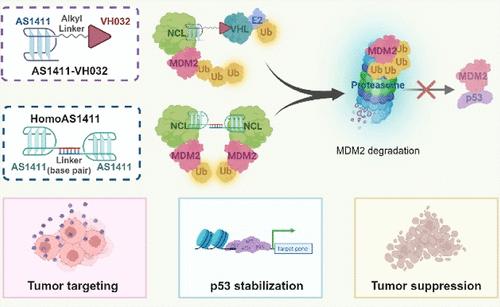
Proteolysis targeting chimeras (PROTACs) are heterobifunctional molecules to induce the proteasomal degradation of target proteins. Currently, there are no tumor-targeting PROTACs for modulating oncogenic murine double minute 2 (MDM2). AS1411 is a tumor-targeting aptamer that specifically recognizes nucleolin (NCL) overexpressed on the surface of tumor cells. We recently repurposed AS1411 as an MDM2 recruiter since it could form an NCL-bridged ternary complex with MDM2. In this study, we design a PROTAC molecule AS1411-VH032 via conjugating AS1411 with a recruiter of von Hippel-Lindau (VHL) ligase VH032. AS1411-VH032 facilitates tumor-selective degradation of MDM2, leading to tumor shrinkage with no detectable toxicity. Besides being a molecular target, MDM2 also serves as an E3 ligase harnessed by PROTACs. Thus, we developed an AS1411-based homo-PROTAC homoAS1411, which induces tumor-specific suicide degradation of MDM2 and prevents tumor progression without causing side effects. Both AS1411-VH032 and homoAS1411 are promising MDM2 degraders with built-in tumor-targeting ability, which balances the antitumor efficacy with a favorable safety profile.
期刊介绍:
The Journal of Medicinal Chemistry is a prestigious biweekly peer-reviewed publication that focuses on the multifaceted field of medicinal chemistry. Since its inception in 1959 as the Journal of Medicinal and Pharmaceutical Chemistry, it has evolved to become a cornerstone in the dissemination of research findings related to the design, synthesis, and development of therapeutic agents.
The Journal of Medicinal Chemistry is recognized for its significant impact in the scientific community, as evidenced by its 2022 impact factor of 7.3. This metric reflects the journal's influence and the importance of its content in shaping the future of drug discovery and development. The journal serves as a vital resource for chemists, pharmacologists, and other researchers interested in the molecular mechanisms of drug action and the optimization of therapeutic compounds.




 京公网安备 11010802042870号
京ICP备2023020795号-1
京公网安备 11010802042870号
京ICP备2023020795号-1

 分享
分享
 求助内容:
求助内容: 应助结果提醒方式:
 扫码关注我们
