Mengru Liu, Xueqing Ma, Qianyu Zhao, Zhenya Li, Yingliang Liu, Shengang Xu and Shaokui Cao
{"title":"具有原位共价构建的三维树枝形分子框架的稳定灵活的 FP-RRAM","authors":"Mengru Liu, Xueqing Ma, Qianyu Zhao, Zhenya Li, Yingliang Liu, Shengang Xu and Shaokui Cao","doi":"10.1039/D4TA03986F","DOIUrl":null,"url":null,"abstract":"<p >In this study, the stability and flexibility of fiber perovskite resistive random-access memory (FP-RRAM) were optimized <em>via</em> a 3D urea-spherical dendritic framework, which was produced using amino-terminal PAMAM and toluene diisocyanate (TDI). Spherical dendritic PAMAM optimized the perovskite crystallization process in the precursor solution. Next, TDI was added to an anti-solvent to establish the 3D urea-spherical dendritic framework <em>via</em> strong covalent bonds. This covalently connected 3D framework was used as a crystallization template in this work to obtain a more uniform and smoother perovskite morphology. Meanwhile, the urea components protect the surface of the perovskite device, affording better stability and flexibility. When 2 mol L<small><sup>−1</sup></small> PAMAM in the perovskite precursor solution and 10% TDI in the anti-solvent were applied, the RRAM device modified using the covalently constructed 3D framework (<em>cf</em>-RRAM) achieved optimal resistive switching (RS) performance with an ON/OFF ratio of 10<small><sup>8</sup></small>, 500 cycles and a data retention time of 10<small><sup>4</sup></small> s. This optimized RS performance provides the potential to construct a woven and multi-storage device, implying high-density storage. In the exploration of <em>cf</em>-RRAM flexibility, the ON/OFF ratio of the perovskite film was still maintained when the elongation at break reached 28.91% or after bending 400 times at a radius of 5 mm. The loss of RS performance of <em>cf</em>-RRAM devices was less even under frictional conditions. In the exploration of <em>cf</em>-RRAM stability, the devices could withstand a high-temperature environment below 200 °C and maintained good RS performance after 90 day exposure to the ambient environment.</p>","PeriodicalId":82,"journal":{"name":"Journal of Materials Chemistry A","volume":" 45","pages":" 31638-31646"},"PeriodicalIF":9.5000,"publicationDate":"2024-10-23","publicationTypes":"Journal Article","fieldsOfStudy":null,"isOpenAccess":false,"openAccessPdf":"","citationCount":"0","resultStr":"{\"title\":\"Stable and flexible FP-RRAM with an in situ covalently constructed 3D dendritic framework†\",\"authors\":\"Mengru Liu, Xueqing Ma, Qianyu Zhao, Zhenya Li, Yingliang Liu, Shengang Xu and Shaokui Cao\",\"doi\":\"10.1039/D4TA03986F\",\"DOIUrl\":null,\"url\":null,\"abstract\":\"<p >In this study, the stability and flexibility of fiber perovskite resistive random-access memory (FP-RRAM) were optimized <em>via</em> a 3D urea-spherical dendritic framework, which was produced using amino-terminal PAMAM and toluene diisocyanate (TDI). Spherical dendritic PAMAM optimized the perovskite crystallization process in the precursor solution. Next, TDI was added to an anti-solvent to establish the 3D urea-spherical dendritic framework <em>via</em> strong covalent bonds. This covalently connected 3D framework was used as a crystallization template in this work to obtain a more uniform and smoother perovskite morphology. Meanwhile, the urea components protect the surface of the perovskite device, affording better stability and flexibility. When 2 mol L<small><sup>−1</sup></small> PAMAM in the perovskite precursor solution and 10% TDI in the anti-solvent were applied, the RRAM device modified using the covalently constructed 3D framework (<em>cf</em>-RRAM) achieved optimal resistive switching (RS) performance with an ON/OFF ratio of 10<small><sup>8</sup></small>, 500 cycles and a data retention time of 10<small><sup>4</sup></small> s. This optimized RS performance provides the potential to construct a woven and multi-storage device, implying high-density storage. In the exploration of <em>cf</em>-RRAM flexibility, the ON/OFF ratio of the perovskite film was still maintained when the elongation at break reached 28.91% or after bending 400 times at a radius of 5 mm. The loss of RS performance of <em>cf</em>-RRAM devices was less even under frictional conditions. In the exploration of <em>cf</em>-RRAM stability, the devices could withstand a high-temperature environment below 200 °C and maintained good RS performance after 90 day exposure to the ambient environment.</p>\",\"PeriodicalId\":82,\"journal\":{\"name\":\"Journal of Materials Chemistry A\",\"volume\":\" 45\",\"pages\":\" 31638-31646\"},\"PeriodicalIF\":9.5000,\"publicationDate\":\"2024-10-23\",\"publicationTypes\":\"Journal Article\",\"fieldsOfStudy\":null,\"isOpenAccess\":false,\"openAccessPdf\":\"\",\"citationCount\":\"0\",\"resultStr\":null,\"platform\":\"Semanticscholar\",\"paperid\":null,\"PeriodicalName\":\"Journal of Materials Chemistry A\",\"FirstCategoryId\":\"88\",\"ListUrlMain\":\"https://pubs.rsc.org/en/content/articlelanding/2024/ta/d4ta03986f\",\"RegionNum\":2,\"RegionCategory\":\"材料科学\",\"ArticlePicture\":[],\"TitleCN\":null,\"AbstractTextCN\":null,\"PMCID\":null,\"EPubDate\":\"\",\"PubModel\":\"\",\"JCR\":\"Q1\",\"JCRName\":\"CHEMISTRY, PHYSICAL\",\"Score\":null,\"Total\":0}","platform":"Semanticscholar","paperid":null,"PeriodicalName":"Journal of Materials Chemistry A","FirstCategoryId":"88","ListUrlMain":"https://pubs.rsc.org/en/content/articlelanding/2024/ta/d4ta03986f","RegionNum":2,"RegionCategory":"材料科学","ArticlePicture":[],"TitleCN":null,"AbstractTextCN":null,"PMCID":null,"EPubDate":"","PubModel":"","JCR":"Q1","JCRName":"CHEMISTRY, PHYSICAL","Score":null,"Total":0}
Stable and flexible FP-RRAM with an in situ covalently constructed 3D dendritic framework†
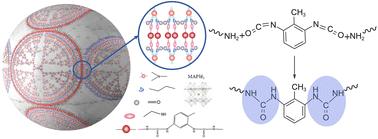
In this study, the stability and flexibility of fiber perovskite resistive random-access memory (FP-RRAM) were optimized via a 3D urea-spherical dendritic framework, which was produced using amino-terminal PAMAM and toluene diisocyanate (TDI). Spherical dendritic PAMAM optimized the perovskite crystallization process in the precursor solution. Next, TDI was added to an anti-solvent to establish the 3D urea-spherical dendritic framework via strong covalent bonds. This covalently connected 3D framework was used as a crystallization template in this work to obtain a more uniform and smoother perovskite morphology. Meanwhile, the urea components protect the surface of the perovskite device, affording better stability and flexibility. When 2 mol L−1 PAMAM in the perovskite precursor solution and 10% TDI in the anti-solvent were applied, the RRAM device modified using the covalently constructed 3D framework (cf-RRAM) achieved optimal resistive switching (RS) performance with an ON/OFF ratio of 108, 500 cycles and a data retention time of 104 s. This optimized RS performance provides the potential to construct a woven and multi-storage device, implying high-density storage. In the exploration of cf-RRAM flexibility, the ON/OFF ratio of the perovskite film was still maintained when the elongation at break reached 28.91% or after bending 400 times at a radius of 5 mm. The loss of RS performance of cf-RRAM devices was less even under frictional conditions. In the exploration of cf-RRAM stability, the devices could withstand a high-temperature environment below 200 °C and maintained good RS performance after 90 day exposure to the ambient environment.
期刊介绍:
The Journal of Materials Chemistry A, B & C covers a wide range of high-quality studies in the field of materials chemistry, with each section focusing on specific applications of the materials studied. Journal of Materials Chemistry A emphasizes applications in energy and sustainability, including topics such as artificial photosynthesis, batteries, and fuel cells. Journal of Materials Chemistry B focuses on applications in biology and medicine, while Journal of Materials Chemistry C covers applications in optical, magnetic, and electronic devices. Example topic areas within the scope of Journal of Materials Chemistry A include catalysis, green/sustainable materials, sensors, and water treatment, among others.




 京公网安备 11010802042870号
京ICP备2023020795号-1
京公网安备 11010802042870号
京ICP备2023020795号-1

 分享
分享
 求助内容:
求助内容: 应助结果提醒方式:
 扫码关注我们
