David Lledó, Guillermo Grindlay, H. Q. Nimal Gunaratne, Abel de Cózar, Ana Sirvent and José M. Sansano
{"title":"环丙沙星衍生任务特定离子液体作为钍与铀的高选择性萃取剂","authors":"David Lledó, Guillermo Grindlay, H. Q. Nimal Gunaratne, Abel de Cózar, Ana Sirvent and José M. Sansano","doi":"10.1039/D4TA06496H","DOIUrl":null,"url":null,"abstract":"<p >A selective extraction system of thorium(<small>IV</small>), formed with a TSIL derived from ciprofloxacin and [BMIM][NTf<small><sub>2</sub></small>] as a co-solvent, is described. Under acidic conditions, this IL solution was able to complex selectively this metal <em>versus</em> the rest of the other metals of the periodic table. The synthesis of the TSIL was detailed using known procedures and it was isolated in good overall yield. The extraction coefficients (K) were determined by a microextractive survey at 25 °C. Spectroscopic analyses of thorium(<small>IV</small>) and uranium(<small>VI</small>) complexes were performed in order to demonstrate the strength of the metal–TSIL interaction, which was supported by DFT-based computational optimization of the formation of the experimentally observed complexes. Kinetic analysis, loading tests for the extractive protocol, and the optimization for recycling were also performed to justify the conditions of a laboratory prototype for this selective extraction of thorium(<small>IV</small>) salts.</p>","PeriodicalId":82,"journal":{"name":"Journal of Materials Chemistry A","volume":" 45","pages":" 31557-31569"},"PeriodicalIF":9.2000,"publicationDate":"2024-10-23","publicationTypes":"Journal Article","fieldsOfStudy":null,"isOpenAccess":false,"openAccessPdf":"https://pubs.rsc.org/en/content/articlepdf/2024/ta/d4ta06496h?page=search","citationCount":"0","resultStr":"{\"title\":\"A ciprofloxacin derived task specific ionic liquid as a highly selective extractant of thorium versus uranium†‡\",\"authors\":\"David Lledó, Guillermo Grindlay, H. Q. Nimal Gunaratne, Abel de Cózar, Ana Sirvent and José M. Sansano\",\"doi\":\"10.1039/D4TA06496H\",\"DOIUrl\":null,\"url\":null,\"abstract\":\"<p >A selective extraction system of thorium(<small>IV</small>), formed with a TSIL derived from ciprofloxacin and [BMIM][NTf<small><sub>2</sub></small>] as a co-solvent, is described. Under acidic conditions, this IL solution was able to complex selectively this metal <em>versus</em> the rest of the other metals of the periodic table. The synthesis of the TSIL was detailed using known procedures and it was isolated in good overall yield. The extraction coefficients (K) were determined by a microextractive survey at 25 °C. Spectroscopic analyses of thorium(<small>IV</small>) and uranium(<small>VI</small>) complexes were performed in order to demonstrate the strength of the metal–TSIL interaction, which was supported by DFT-based computational optimization of the formation of the experimentally observed complexes. Kinetic analysis, loading tests for the extractive protocol, and the optimization for recycling were also performed to justify the conditions of a laboratory prototype for this selective extraction of thorium(<small>IV</small>) salts.</p>\",\"PeriodicalId\":82,\"journal\":{\"name\":\"Journal of Materials Chemistry A\",\"volume\":\" 45\",\"pages\":\" 31557-31569\"},\"PeriodicalIF\":9.2000,\"publicationDate\":\"2024-10-23\",\"publicationTypes\":\"Journal Article\",\"fieldsOfStudy\":null,\"isOpenAccess\":false,\"openAccessPdf\":\"https://pubs.rsc.org/en/content/articlepdf/2024/ta/d4ta06496h?page=search\",\"citationCount\":\"0\",\"resultStr\":null,\"platform\":\"Semanticscholar\",\"paperid\":null,\"PeriodicalName\":\"Journal of Materials Chemistry A\",\"FirstCategoryId\":\"88\",\"ListUrlMain\":\"https://pubs.rsc.org/en/content/articlelanding/2024/ta/d4ta06496h\",\"RegionNum\":2,\"RegionCategory\":\"材料科学\",\"ArticlePicture\":[],\"TitleCN\":null,\"AbstractTextCN\":null,\"PMCID\":null,\"EPubDate\":\"\",\"PubModel\":\"\",\"JCR\":\"Q1\",\"JCRName\":\"CHEMISTRY, PHYSICAL\",\"Score\":null,\"Total\":0}","platform":"Semanticscholar","paperid":null,"PeriodicalName":"Journal of Materials Chemistry A","FirstCategoryId":"88","ListUrlMain":"https://pubs.rsc.org/en/content/articlelanding/2024/ta/d4ta06496h","RegionNum":2,"RegionCategory":"材料科学","ArticlePicture":[],"TitleCN":null,"AbstractTextCN":null,"PMCID":null,"EPubDate":"","PubModel":"","JCR":"Q1","JCRName":"CHEMISTRY, PHYSICAL","Score":null,"Total":0}
引用次数: 0
摘要
本文介绍了一种钍(IV)选择性萃取系统,该系统由环丙沙星衍生的 TSIL 和作为辅助溶剂的 [BMIM][NTf2] 构成。在酸性条件下,这种 IL 溶液能够选择性地络合这种金属而不是元素周期表中的其他金属。使用已知程序详细合成了 TSIL,并以良好的总产率分离出来。萃取系数 (K) 是在 25 °C 下通过微萃取调查确定的。对钍(IV)和铀(IV)络合物进行了光谱分析,以证明金属-TSIL 相互作用的强度。此外,还进行了动力学分析、萃取方案的负载测试以及循环优化,以证明实验室原型对钍(IV)盐选择性萃取的条件是合理的。
A ciprofloxacin derived task specific ionic liquid as a highly selective extractant of thorium versus uranium†‡
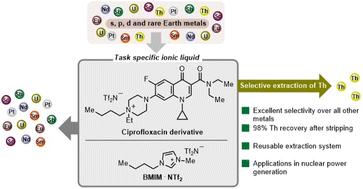
A selective extraction system of thorium(IV), formed with a TSIL derived from ciprofloxacin and [BMIM][NTf2] as a co-solvent, is described. Under acidic conditions, this IL solution was able to complex selectively this metal versus the rest of the other metals of the periodic table. The synthesis of the TSIL was detailed using known procedures and it was isolated in good overall yield. The extraction coefficients (K) were determined by a microextractive survey at 25 °C. Spectroscopic analyses of thorium(IV) and uranium(VI) complexes were performed in order to demonstrate the strength of the metal–TSIL interaction, which was supported by DFT-based computational optimization of the formation of the experimentally observed complexes. Kinetic analysis, loading tests for the extractive protocol, and the optimization for recycling were also performed to justify the conditions of a laboratory prototype for this selective extraction of thorium(IV) salts.
期刊介绍:
The Journal of Materials Chemistry A, B & C covers a wide range of high-quality studies in the field of materials chemistry, with each section focusing on specific applications of the materials studied. Journal of Materials Chemistry A emphasizes applications in energy and sustainability, including topics such as artificial photosynthesis, batteries, and fuel cells. Journal of Materials Chemistry B focuses on applications in biology and medicine, while Journal of Materials Chemistry C covers applications in optical, magnetic, and electronic devices. Example topic areas within the scope of Journal of Materials Chemistry A include catalysis, green/sustainable materials, sensors, and water treatment, among others.




 京公网安备 11010802042870号
京ICP备2023020795号-1
京公网安备 11010802042870号
京ICP备2023020795号-1

 分享
分享
 求助内容:
求助内容: 应助结果提醒方式:
 扫码关注我们
