{"title":"通过点对点多输入多输出信道实现巨容量的最佳双极化平面阵列","authors":"Amna Irshad;Alva Kosasih;Emil Björnson;Luca Sanguinetti","doi":"10.1109/TWC.2024.3482462","DOIUrl":null,"url":null,"abstract":"Future wireless networks must provide ever higher data rates. The available bandwidth increases roughly linearly as we increase the carrier frequency, but the range shrinks drastically. This paper explores if we can instead reach massive capacities using spatial multiplexing over multiple-input multiple-output (MIMO) channels. In line-of-sight (LOS) scenarios, the rank of the MIMO channel matrix depends on the polarization and antenna arrangement. We optimize the rank and condition number by identifying the optimal antenna spacing in dual-polarized planar antenna arrays with imperfect isolation. The result is sparsely spaced antenna arrays that exploit radiative near-field properties. We further optimize the array geometry for minimum aperture length and aperture area, which leads to different configurations. Moreover, we prove analytically that for fixed-sized arrays, the MIMO rank grows quadratically with the carrier frequency in LOS scenarios, if the antennas are appropriately designed. Hence, MIMO technology contributes more to the capacity growth than the bandwidth. The numerical results show that massive data rates, far beyond 1 Tbps, can be reached both over fixed and mobile point-to-point links. It is also possible for a large base station to serve a practically-sized mobile device.","PeriodicalId":13431,"journal":{"name":"IEEE Transactions on Wireless Communications","volume":"23 12","pages":"19350-19364"},"PeriodicalIF":10.7000,"publicationDate":"2024-10-24","publicationTypes":"Journal Article","fieldsOfStudy":null,"isOpenAccess":false,"openAccessPdf":"https://ieeexplore.ieee.org/stamp/stamp.jsp?tp=&arnumber=10735098","citationCount":"0","resultStr":"{\"title\":\"Optimal Dual-Polarized Planar Arrays for Massive Capacity Over Point-to-Point MIMO Channels\",\"authors\":\"Amna Irshad;Alva Kosasih;Emil Björnson;Luca Sanguinetti\",\"doi\":\"10.1109/TWC.2024.3482462\",\"DOIUrl\":null,\"url\":null,\"abstract\":\"Future wireless networks must provide ever higher data rates. The available bandwidth increases roughly linearly as we increase the carrier frequency, but the range shrinks drastically. This paper explores if we can instead reach massive capacities using spatial multiplexing over multiple-input multiple-output (MIMO) channels. In line-of-sight (LOS) scenarios, the rank of the MIMO channel matrix depends on the polarization and antenna arrangement. We optimize the rank and condition number by identifying the optimal antenna spacing in dual-polarized planar antenna arrays with imperfect isolation. The result is sparsely spaced antenna arrays that exploit radiative near-field properties. We further optimize the array geometry for minimum aperture length and aperture area, which leads to different configurations. Moreover, we prove analytically that for fixed-sized arrays, the MIMO rank grows quadratically with the carrier frequency in LOS scenarios, if the antennas are appropriately designed. Hence, MIMO technology contributes more to the capacity growth than the bandwidth. The numerical results show that massive data rates, far beyond 1 Tbps, can be reached both over fixed and mobile point-to-point links. It is also possible for a large base station to serve a practically-sized mobile device.\",\"PeriodicalId\":13431,\"journal\":{\"name\":\"IEEE Transactions on Wireless Communications\",\"volume\":\"23 12\",\"pages\":\"19350-19364\"},\"PeriodicalIF\":10.7000,\"publicationDate\":\"2024-10-24\",\"publicationTypes\":\"Journal Article\",\"fieldsOfStudy\":null,\"isOpenAccess\":false,\"openAccessPdf\":\"https://ieeexplore.ieee.org/stamp/stamp.jsp?tp=&arnumber=10735098\",\"citationCount\":\"0\",\"resultStr\":null,\"platform\":\"Semanticscholar\",\"paperid\":null,\"PeriodicalName\":\"IEEE Transactions on Wireless Communications\",\"FirstCategoryId\":\"94\",\"ListUrlMain\":\"https://ieeexplore.ieee.org/document/10735098/\",\"RegionNum\":1,\"RegionCategory\":\"计算机科学\",\"ArticlePicture\":[],\"TitleCN\":null,\"AbstractTextCN\":null,\"PMCID\":null,\"EPubDate\":\"\",\"PubModel\":\"\",\"JCR\":\"Q1\",\"JCRName\":\"ENGINEERING, ELECTRICAL & ELECTRONIC\",\"Score\":null,\"Total\":0}","platform":"Semanticscholar","paperid":null,"PeriodicalName":"IEEE Transactions on Wireless Communications","FirstCategoryId":"94","ListUrlMain":"https://ieeexplore.ieee.org/document/10735098/","RegionNum":1,"RegionCategory":"计算机科学","ArticlePicture":[],"TitleCN":null,"AbstractTextCN":null,"PMCID":null,"EPubDate":"","PubModel":"","JCR":"Q1","JCRName":"ENGINEERING, ELECTRICAL & ELECTRONIC","Score":null,"Total":0}
Optimal Dual-Polarized Planar Arrays for Massive Capacity Over Point-to-Point MIMO Channels
Future wireless networks must provide ever higher data rates. The available bandwidth increases roughly linearly as we increase the carrier frequency, but the range shrinks drastically. This paper explores if we can instead reach massive capacities using spatial multiplexing over multiple-input multiple-output (MIMO) channels. In line-of-sight (LOS) scenarios, the rank of the MIMO channel matrix depends on the polarization and antenna arrangement. We optimize the rank and condition number by identifying the optimal antenna spacing in dual-polarized planar antenna arrays with imperfect isolation. The result is sparsely spaced antenna arrays that exploit radiative near-field properties. We further optimize the array geometry for minimum aperture length and aperture area, which leads to different configurations. Moreover, we prove analytically that for fixed-sized arrays, the MIMO rank grows quadratically with the carrier frequency in LOS scenarios, if the antennas are appropriately designed. Hence, MIMO technology contributes more to the capacity growth than the bandwidth. The numerical results show that massive data rates, far beyond 1 Tbps, can be reached both over fixed and mobile point-to-point links. It is also possible for a large base station to serve a practically-sized mobile device.
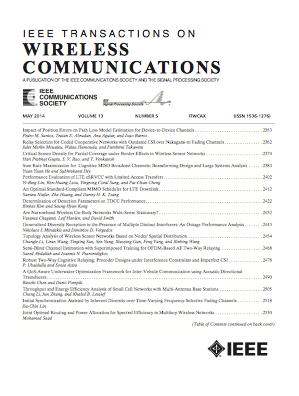
期刊介绍:
The IEEE Transactions on Wireless Communications is a prestigious publication that showcases cutting-edge advancements in wireless communications. It welcomes both theoretical and practical contributions in various areas. The scope of the Transactions encompasses a wide range of topics, including modulation and coding, detection and estimation, propagation and channel characterization, and diversity techniques. The journal also emphasizes the physical and link layer communication aspects of network architectures and protocols.
The journal is open to papers on specific topics or non-traditional topics related to specific application areas. This includes simulation tools and methodologies, orthogonal frequency division multiplexing, MIMO systems, and wireless over optical technologies.
Overall, the IEEE Transactions on Wireless Communications serves as a platform for high-quality manuscripts that push the boundaries of wireless communications and contribute to advancements in the field.



 京公网安备 11010802042870号
京ICP备2023020795号-1
京公网安备 11010802042870号
京ICP备2023020795号-1

 分享
分享
 求助内容:
求助内容: 应助结果提醒方式:
 扫码关注我们
