Ian C. Anderson, Darwin C. Gomez, Meijing Zhang, Stephen J. Koehler, Prof. C. Adrian Figg
{"title":"利用具有固有光活性的肌红蛋白锌催化 PET-RAFT 聚合反应。","authors":"Ian C. Anderson, Darwin C. Gomez, Meijing Zhang, Stephen J. Koehler, Prof. C. Adrian Figg","doi":"10.1002/anie.202414431","DOIUrl":null,"url":null,"abstract":"<p>Protein photocatalysts provide a modular platform to access new reaction pathways and affect product outcomes, but their use in polymer synthesis is limited because co-catalysts and/or co-reductants are required to complete catalytic cycles. Herein, we report using zinc myoglobin (ZnMb), an inherently photoactive protein, to mediate photoinduced electron/energy transfer (PET) reversible addition-fragmentation chain transfer (RAFT) polymerizations. Using ZnMb as the sole reagent for catalysis, photomediated polymerizations of <i>N</i>,<i>N</i>-dimethylacrylamide in PBS were achieved with predictable molecular weights, dispersity values approaching 1.1, and high chain-end fidelity. We found that initial apparent rate constants of polymerization increased from 4.6×10⁻⁵ s<sup>−1</sup> for zinc mesoporpyhrin IX (ZnMIX) to 6.5×10⁻⁵ s<sup>−1</sup> when ZnMIX was incorporated into myoglobin to yield ZnMb, indicating that the protein binding site enhanced catalytic activity. Chain extension reactions comparing ZnMb-mediated RAFT polymerizations to thermally-initiated RAFT polymerizations showed minimal differences in block copolymer molecular weights and dispersities. This work enables studies to elucidate how protein modifications (e.g., secondary structure folding, site-directed mutagenesis, directed evolution) can be used to modulate polymerization outcomes (e.g., selective monomer additions towards sequence control, tacticity control, molar mass distributions).</p>","PeriodicalId":125,"journal":{"name":"Angewandte Chemie International Edition","volume":"64 2","pages":""},"PeriodicalIF":17.6000,"publicationDate":"2024-10-29","publicationTypes":"Journal Article","fieldsOfStudy":null,"isOpenAccess":false,"openAccessPdf":"https://www.ncbi.nlm.nih.gov/pmc/articles/PMC11720391/pdf/","citationCount":"0","resultStr":"{\"title\":\"Catalyzing PET-RAFT Polymerizations Using Inherently Photoactive Zinc Myoglobin\",\"authors\":\"Ian C. Anderson, Darwin C. Gomez, Meijing Zhang, Stephen J. Koehler, Prof. C. Adrian Figg\",\"doi\":\"10.1002/anie.202414431\",\"DOIUrl\":null,\"url\":null,\"abstract\":\"<p>Protein photocatalysts provide a modular platform to access new reaction pathways and affect product outcomes, but their use in polymer synthesis is limited because co-catalysts and/or co-reductants are required to complete catalytic cycles. Herein, we report using zinc myoglobin (ZnMb), an inherently photoactive protein, to mediate photoinduced electron/energy transfer (PET) reversible addition-fragmentation chain transfer (RAFT) polymerizations. Using ZnMb as the sole reagent for catalysis, photomediated polymerizations of <i>N</i>,<i>N</i>-dimethylacrylamide in PBS were achieved with predictable molecular weights, dispersity values approaching 1.1, and high chain-end fidelity. We found that initial apparent rate constants of polymerization increased from 4.6×10⁻⁵ s<sup>−1</sup> for zinc mesoporpyhrin IX (ZnMIX) to 6.5×10⁻⁵ s<sup>−1</sup> when ZnMIX was incorporated into myoglobin to yield ZnMb, indicating that the protein binding site enhanced catalytic activity. Chain extension reactions comparing ZnMb-mediated RAFT polymerizations to thermally-initiated RAFT polymerizations showed minimal differences in block copolymer molecular weights and dispersities. This work enables studies to elucidate how protein modifications (e.g., secondary structure folding, site-directed mutagenesis, directed evolution) can be used to modulate polymerization outcomes (e.g., selective monomer additions towards sequence control, tacticity control, molar mass distributions).</p>\",\"PeriodicalId\":125,\"journal\":{\"name\":\"Angewandte Chemie International Edition\",\"volume\":\"64 2\",\"pages\":\"\"},\"PeriodicalIF\":17.6000,\"publicationDate\":\"2024-10-29\",\"publicationTypes\":\"Journal Article\",\"fieldsOfStudy\":null,\"isOpenAccess\":false,\"openAccessPdf\":\"https://www.ncbi.nlm.nih.gov/pmc/articles/PMC11720391/pdf/\",\"citationCount\":\"0\",\"resultStr\":null,\"platform\":\"Semanticscholar\",\"paperid\":null,\"PeriodicalName\":\"Angewandte Chemie International Edition\",\"FirstCategoryId\":\"92\",\"ListUrlMain\":\"https://onlinelibrary.wiley.com/doi/10.1002/anie.202414431\",\"RegionNum\":1,\"RegionCategory\":\"化学\",\"ArticlePicture\":[],\"TitleCN\":null,\"AbstractTextCN\":null,\"PMCID\":null,\"EPubDate\":\"\",\"PubModel\":\"\",\"JCR\":\"Q1\",\"JCRName\":\"CHEMISTRY, MULTIDISCIPLINARY\",\"Score\":null,\"Total\":0}","platform":"Semanticscholar","paperid":null,"PeriodicalName":"Angewandte Chemie International Edition","FirstCategoryId":"92","ListUrlMain":"https://onlinelibrary.wiley.com/doi/10.1002/anie.202414431","RegionNum":1,"RegionCategory":"化学","ArticlePicture":[],"TitleCN":null,"AbstractTextCN":null,"PMCID":null,"EPubDate":"","PubModel":"","JCR":"Q1","JCRName":"CHEMISTRY, MULTIDISCIPLINARY","Score":null,"Total":0}
Catalyzing PET-RAFT Polymerizations Using Inherently Photoactive Zinc Myoglobin
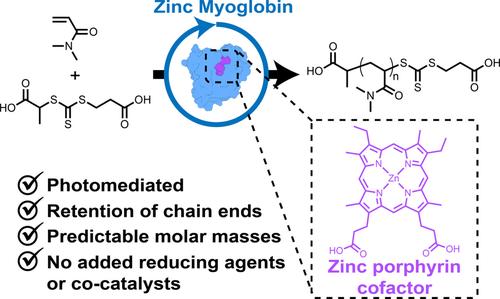
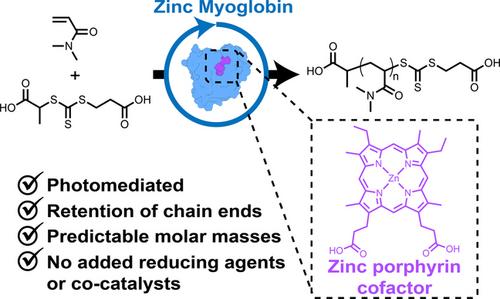
Protein photocatalysts provide a modular platform to access new reaction pathways and affect product outcomes, but their use in polymer synthesis is limited because co-catalysts and/or co-reductants are required to complete catalytic cycles. Herein, we report using zinc myoglobin (ZnMb), an inherently photoactive protein, to mediate photoinduced electron/energy transfer (PET) reversible addition-fragmentation chain transfer (RAFT) polymerizations. Using ZnMb as the sole reagent for catalysis, photomediated polymerizations of N,N-dimethylacrylamide in PBS were achieved with predictable molecular weights, dispersity values approaching 1.1, and high chain-end fidelity. We found that initial apparent rate constants of polymerization increased from 4.6×10⁻⁵ s−1 for zinc mesoporpyhrin IX (ZnMIX) to 6.5×10⁻⁵ s−1 when ZnMIX was incorporated into myoglobin to yield ZnMb, indicating that the protein binding site enhanced catalytic activity. Chain extension reactions comparing ZnMb-mediated RAFT polymerizations to thermally-initiated RAFT polymerizations showed minimal differences in block copolymer molecular weights and dispersities. This work enables studies to elucidate how protein modifications (e.g., secondary structure folding, site-directed mutagenesis, directed evolution) can be used to modulate polymerization outcomes (e.g., selective monomer additions towards sequence control, tacticity control, molar mass distributions).
期刊介绍:
Angewandte Chemie, a journal of the German Chemical Society (GDCh), maintains a leading position among scholarly journals in general chemistry with an impressive Impact Factor of 16.6 (2022 Journal Citation Reports, Clarivate, 2023). Published weekly in a reader-friendly format, it features new articles almost every day. Established in 1887, Angewandte Chemie is a prominent chemistry journal, offering a dynamic blend of Review-type articles, Highlights, Communications, and Research Articles on a weekly basis, making it unique in the field.




 京公网安备 11010802042870号
京ICP备2023020795号-1
京公网安备 11010802042870号
京ICP备2023020795号-1

 分享
分享
 求助内容:
求助内容: 应助结果提醒方式:
 扫码关注我们
