{"title":"2024 AA 阿尔茨海默病诊断标准:主要锚定于 Aβ 而非 tau。","authors":"Alexis Moscoso, Nicolas Villain","doi":"10.1002/alz.14340","DOIUrl":null,"url":null,"abstract":"<p>We were particularly interested in the 2024 Revised Criteria for Diagnosis and Staging of Alzheimer's Disease (AD) from the Alzheimer's Association (AA) workgroup. These criteria seek to update the biological definition of AD, originally introduced in 2011, to inform both research and clinical care.<span><sup>1</sup></span> The proposal of a formal transition from a clinico-biological to a purely biological disease definition marks a significant historical and epistemological shift,<span><sup>2</sup></span> placing greater emphasis on the threshold of pathologic changes that distinguish between normality and disease, without relying on clinical factors. However, establishing this threshold and the corresponding pathological anchors poses various challenges.</p><p>The Revised Criteria define AD as “a biological process that begins with the appearance of AD neuropathologic change.”<span><sup>1</sup></span> According to the National Institute on Aging–AA guidelines for the neuropathologic assessment of AD,<span><sup>3</sup></span> the very first AD neuropathologic changes correspond to a Thal amyloid beta (Aβ) plaque score of 1, which includes neuritic and non-neuritic plaques, in the absence or presence of neurofibrillary tangles. Therefore, the Revised Criteria implicitly establish the theoretical threshold between normality and AD based exclusively on the presence of Aβ aggregates, regardless of neurofibrillary tangles. The Revised Criteria are the first to anchor the AD definition at a biological model recognizing the precedence of Aβ over tau pathology: the Aβ cascade hypothesis.<span><sup>4</sup></span></p><p>The Revised Criteria establishes a positive visual read on an Aβ positron emission tomography (PET) scan, along with several “Core 1 Biomarkers” validated against Aβ PET, as the new gold standard for AD diagnosis. To justify that the operationalization of this definition of AD does not deviate from the historical definition based on Aβ plaques and tangles, the authors claim that Aβ positivity on PET reflects not only Aβ plaques but also, in the majority of cases, Braak stages ≥ III. To justify this statement, the authors used data from the National Alzheimer's Coordinating Center (NACC; <i>n</i> = 252) and the Arizona Study of Aging and Neurodegenerative Disorders and Brain and Body Donation Program (<i>n</i> = 123) neuropathologic cohorts. They found that 74% and 87%, respectively, of the unimpaired individuals with moderate/frequent Consortium to Establish a Registry for Alzheimer's Disease (CERAD) scores of neuritic Aβ plaques also had Braak stage ≥ III, supporting their claim that Aβ PET positivity (moderate/frequent CERAD scores) corresponds to both plaques and tangles. However, because the prevalence of Braak stages ≥ III increases with age independent of Aβ,<span><sup>5</sup></span> we questioned whether the advanced average age of the individuals included in the neuropathologic cohorts used by the authors (≈ 86.5 years in the NACC sample) could have contributed to the high proportion of individuals with Braak stages ≥ III. A logistic regression analysis in the NACC sample of unimpaired individuals (Clinical Dementia Rating = 0 within 1 year of death, <i>n</i> = 154) with moderate/frequent CERAD scores shows that the proportion of individuals with Braak stages ≥ III significantly increased with age (b = 0.062 y<sup>−1</sup>, <i>P</i> = 0.005, Figure 1A). To estimate the actual proportion of Aβ PET–positive unimpaired individuals with Braak stages ≥ III worldwide, we combined previously published estimates of the age distribution of Aβ PET–positive cognitively unimpaired individuals<span><sup>6</sup></span> with our estimates of the age-specific prevalence of Braak stages ≥ III in this population. We found that, out of the previously estimated ≈ 315 million Aβ PET–positive unimpaired persons aged > 50 worldwide, only 113 million (36%, 95% confidence interval [21% to 58%]) have Braak stages III through VI (Figure 1B). Therefore, the operationalization of the earliest stages of the Revised Criteria, involving cognitively unimpaired individuals, will result in a majority (≈ 64%) of none-to-low levels of tau pathology and low levels of AD neuropathologic change. These findings contradict the Revised Criteria's statement on the intermediate-to-high levels of pathological correlates of Aβ PET positivity in the cognitively unimpaired population.</p><p>In summary, the early stages of the Revised Criteria are primarily anchored at Aβ aggregates and not tangles. The Revised Criteria challenge long-standing perspectives emphasizing the combination of Aβ and tau pathology at high levels as defining features of AD.<span><sup>2</sup></span> The present discussion highlights the difficulties in establishing anchors and thresholds when relying on a purely biological disease concept without clinical context. The example of neuropathologists moving away from setting thresholds to define AD<span><sup>7</sup></span> and instead setting mere levels of AD neuropathologic changes<span><sup>3</sup></span> illustrates the inherent challenge of relying purely on a pathological threshold for disease definition.</p><p>The authors declare no conflicts of interest. Independent of this work, NV received research support from Fondation Bettencourt-Schueller, Fondation Servier, Union Nationale pour les Intérêts de la Médecine (UNIM), Fondation Claude Pompidou, Fondation Alzheimer, Banque Publique d'Investissement and Fondation pour la Recherche sur l'Alzheimer; travel grant from the Movement Disorders Society, Merz-Pharma, UCB Pharma, and GE Healthcare SAS; is an unpaid local principal investigator or sub-investigator in NCT04241068 and NCT05310071 (aducanumab, Biogen), NCT05399888 (BIIB080, Biogen), NCT03352557 (gosuranemab, Biogen), NCT05463731 (remternetug, Eli-Lilly), NCT04592341 (gantenerumab, Roche), NCT03887455 (lecanemab, Eisai), NCT03828747 and NCT03289143 (semorinemab, Roche), NCT04619420 (JNJ-63733657, Janssen – Johnson & Johnson), NCT04374136 (AL001, Alector), NCT04592874 (AL002, Alector), NCT04867616 (bepranemab, UCB Pharma), NCT04777396 and NCT04777409 (semaglutide, Novo Nordisk), NCT05469360 (NIO752, Novartis); is an unpaid national coordinator for NCT05564169 (masitinib, ABScience) and NCT (AD04, ADvantage Therapeutics GmbH); has given unpaid lectures in symposia organized by Eisai and the Servier Foundation; has been an unpaid expert for Janssen – Johnson & Johnson. Author disclosures are available in the supporting information.</p><p>Not required.</p>","PeriodicalId":7471,"journal":{"name":"Alzheimer's & Dementia","volume":"20 12","pages":"9079-9081"},"PeriodicalIF":12.8000,"publicationDate":"2024-10-29","publicationTypes":"Journal Article","fieldsOfStudy":null,"isOpenAccess":false,"openAccessPdf":"https://www.ncbi.nlm.nih.gov/pmc/articles/PMC11667487/pdf/","citationCount":"0","resultStr":"{\"title\":\"2024 AA criteria for Alzheimer's disease diagnosis: Mainly anchored at Aβ not tau\",\"authors\":\"Alexis Moscoso, Nicolas Villain\",\"doi\":\"10.1002/alz.14340\",\"DOIUrl\":null,\"url\":null,\"abstract\":\"<p>We were particularly interested in the 2024 Revised Criteria for Diagnosis and Staging of Alzheimer's Disease (AD) from the Alzheimer's Association (AA) workgroup. These criteria seek to update the biological definition of AD, originally introduced in 2011, to inform both research and clinical care.<span><sup>1</sup></span> The proposal of a formal transition from a clinico-biological to a purely biological disease definition marks a significant historical and epistemological shift,<span><sup>2</sup></span> placing greater emphasis on the threshold of pathologic changes that distinguish between normality and disease, without relying on clinical factors. However, establishing this threshold and the corresponding pathological anchors poses various challenges.</p><p>The Revised Criteria define AD as “a biological process that begins with the appearance of AD neuropathologic change.”<span><sup>1</sup></span> According to the National Institute on Aging–AA guidelines for the neuropathologic assessment of AD,<span><sup>3</sup></span> the very first AD neuropathologic changes correspond to a Thal amyloid beta (Aβ) plaque score of 1, which includes neuritic and non-neuritic plaques, in the absence or presence of neurofibrillary tangles. Therefore, the Revised Criteria implicitly establish the theoretical threshold between normality and AD based exclusively on the presence of Aβ aggregates, regardless of neurofibrillary tangles. The Revised Criteria are the first to anchor the AD definition at a biological model recognizing the precedence of Aβ over tau pathology: the Aβ cascade hypothesis.<span><sup>4</sup></span></p><p>The Revised Criteria establishes a positive visual read on an Aβ positron emission tomography (PET) scan, along with several “Core 1 Biomarkers” validated against Aβ PET, as the new gold standard for AD diagnosis. To justify that the operationalization of this definition of AD does not deviate from the historical definition based on Aβ plaques and tangles, the authors claim that Aβ positivity on PET reflects not only Aβ plaques but also, in the majority of cases, Braak stages ≥ III. To justify this statement, the authors used data from the National Alzheimer's Coordinating Center (NACC; <i>n</i> = 252) and the Arizona Study of Aging and Neurodegenerative Disorders and Brain and Body Donation Program (<i>n</i> = 123) neuropathologic cohorts. They found that 74% and 87%, respectively, of the unimpaired individuals with moderate/frequent Consortium to Establish a Registry for Alzheimer's Disease (CERAD) scores of neuritic Aβ plaques also had Braak stage ≥ III, supporting their claim that Aβ PET positivity (moderate/frequent CERAD scores) corresponds to both plaques and tangles. However, because the prevalence of Braak stages ≥ III increases with age independent of Aβ,<span><sup>5</sup></span> we questioned whether the advanced average age of the individuals included in the neuropathologic cohorts used by the authors (≈ 86.5 years in the NACC sample) could have contributed to the high proportion of individuals with Braak stages ≥ III. A logistic regression analysis in the NACC sample of unimpaired individuals (Clinical Dementia Rating = 0 within 1 year of death, <i>n</i> = 154) with moderate/frequent CERAD scores shows that the proportion of individuals with Braak stages ≥ III significantly increased with age (b = 0.062 y<sup>−1</sup>, <i>P</i> = 0.005, Figure 1A). To estimate the actual proportion of Aβ PET–positive unimpaired individuals with Braak stages ≥ III worldwide, we combined previously published estimates of the age distribution of Aβ PET–positive cognitively unimpaired individuals<span><sup>6</sup></span> with our estimates of the age-specific prevalence of Braak stages ≥ III in this population. We found that, out of the previously estimated ≈ 315 million Aβ PET–positive unimpaired persons aged > 50 worldwide, only 113 million (36%, 95% confidence interval [21% to 58%]) have Braak stages III through VI (Figure 1B). Therefore, the operationalization of the earliest stages of the Revised Criteria, involving cognitively unimpaired individuals, will result in a majority (≈ 64%) of none-to-low levels of tau pathology and low levels of AD neuropathologic change. These findings contradict the Revised Criteria's statement on the intermediate-to-high levels of pathological correlates of Aβ PET positivity in the cognitively unimpaired population.</p><p>In summary, the early stages of the Revised Criteria are primarily anchored at Aβ aggregates and not tangles. The Revised Criteria challenge long-standing perspectives emphasizing the combination of Aβ and tau pathology at high levels as defining features of AD.<span><sup>2</sup></span> The present discussion highlights the difficulties in establishing anchors and thresholds when relying on a purely biological disease concept without clinical context. The example of neuropathologists moving away from setting thresholds to define AD<span><sup>7</sup></span> and instead setting mere levels of AD neuropathologic changes<span><sup>3</sup></span> illustrates the inherent challenge of relying purely on a pathological threshold for disease definition.</p><p>The authors declare no conflicts of interest. Independent of this work, NV received research support from Fondation Bettencourt-Schueller, Fondation Servier, Union Nationale pour les Intérêts de la Médecine (UNIM), Fondation Claude Pompidou, Fondation Alzheimer, Banque Publique d'Investissement and Fondation pour la Recherche sur l'Alzheimer; travel grant from the Movement Disorders Society, Merz-Pharma, UCB Pharma, and GE Healthcare SAS; is an unpaid local principal investigator or sub-investigator in NCT04241068 and NCT05310071 (aducanumab, Biogen), NCT05399888 (BIIB080, Biogen), NCT03352557 (gosuranemab, Biogen), NCT05463731 (remternetug, Eli-Lilly), NCT04592341 (gantenerumab, Roche), NCT03887455 (lecanemab, Eisai), NCT03828747 and NCT03289143 (semorinemab, Roche), NCT04619420 (JNJ-63733657, Janssen – Johnson & Johnson), NCT04374136 (AL001, Alector), NCT04592874 (AL002, Alector), NCT04867616 (bepranemab, UCB Pharma), NCT04777396 and NCT04777409 (semaglutide, Novo Nordisk), NCT05469360 (NIO752, Novartis); is an unpaid national coordinator for NCT05564169 (masitinib, ABScience) and NCT (AD04, ADvantage Therapeutics GmbH); has given unpaid lectures in symposia organized by Eisai and the Servier Foundation; has been an unpaid expert for Janssen – Johnson & Johnson. Author disclosures are available in the supporting information.</p><p>Not required.</p>\",\"PeriodicalId\":7471,\"journal\":{\"name\":\"Alzheimer's & Dementia\",\"volume\":\"20 12\",\"pages\":\"9079-9081\"},\"PeriodicalIF\":12.8000,\"publicationDate\":\"2024-10-29\",\"publicationTypes\":\"Journal Article\",\"fieldsOfStudy\":null,\"isOpenAccess\":false,\"openAccessPdf\":\"https://www.ncbi.nlm.nih.gov/pmc/articles/PMC11667487/pdf/\",\"citationCount\":\"0\",\"resultStr\":null,\"platform\":\"Semanticscholar\",\"paperid\":null,\"PeriodicalName\":\"Alzheimer's & Dementia\",\"FirstCategoryId\":\"3\",\"ListUrlMain\":\"https://alz-journals.onlinelibrary.wiley.com/doi/10.1002/alz.14340\",\"RegionNum\":1,\"RegionCategory\":\"医学\",\"ArticlePicture\":[],\"TitleCN\":null,\"AbstractTextCN\":null,\"PMCID\":null,\"EPubDate\":\"\",\"PubModel\":\"\",\"JCR\":\"Q1\",\"JCRName\":\"CLINICAL NEUROLOGY\",\"Score\":null,\"Total\":0}","platform":"Semanticscholar","paperid":null,"PeriodicalName":"Alzheimer's & Dementia","FirstCategoryId":"3","ListUrlMain":"https://alz-journals.onlinelibrary.wiley.com/doi/10.1002/alz.14340","RegionNum":1,"RegionCategory":"医学","ArticlePicture":[],"TitleCN":null,"AbstractTextCN":null,"PMCID":null,"EPubDate":"","PubModel":"","JCR":"Q1","JCRName":"CLINICAL NEUROLOGY","Score":null,"Total":0}
2024 AA criteria for Alzheimer's disease diagnosis: Mainly anchored at Aβ not tau
We were particularly interested in the 2024 Revised Criteria for Diagnosis and Staging of Alzheimer's Disease (AD) from the Alzheimer's Association (AA) workgroup. These criteria seek to update the biological definition of AD, originally introduced in 2011, to inform both research and clinical care.1 The proposal of a formal transition from a clinico-biological to a purely biological disease definition marks a significant historical and epistemological shift,2 placing greater emphasis on the threshold of pathologic changes that distinguish between normality and disease, without relying on clinical factors. However, establishing this threshold and the corresponding pathological anchors poses various challenges.
The Revised Criteria define AD as “a biological process that begins with the appearance of AD neuropathologic change.”1 According to the National Institute on Aging–AA guidelines for the neuropathologic assessment of AD,3 the very first AD neuropathologic changes correspond to a Thal amyloid beta (Aβ) plaque score of 1, which includes neuritic and non-neuritic plaques, in the absence or presence of neurofibrillary tangles. Therefore, the Revised Criteria implicitly establish the theoretical threshold between normality and AD based exclusively on the presence of Aβ aggregates, regardless of neurofibrillary tangles. The Revised Criteria are the first to anchor the AD definition at a biological model recognizing the precedence of Aβ over tau pathology: the Aβ cascade hypothesis.4
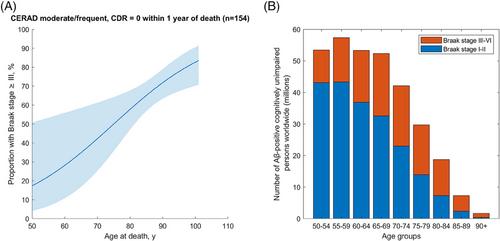
The Revised Criteria establishes a positive visual read on an Aβ positron emission tomography (PET) scan, along with several “Core 1 Biomarkers” validated against Aβ PET, as the new gold standard for AD diagnosis. To justify that the operationalization of this definition of AD does not deviate from the historical definition based on Aβ plaques and tangles, the authors claim that Aβ positivity on PET reflects not only Aβ plaques but also, in the majority of cases, Braak stages ≥ III. To justify this statement, the authors used data from the National Alzheimer's Coordinating Center (NACC; n = 252) and the Arizona Study of Aging and Neurodegenerative Disorders and Brain and Body Donation Program (n = 123) neuropathologic cohorts. They found that 74% and 87%, respectively, of the unimpaired individuals with moderate/frequent Consortium to Establish a Registry for Alzheimer's Disease (CERAD) scores of neuritic Aβ plaques also had Braak stage ≥ III, supporting their claim that Aβ PET positivity (moderate/frequent CERAD scores) corresponds to both plaques and tangles. However, because the prevalence of Braak stages ≥ III increases with age independent of Aβ,5 we questioned whether the advanced average age of the individuals included in the neuropathologic cohorts used by the authors (≈ 86.5 years in the NACC sample) could have contributed to the high proportion of individuals with Braak stages ≥ III. A logistic regression analysis in the NACC sample of unimpaired individuals (Clinical Dementia Rating = 0 within 1 year of death, n = 154) with moderate/frequent CERAD scores shows that the proportion of individuals with Braak stages ≥ III significantly increased with age (b = 0.062 y−1, P = 0.005, Figure 1A). To estimate the actual proportion of Aβ PET–positive unimpaired individuals with Braak stages ≥ III worldwide, we combined previously published estimates of the age distribution of Aβ PET–positive cognitively unimpaired individuals6 with our estimates of the age-specific prevalence of Braak stages ≥ III in this population. We found that, out of the previously estimated ≈ 315 million Aβ PET–positive unimpaired persons aged > 50 worldwide, only 113 million (36%, 95% confidence interval [21% to 58%]) have Braak stages III through VI (Figure 1B). Therefore, the operationalization of the earliest stages of the Revised Criteria, involving cognitively unimpaired individuals, will result in a majority (≈ 64%) of none-to-low levels of tau pathology and low levels of AD neuropathologic change. These findings contradict the Revised Criteria's statement on the intermediate-to-high levels of pathological correlates of Aβ PET positivity in the cognitively unimpaired population.
In summary, the early stages of the Revised Criteria are primarily anchored at Aβ aggregates and not tangles. The Revised Criteria challenge long-standing perspectives emphasizing the combination of Aβ and tau pathology at high levels as defining features of AD.2 The present discussion highlights the difficulties in establishing anchors and thresholds when relying on a purely biological disease concept without clinical context. The example of neuropathologists moving away from setting thresholds to define AD7 and instead setting mere levels of AD neuropathologic changes3 illustrates the inherent challenge of relying purely on a pathological threshold for disease definition.
The authors declare no conflicts of interest. Independent of this work, NV received research support from Fondation Bettencourt-Schueller, Fondation Servier, Union Nationale pour les Intérêts de la Médecine (UNIM), Fondation Claude Pompidou, Fondation Alzheimer, Banque Publique d'Investissement and Fondation pour la Recherche sur l'Alzheimer; travel grant from the Movement Disorders Society, Merz-Pharma, UCB Pharma, and GE Healthcare SAS; is an unpaid local principal investigator or sub-investigator in NCT04241068 and NCT05310071 (aducanumab, Biogen), NCT05399888 (BIIB080, Biogen), NCT03352557 (gosuranemab, Biogen), NCT05463731 (remternetug, Eli-Lilly), NCT04592341 (gantenerumab, Roche), NCT03887455 (lecanemab, Eisai), NCT03828747 and NCT03289143 (semorinemab, Roche), NCT04619420 (JNJ-63733657, Janssen – Johnson & Johnson), NCT04374136 (AL001, Alector), NCT04592874 (AL002, Alector), NCT04867616 (bepranemab, UCB Pharma), NCT04777396 and NCT04777409 (semaglutide, Novo Nordisk), NCT05469360 (NIO752, Novartis); is an unpaid national coordinator for NCT05564169 (masitinib, ABScience) and NCT (AD04, ADvantage Therapeutics GmbH); has given unpaid lectures in symposia organized by Eisai and the Servier Foundation; has been an unpaid expert for Janssen – Johnson & Johnson. Author disclosures are available in the supporting information.
期刊介绍:
Alzheimer's & Dementia is a peer-reviewed journal that aims to bridge knowledge gaps in dementia research by covering the entire spectrum, from basic science to clinical trials to social and behavioral investigations. It provides a platform for rapid communication of new findings and ideas, optimal translation of research into practical applications, increasing knowledge across diverse disciplines for early detection, diagnosis, and intervention, and identifying promising new research directions. In July 2008, Alzheimer's & Dementia was accepted for indexing by MEDLINE, recognizing its scientific merit and contribution to Alzheimer's research.





 京公网安备 11010802042870号
京ICP备2023020795号-1
京公网安备 11010802042870号
京ICP备2023020795号-1

 分享
分享
 求助内容:
求助内容: 应助结果提醒方式:
 扫码关注我们
