Acaricide resistance mechanisms and host plant responses in the tomato specialist Aculops lycopersici
BACKGROUND
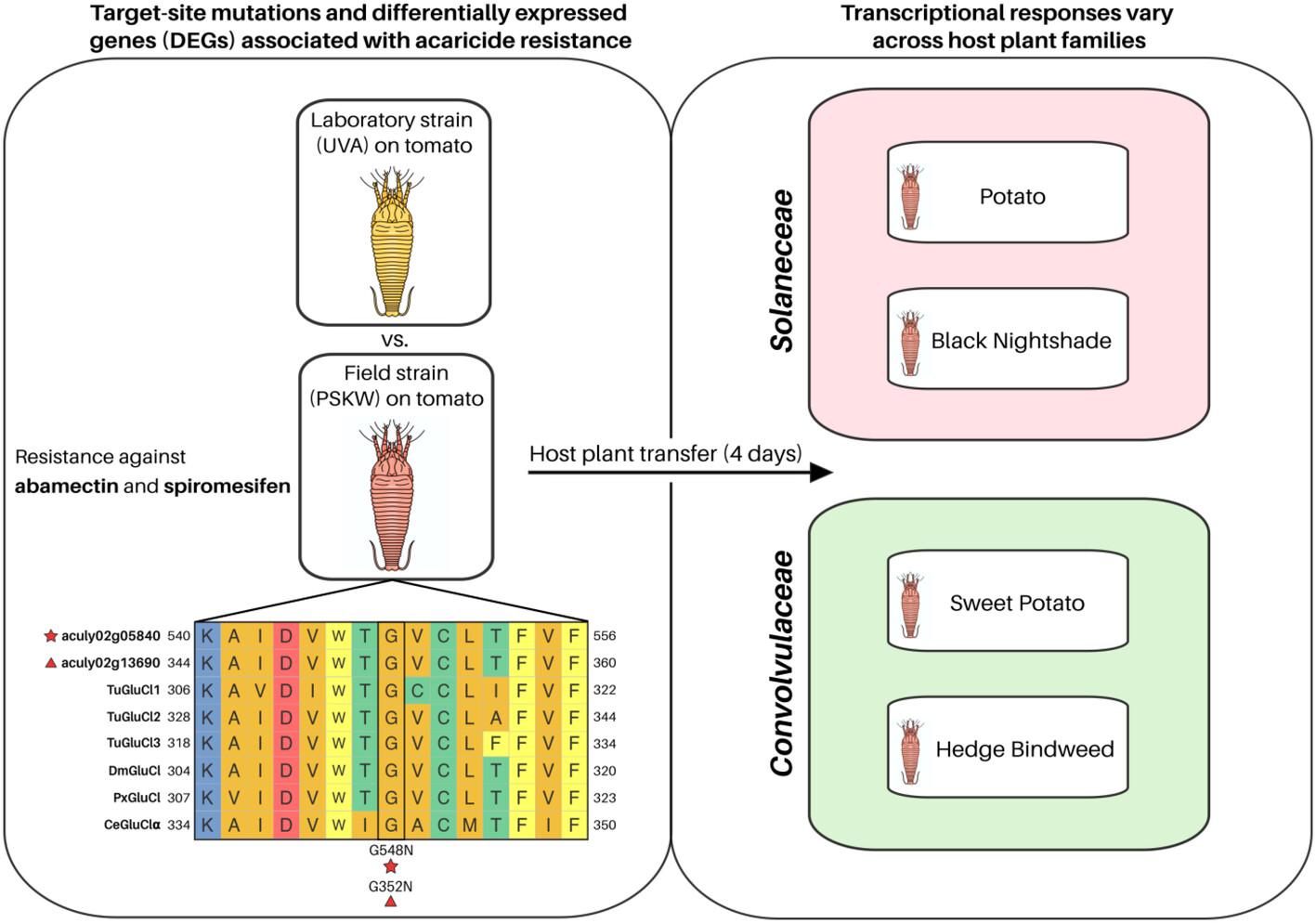
The mite Aculops lycopersici is a major tomato pest with extremely reduced gene families involved in chemoreception and detoxification. How this limited detoxification toolbox affects the evolution of resistance to acaricides in tomato russet mite(s) (TRM) remains enigmatic. Moreover, although a tomato specialist, TRM has been observed on other Solanaceae and Convolvulaceae plant species, raising questions about transcriptional plasticity underlying host exchange.
RESULTS
We identified a field strain with strongly decreased susceptibility to both abamectin and spiromesifen. We detected target-site resistance caused by mutations at conserved positions in two glutamate-gated chloride channels (GluCl), as well as four overexpressed detoxification genes. We then examined transcriptional responses after host shift from tomato to two Solanaceae (potato and black nightshade) and two Convolvulaceae (sweet potato and hedge bindweed) species, as more challenging host plants. Transcriptional responses varied significantly between host plant families, with key differentially expressed genes (DEGs) related to proteolytic, metabolic and detoxification processes. Last, we also identified DEGs encoding for secreted proteins potentially involved in TRM–host plant interactions.
期刊介绍:
Pest Management Science is the international journal of research and development in crop protection and pest control. Since its launch in 1970, the journal has become the premier forum for papers on the discovery, application, and impact on the environment of products and strategies designed for pest management.
Published for SCI by John Wiley & Sons Ltd.







 京公网安备 11010802042870号
京ICP备2023020795号-1
京公网安备 11010802042870号
京ICP备2023020795号-1

 分享
分享
 求助内容:
求助内容: 应助结果提醒方式:
 扫码关注我们
