Deborah Hubers MSc, Larissa R. Heideman MD, Mariëlle J. Stam MSc, Joke M. Dijk MD, PhD, P. Rick Schuurman MD, PhD, Rob M.A. de Bie MD, PhD, Laura A. van de Pol MD, PhD, Martijn Beudel MD, PhD
{"title":"小儿肌张力障碍的临床改善与低频振荡密切相关","authors":"Deborah Hubers MSc, Larissa R. Heideman MD, Mariëlle J. Stam MSc, Joke M. Dijk MD, PhD, P. Rick Schuurman MD, PhD, Rob M.A. de Bie MD, PhD, Laura A. van de Pol MD, PhD, Martijn Beudel MD, PhD","doi":"10.1002/mds.30053","DOIUrl":null,"url":null,"abstract":"<p>Deep brain stimulation (DBS) of the globus pallidus internus (GPi) can be an effective intervention for severe refractory dystonia. Nonetheless, outcomes are often variable and unpredictable. To improve and predict outcomes, further development of <i>physiomarkers</i> can be useful. In contrast to more established β (±13–30 Hz) local field potential (LFP) oscillations in Parkinson's disease, low-frequency (4–12 Hz) oscillations (LFOs) are present in dystonia.<span><sup>1</sup></span> LFP recordings perioperatively demonstrate suppression of LFOs related to clinical improvement.<span><sup>2, 3</sup></span> Furthermore, LFOs have been used as a physiomarker for adaptive DBS (aDBS).<span><sup>3, 4</sup></span> Although it is understood that LFOs evolve, longitudinal evolution of LFOs and their relation to symptoms are not yet established. Here, we describe a 22-day recording of LFOs with clinical correlations in a pediatric patient with generalized dystonia, who first received bilateral GPi DBS in a status dystonicus (SD) in 2019.<span><sup>5</sup></span></p><p>A 10-year-old patient with GNAO1-related dystonia was presented at our emergency department with an impending SD, triggered by left lead malfunctioning. He underwent DBS revision surgery (day 0) and received a sensing-enabled rechargeable device (Medtronic Percept RC, Minneapolis, MN) and a new left lead on the same position as the former lead. The neurostimulator was activated perioperatively with the following stimulation parameters: bilateral monopolar case (+), contacts 2 (right) and 9 (left), pulse width (90 μs), stimulation frequency 130 Hz, and stimulation amplitude 2.2 mA (right) and 2.7 mA (left). Brain sensing was activated, and a periodogram of LFPs was analyzed to identify a frequency band of interest to record every 10 minutes. Presence of dystonia (0 = absent, 1 = present) was assessed four times daily for each body part (arm, leg, face, and torso) and side (left/right). On day 7 the new left lead needed to be repositioned because his symptoms, predominantly right sided, did not improve sufficiently. LFPs were analyzed, and the periodogram underwent bandpass filtering from 1 to 100 Hz and bandstop filtering at 40 Hz for artifact removal. Subsequently, fitting oscillations and one-over-F<span><sup>6</sup></span> was applied. Longitudinal LFP band powers were normalized using <i>z</i> scores. After lead replacement on day 7, separate <i>z</i> scores were calculated pre- and postoperatively. Postoperative computed tomography imaging confirmed lead localization. Clinical scores and LFPs were plotted with a 5-day moving average. Spearman's correlation was performed on dystonia severity estimation and mean LFP power.</p><p>During a 1-minute rest recording (day 0), a clear LFO peak was visible for the left GPi (Fig. 1A). The surrounding 5-Hz spectrum (7.27–12.27 Hz) was used for chronic LFP recording for 22 days. No major mechanical movement artifacts were visible in the signal. Figure 1B shows the relation between severity for right-sided dystonia and left GPi-LFP power, with a significant correlation of −0.69 (<i>P</i> < 0.001). The right GPi is not shown because no clear LFP peak could be detected.</p><p>Here, we demonstrated a strong correlation between LFOs and severity of dystonia, which further illustrates the importance of this physiomarker.<span><sup>1, 2</sup></span> With sensing-enabled DBS systems, LFO dynamics might function as a physiomarker to help titrating DBS for dystonia and guide treatment, potentially applied as aDBS in dystonia.<span><sup>3, 4</sup></span></p><p>J.M.D. received funding for research from the Netherlands Organisation for Health Research and Development (ZonMW), Medtronic, and Amsterdam Neuroscience, all paid to the institution. L.A.P. received a research grant from the ForWhishdom Foundation. P.R.S. received TKI-PPP grants from the Ministry of Economic Affairs, Brainlab, and Boston Scientific, and support grants from the Dutch Brain Foundation. R.M.A.B. received research grants from Medtronic, Bial, ZonMw, AMC Foundation, ROMO Foundation, and Stichting ParkinsonFonds, all paid to the institution. M.B received research funding from the EU Joint Programme—Neurodegenerative Disease Research (JPND) project (2020 call), the Amsterdam UMC TKI-PPP grant (2021 and2023 call), Stichting ParkinsonFonds (2023), and Medtronic (2023, 2024).</p><p>(1) Research project: A. Conception, B. Organization, C. Execution; (2) Statistical Analysis: A. Design, B. Execution, C. Review and Critique; (3) Manuscript Preparation: A. Writing of the first draft, B. Review and Critique.</p><p>D. H: 1A, 1B, 1C, 2A, 2B, 3A</p><p>L.R.H: 1A, 1B, 1C, 2C, 3A, 3B</p><p>M.J.S: 1C, 2C, 3B</p><p>J.M.D: 2C, 3B</p><p>P.R.S: 2C, 3B</p><p>R.M.A.B: 2C, 3B</p><p>L.A.P: 1B, 2C, 3B</p><p>M.B: 1A, 1B, 2C, 3B</p>","PeriodicalId":213,"journal":{"name":"Movement Disorders","volume":"40 1","pages":"179-180"},"PeriodicalIF":7.6000,"publicationDate":"2024-10-30","publicationTypes":"Journal Article","fieldsOfStudy":null,"isOpenAccess":false,"openAccessPdf":"https://www.ncbi.nlm.nih.gov/pmc/articles/PMC11752978/pdf/","citationCount":"0","resultStr":"{\"title\":\"Strong Correlation between Clinical Improvement and Low-Frequency Oscillations in Pediatric Dystonia\",\"authors\":\"Deborah Hubers MSc, Larissa R. Heideman MD, Mariëlle J. Stam MSc, Joke M. Dijk MD, PhD, P. Rick Schuurman MD, PhD, Rob M.A. de Bie MD, PhD, Laura A. van de Pol MD, PhD, Martijn Beudel MD, PhD\",\"doi\":\"10.1002/mds.30053\",\"DOIUrl\":null,\"url\":null,\"abstract\":\"<p>Deep brain stimulation (DBS) of the globus pallidus internus (GPi) can be an effective intervention for severe refractory dystonia. Nonetheless, outcomes are often variable and unpredictable. To improve and predict outcomes, further development of <i>physiomarkers</i> can be useful. In contrast to more established β (±13–30 Hz) local field potential (LFP) oscillations in Parkinson's disease, low-frequency (4–12 Hz) oscillations (LFOs) are present in dystonia.<span><sup>1</sup></span> LFP recordings perioperatively demonstrate suppression of LFOs related to clinical improvement.<span><sup>2, 3</sup></span> Furthermore, LFOs have been used as a physiomarker for adaptive DBS (aDBS).<span><sup>3, 4</sup></span> Although it is understood that LFOs evolve, longitudinal evolution of LFOs and their relation to symptoms are not yet established. Here, we describe a 22-day recording of LFOs with clinical correlations in a pediatric patient with generalized dystonia, who first received bilateral GPi DBS in a status dystonicus (SD) in 2019.<span><sup>5</sup></span></p><p>A 10-year-old patient with GNAO1-related dystonia was presented at our emergency department with an impending SD, triggered by left lead malfunctioning. He underwent DBS revision surgery (day 0) and received a sensing-enabled rechargeable device (Medtronic Percept RC, Minneapolis, MN) and a new left lead on the same position as the former lead. The neurostimulator was activated perioperatively with the following stimulation parameters: bilateral monopolar case (+), contacts 2 (right) and 9 (left), pulse width (90 μs), stimulation frequency 130 Hz, and stimulation amplitude 2.2 mA (right) and 2.7 mA (left). Brain sensing was activated, and a periodogram of LFPs was analyzed to identify a frequency band of interest to record every 10 minutes. Presence of dystonia (0 = absent, 1 = present) was assessed four times daily for each body part (arm, leg, face, and torso) and side (left/right). On day 7 the new left lead needed to be repositioned because his symptoms, predominantly right sided, did not improve sufficiently. LFPs were analyzed, and the periodogram underwent bandpass filtering from 1 to 100 Hz and bandstop filtering at 40 Hz for artifact removal. Subsequently, fitting oscillations and one-over-F<span><sup>6</sup></span> was applied. Longitudinal LFP band powers were normalized using <i>z</i> scores. After lead replacement on day 7, separate <i>z</i> scores were calculated pre- and postoperatively. Postoperative computed tomography imaging confirmed lead localization. Clinical scores and LFPs were plotted with a 5-day moving average. Spearman's correlation was performed on dystonia severity estimation and mean LFP power.</p><p>During a 1-minute rest recording (day 0), a clear LFO peak was visible for the left GPi (Fig. 1A). The surrounding 5-Hz spectrum (7.27–12.27 Hz) was used for chronic LFP recording for 22 days. No major mechanical movement artifacts were visible in the signal. Figure 1B shows the relation between severity for right-sided dystonia and left GPi-LFP power, with a significant correlation of −0.69 (<i>P</i> < 0.001). The right GPi is not shown because no clear LFP peak could be detected.</p><p>Here, we demonstrated a strong correlation between LFOs and severity of dystonia, which further illustrates the importance of this physiomarker.<span><sup>1, 2</sup></span> With sensing-enabled DBS systems, LFO dynamics might function as a physiomarker to help titrating DBS for dystonia and guide treatment, potentially applied as aDBS in dystonia.<span><sup>3, 4</sup></span></p><p>J.M.D. received funding for research from the Netherlands Organisation for Health Research and Development (ZonMW), Medtronic, and Amsterdam Neuroscience, all paid to the institution. L.A.P. received a research grant from the ForWhishdom Foundation. P.R.S. received TKI-PPP grants from the Ministry of Economic Affairs, Brainlab, and Boston Scientific, and support grants from the Dutch Brain Foundation. R.M.A.B. received research grants from Medtronic, Bial, ZonMw, AMC Foundation, ROMO Foundation, and Stichting ParkinsonFonds, all paid to the institution. M.B received research funding from the EU Joint Programme—Neurodegenerative Disease Research (JPND) project (2020 call), the Amsterdam UMC TKI-PPP grant (2021 and2023 call), Stichting ParkinsonFonds (2023), and Medtronic (2023, 2024).</p><p>(1) Research project: A. Conception, B. Organization, C. Execution; (2) Statistical Analysis: A. Design, B. Execution, C. Review and Critique; (3) Manuscript Preparation: A. Writing of the first draft, B. Review and Critique.</p><p>D. H: 1A, 1B, 1C, 2A, 2B, 3A</p><p>L.R.H: 1A, 1B, 1C, 2C, 3A, 3B</p><p>M.J.S: 1C, 2C, 3B</p><p>J.M.D: 2C, 3B</p><p>P.R.S: 2C, 3B</p><p>R.M.A.B: 2C, 3B</p><p>L.A.P: 1B, 2C, 3B</p><p>M.B: 1A, 1B, 2C, 3B</p>\",\"PeriodicalId\":213,\"journal\":{\"name\":\"Movement Disorders\",\"volume\":\"40 1\",\"pages\":\"179-180\"},\"PeriodicalIF\":7.6000,\"publicationDate\":\"2024-10-30\",\"publicationTypes\":\"Journal Article\",\"fieldsOfStudy\":null,\"isOpenAccess\":false,\"openAccessPdf\":\"https://www.ncbi.nlm.nih.gov/pmc/articles/PMC11752978/pdf/\",\"citationCount\":\"0\",\"resultStr\":null,\"platform\":\"Semanticscholar\",\"paperid\":null,\"PeriodicalName\":\"Movement Disorders\",\"FirstCategoryId\":\"3\",\"ListUrlMain\":\"https://movementdisorders.onlinelibrary.wiley.com/doi/10.1002/mds.30053\",\"RegionNum\":1,\"RegionCategory\":\"医学\",\"ArticlePicture\":[],\"TitleCN\":null,\"AbstractTextCN\":null,\"PMCID\":null,\"EPubDate\":\"\",\"PubModel\":\"\",\"JCR\":\"Q1\",\"JCRName\":\"CLINICAL NEUROLOGY\",\"Score\":null,\"Total\":0}","platform":"Semanticscholar","paperid":null,"PeriodicalName":"Movement Disorders","FirstCategoryId":"3","ListUrlMain":"https://movementdisorders.onlinelibrary.wiley.com/doi/10.1002/mds.30053","RegionNum":1,"RegionCategory":"医学","ArticlePicture":[],"TitleCN":null,"AbstractTextCN":null,"PMCID":null,"EPubDate":"","PubModel":"","JCR":"Q1","JCRName":"CLINICAL NEUROLOGY","Score":null,"Total":0}
Strong Correlation between Clinical Improvement and Low-Frequency Oscillations in Pediatric Dystonia
Deep brain stimulation (DBS) of the globus pallidus internus (GPi) can be an effective intervention for severe refractory dystonia. Nonetheless, outcomes are often variable and unpredictable. To improve and predict outcomes, further development of physiomarkers can be useful. In contrast to more established β (±13–30 Hz) local field potential (LFP) oscillations in Parkinson's disease, low-frequency (4–12 Hz) oscillations (LFOs) are present in dystonia.1 LFP recordings perioperatively demonstrate suppression of LFOs related to clinical improvement.2, 3 Furthermore, LFOs have been used as a physiomarker for adaptive DBS (aDBS).3, 4 Although it is understood that LFOs evolve, longitudinal evolution of LFOs and their relation to symptoms are not yet established. Here, we describe a 22-day recording of LFOs with clinical correlations in a pediatric patient with generalized dystonia, who first received bilateral GPi DBS in a status dystonicus (SD) in 2019.5
A 10-year-old patient with GNAO1-related dystonia was presented at our emergency department with an impending SD, triggered by left lead malfunctioning. He underwent DBS revision surgery (day 0) and received a sensing-enabled rechargeable device (Medtronic Percept RC, Minneapolis, MN) and a new left lead on the same position as the former lead. The neurostimulator was activated perioperatively with the following stimulation parameters: bilateral monopolar case (+), contacts 2 (right) and 9 (left), pulse width (90 μs), stimulation frequency 130 Hz, and stimulation amplitude 2.2 mA (right) and 2.7 mA (left). Brain sensing was activated, and a periodogram of LFPs was analyzed to identify a frequency band of interest to record every 10 minutes. Presence of dystonia (0 = absent, 1 = present) was assessed four times daily for each body part (arm, leg, face, and torso) and side (left/right). On day 7 the new left lead needed to be repositioned because his symptoms, predominantly right sided, did not improve sufficiently. LFPs were analyzed, and the periodogram underwent bandpass filtering from 1 to 100 Hz and bandstop filtering at 40 Hz for artifact removal. Subsequently, fitting oscillations and one-over-F6 was applied. Longitudinal LFP band powers were normalized using z scores. After lead replacement on day 7, separate z scores were calculated pre- and postoperatively. Postoperative computed tomography imaging confirmed lead localization. Clinical scores and LFPs were plotted with a 5-day moving average. Spearman's correlation was performed on dystonia severity estimation and mean LFP power.
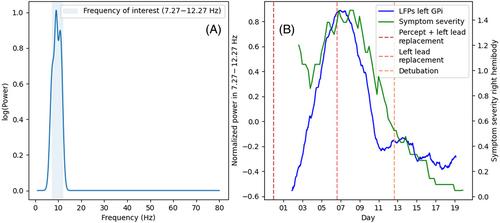
During a 1-minute rest recording (day 0), a clear LFO peak was visible for the left GPi (Fig. 1A). The surrounding 5-Hz spectrum (7.27–12.27 Hz) was used for chronic LFP recording for 22 days. No major mechanical movement artifacts were visible in the signal. Figure 1B shows the relation between severity for right-sided dystonia and left GPi-LFP power, with a significant correlation of −0.69 (P < 0.001). The right GPi is not shown because no clear LFP peak could be detected.
Here, we demonstrated a strong correlation between LFOs and severity of dystonia, which further illustrates the importance of this physiomarker.1, 2 With sensing-enabled DBS systems, LFO dynamics might function as a physiomarker to help titrating DBS for dystonia and guide treatment, potentially applied as aDBS in dystonia.3, 4
J.M.D. received funding for research from the Netherlands Organisation for Health Research and Development (ZonMW), Medtronic, and Amsterdam Neuroscience, all paid to the institution. L.A.P. received a research grant from the ForWhishdom Foundation. P.R.S. received TKI-PPP grants from the Ministry of Economic Affairs, Brainlab, and Boston Scientific, and support grants from the Dutch Brain Foundation. R.M.A.B. received research grants from Medtronic, Bial, ZonMw, AMC Foundation, ROMO Foundation, and Stichting ParkinsonFonds, all paid to the institution. M.B received research funding from the EU Joint Programme—Neurodegenerative Disease Research (JPND) project (2020 call), the Amsterdam UMC TKI-PPP grant (2021 and2023 call), Stichting ParkinsonFonds (2023), and Medtronic (2023, 2024).
(1) Research project: A. Conception, B. Organization, C. Execution; (2) Statistical Analysis: A. Design, B. Execution, C. Review and Critique; (3) Manuscript Preparation: A. Writing of the first draft, B. Review and Critique.
期刊介绍:
Movement Disorders publishes a variety of content types including Reviews, Viewpoints, Full Length Articles, Historical Reports, Brief Reports, and Letters. The journal considers original manuscripts on topics related to the diagnosis, therapeutics, pharmacology, biochemistry, physiology, etiology, genetics, and epidemiology of movement disorders. Appropriate topics include Parkinsonism, Chorea, Tremors, Dystonia, Myoclonus, Tics, Tardive Dyskinesia, Spasticity, and Ataxia.







 京公网安备 11010802042870号
京ICP备2023020795号-1
京公网安备 11010802042870号
京ICP备2023020795号-1

 分享
分享
 求助内容:
求助内容: 应助结果提醒方式:
 扫码关注我们
