{"title":"利用高频集成电路中的线性时不变增强锁相环为 IPMSMs 进行初始位置检测和极性识别","authors":"Xinran Shi;Jinglin Liu;Chao Gong;Jiasheng Yin","doi":"10.1109/JESTPE.2024.3488207","DOIUrl":null,"url":null,"abstract":"This article proposes an improved position sensorless control method for interior permanent magnet synchronous motors (IPMSMs) using high-frequency square-wave injection (HFSI). Conventional HFSI methods obtain the initial position using a quadrature phase-locked loop (QPLL) and then identify the NS polarity through additional pulse voltage injection. This method requires extra signal injection, and the identification process is independent of the initial position estimation process, complicating the system design. To address these issues, a linear time-invariant enhanced phase-locked loop (LTI-EPLL) is introduced to replace the QPLL. The LTI-EPLL has a bidirectional convergence property, enabling it to estimate both the position and the amplitude of the input signal simultaneously. The estimated amplitude corresponds to the high-frequency response current amplitude in the HFSI, with its sign indicating the NS polarity. By using this method, the initial position and NS polarity can be determined simultaneously during HFSI, significantly simplifying the system design process. This method also ensures accurate position estimation, contributing to high-energy efficiency. The proposed LTI-EPLL-based HFSI method is verified through experiments on a 15 kW IPMSM.","PeriodicalId":13093,"journal":{"name":"IEEE Journal of Emerging and Selected Topics in Power Electronics","volume":"13 2","pages":"1844-1855"},"PeriodicalIF":5.7000,"publicationDate":"2024-10-30","publicationTypes":"Journal Article","fieldsOfStudy":null,"isOpenAccess":false,"openAccessPdf":"","citationCount":"0","resultStr":"{\"title\":\"Initial Position Detection and Polarity Identification for IPMSMs Using a Linear Time-Invariant Enhanced Phase-Locked Loop in HFSI\",\"authors\":\"Xinran Shi;Jinglin Liu;Chao Gong;Jiasheng Yin\",\"doi\":\"10.1109/JESTPE.2024.3488207\",\"DOIUrl\":null,\"url\":null,\"abstract\":\"This article proposes an improved position sensorless control method for interior permanent magnet synchronous motors (IPMSMs) using high-frequency square-wave injection (HFSI). Conventional HFSI methods obtain the initial position using a quadrature phase-locked loop (QPLL) and then identify the NS polarity through additional pulse voltage injection. This method requires extra signal injection, and the identification process is independent of the initial position estimation process, complicating the system design. To address these issues, a linear time-invariant enhanced phase-locked loop (LTI-EPLL) is introduced to replace the QPLL. The LTI-EPLL has a bidirectional convergence property, enabling it to estimate both the position and the amplitude of the input signal simultaneously. The estimated amplitude corresponds to the high-frequency response current amplitude in the HFSI, with its sign indicating the NS polarity. By using this method, the initial position and NS polarity can be determined simultaneously during HFSI, significantly simplifying the system design process. This method also ensures accurate position estimation, contributing to high-energy efficiency. The proposed LTI-EPLL-based HFSI method is verified through experiments on a 15 kW IPMSM.\",\"PeriodicalId\":13093,\"journal\":{\"name\":\"IEEE Journal of Emerging and Selected Topics in Power Electronics\",\"volume\":\"13 2\",\"pages\":\"1844-1855\"},\"PeriodicalIF\":5.7000,\"publicationDate\":\"2024-10-30\",\"publicationTypes\":\"Journal Article\",\"fieldsOfStudy\":null,\"isOpenAccess\":false,\"openAccessPdf\":\"\",\"citationCount\":\"0\",\"resultStr\":null,\"platform\":\"Semanticscholar\",\"paperid\":null,\"PeriodicalName\":\"IEEE Journal of Emerging and Selected Topics in Power Electronics\",\"FirstCategoryId\":\"5\",\"ListUrlMain\":\"https://ieeexplore.ieee.org/document/10738810/\",\"RegionNum\":2,\"RegionCategory\":\"工程技术\",\"ArticlePicture\":[],\"TitleCN\":null,\"AbstractTextCN\":null,\"PMCID\":null,\"EPubDate\":\"\",\"PubModel\":\"\",\"JCR\":\"Q1\",\"JCRName\":\"ENGINEERING, ELECTRICAL & ELECTRONIC\",\"Score\":null,\"Total\":0}","platform":"Semanticscholar","paperid":null,"PeriodicalName":"IEEE Journal of Emerging and Selected Topics in Power Electronics","FirstCategoryId":"5","ListUrlMain":"https://ieeexplore.ieee.org/document/10738810/","RegionNum":2,"RegionCategory":"工程技术","ArticlePicture":[],"TitleCN":null,"AbstractTextCN":null,"PMCID":null,"EPubDate":"","PubModel":"","JCR":"Q1","JCRName":"ENGINEERING, ELECTRICAL & ELECTRONIC","Score":null,"Total":0}
Initial Position Detection and Polarity Identification for IPMSMs Using a Linear Time-Invariant Enhanced Phase-Locked Loop in HFSI
This article proposes an improved position sensorless control method for interior permanent magnet synchronous motors (IPMSMs) using high-frequency square-wave injection (HFSI). Conventional HFSI methods obtain the initial position using a quadrature phase-locked loop (QPLL) and then identify the NS polarity through additional pulse voltage injection. This method requires extra signal injection, and the identification process is independent of the initial position estimation process, complicating the system design. To address these issues, a linear time-invariant enhanced phase-locked loop (LTI-EPLL) is introduced to replace the QPLL. The LTI-EPLL has a bidirectional convergence property, enabling it to estimate both the position and the amplitude of the input signal simultaneously. The estimated amplitude corresponds to the high-frequency response current amplitude in the HFSI, with its sign indicating the NS polarity. By using this method, the initial position and NS polarity can be determined simultaneously during HFSI, significantly simplifying the system design process. This method also ensures accurate position estimation, contributing to high-energy efficiency. The proposed LTI-EPLL-based HFSI method is verified through experiments on a 15 kW IPMSM.
期刊介绍:
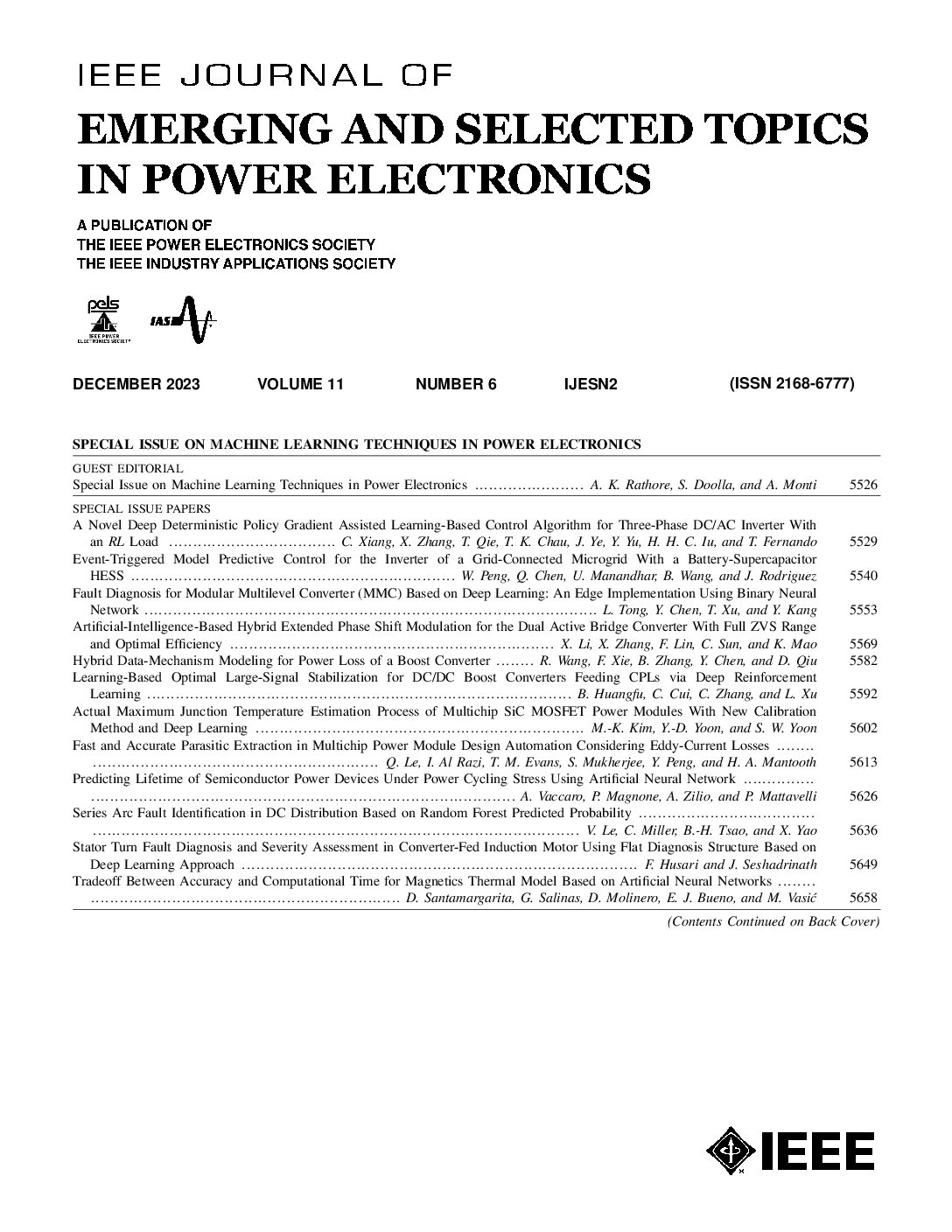
The aim of the journal is to enable the power electronics community to address the emerging and selected topics in power electronics in an agile fashion. It is a forum where multidisciplinary and discriminating technologies and applications are discussed by and for both practitioners and researchers on timely topics in power electronics from components to systems.




 京公网安备 11010802042870号
京ICP备2023020795号-1
京公网安备 11010802042870号
京ICP备2023020795号-1

 分享
分享
 求助内容:
求助内容: 应助结果提醒方式:
 扫码关注我们
