Yuelin Yang, Jie Guan, Nannan Zhang, Lin Ru, Yihao Zou and Yuanyuan Wang
{"title":"纳米材料直接光学光刻技术的进展","authors":"Yuelin Yang, Jie Guan, Nannan Zhang, Lin Ru, Yihao Zou and Yuanyuan Wang","doi":"10.1039/D4TA06618A","DOIUrl":null,"url":null,"abstract":"<p >The precise assembly of nanomaterials is essential for integrating nanomaterials into sophisticated devices. However, conventional nanoscale patterning methods face obstacles such as high cost, low resolution, and environmental contamination. Direct optical lithography is used to fabricate photosensitive nanomaterials using surface engineering and utilizes the photochemical reactions of ligands to alter their solubility, enabling optical patterning. This method, which does not rely on polymer photoresists, holds great potential as an emerging lithographic technology. This approach simplifies the lithography process, reduces costs, and minimizes the environmental impact. In this review, we begin with an in-depth analysis of the evolution of optical lithography and key optical pattern strategies. We then emphasize how advanced nanomaterials, such as quantum dots, metal oxides, metals, clusters, and metal–organic frameworks, contribute to precise patterning for electronic and optoelectronic applications. Finally, we discuss current challenges in this field and propose solutions to improve patterning efficiency and quality while addressing issues about environmental sustainability.</p>","PeriodicalId":82,"journal":{"name":"Journal of Materials Chemistry A","volume":" 47","pages":" 32505-32525"},"PeriodicalIF":9.5000,"publicationDate":"2024-11-05","publicationTypes":"Journal Article","fieldsOfStudy":null,"isOpenAccess":false,"openAccessPdf":"","citationCount":"0","resultStr":"{\"title\":\"Advances in direct optical lithography of nanomaterials\",\"authors\":\"Yuelin Yang, Jie Guan, Nannan Zhang, Lin Ru, Yihao Zou and Yuanyuan Wang\",\"doi\":\"10.1039/D4TA06618A\",\"DOIUrl\":null,\"url\":null,\"abstract\":\"<p >The precise assembly of nanomaterials is essential for integrating nanomaterials into sophisticated devices. However, conventional nanoscale patterning methods face obstacles such as high cost, low resolution, and environmental contamination. Direct optical lithography is used to fabricate photosensitive nanomaterials using surface engineering and utilizes the photochemical reactions of ligands to alter their solubility, enabling optical patterning. This method, which does not rely on polymer photoresists, holds great potential as an emerging lithographic technology. This approach simplifies the lithography process, reduces costs, and minimizes the environmental impact. In this review, we begin with an in-depth analysis of the evolution of optical lithography and key optical pattern strategies. We then emphasize how advanced nanomaterials, such as quantum dots, metal oxides, metals, clusters, and metal–organic frameworks, contribute to precise patterning for electronic and optoelectronic applications. Finally, we discuss current challenges in this field and propose solutions to improve patterning efficiency and quality while addressing issues about environmental sustainability.</p>\",\"PeriodicalId\":82,\"journal\":{\"name\":\"Journal of Materials Chemistry A\",\"volume\":\" 47\",\"pages\":\" 32505-32525\"},\"PeriodicalIF\":9.5000,\"publicationDate\":\"2024-11-05\",\"publicationTypes\":\"Journal Article\",\"fieldsOfStudy\":null,\"isOpenAccess\":false,\"openAccessPdf\":\"\",\"citationCount\":\"0\",\"resultStr\":null,\"platform\":\"Semanticscholar\",\"paperid\":null,\"PeriodicalName\":\"Journal of Materials Chemistry A\",\"FirstCategoryId\":\"88\",\"ListUrlMain\":\"https://pubs.rsc.org/en/content/articlelanding/2024/ta/d4ta06618a\",\"RegionNum\":2,\"RegionCategory\":\"材料科学\",\"ArticlePicture\":[],\"TitleCN\":null,\"AbstractTextCN\":null,\"PMCID\":null,\"EPubDate\":\"\",\"PubModel\":\"\",\"JCR\":\"Q1\",\"JCRName\":\"CHEMISTRY, PHYSICAL\",\"Score\":null,\"Total\":0}","platform":"Semanticscholar","paperid":null,"PeriodicalName":"Journal of Materials Chemistry A","FirstCategoryId":"88","ListUrlMain":"https://pubs.rsc.org/en/content/articlelanding/2024/ta/d4ta06618a","RegionNum":2,"RegionCategory":"材料科学","ArticlePicture":[],"TitleCN":null,"AbstractTextCN":null,"PMCID":null,"EPubDate":"","PubModel":"","JCR":"Q1","JCRName":"CHEMISTRY, PHYSICAL","Score":null,"Total":0}
Advances in direct optical lithography of nanomaterials
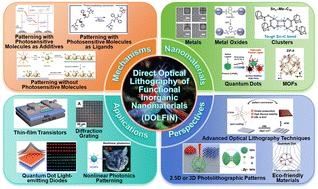
The precise assembly of nanomaterials is essential for integrating nanomaterials into sophisticated devices. However, conventional nanoscale patterning methods face obstacles such as high cost, low resolution, and environmental contamination. Direct optical lithography is used to fabricate photosensitive nanomaterials using surface engineering and utilizes the photochemical reactions of ligands to alter their solubility, enabling optical patterning. This method, which does not rely on polymer photoresists, holds great potential as an emerging lithographic technology. This approach simplifies the lithography process, reduces costs, and minimizes the environmental impact. In this review, we begin with an in-depth analysis of the evolution of optical lithography and key optical pattern strategies. We then emphasize how advanced nanomaterials, such as quantum dots, metal oxides, metals, clusters, and metal–organic frameworks, contribute to precise patterning for electronic and optoelectronic applications. Finally, we discuss current challenges in this field and propose solutions to improve patterning efficiency and quality while addressing issues about environmental sustainability.
期刊介绍:
The Journal of Materials Chemistry A, B & C covers a wide range of high-quality studies in the field of materials chemistry, with each section focusing on specific applications of the materials studied. Journal of Materials Chemistry A emphasizes applications in energy and sustainability, including topics such as artificial photosynthesis, batteries, and fuel cells. Journal of Materials Chemistry B focuses on applications in biology and medicine, while Journal of Materials Chemistry C covers applications in optical, magnetic, and electronic devices. Example topic areas within the scope of Journal of Materials Chemistry A include catalysis, green/sustainable materials, sensors, and water treatment, among others.




 京公网安备 11010802042870号
京ICP备2023020795号-1
京公网安备 11010802042870号
京ICP备2023020795号-1

 分享
分享
 求助内容:
求助内容: 应助结果提醒方式:
 扫码关注我们
