Keya Mondal, Kushagra Advani, Snigdha Ghosh, Kadhiravan Shanmugnathan, Goutam Kulsi, Swaminathan Sivaram and Sayam Sen Gupta
{"title":"舒拉用于高效油水分离的三维多孔疏水亲油木质纤维素材料","authors":"Keya Mondal, Kushagra Advani, Snigdha Ghosh, Kadhiravan Shanmugnathan, Goutam Kulsi, Swaminathan Sivaram and Sayam Sen Gupta","doi":"10.1039/D4TA06463A","DOIUrl":null,"url":null,"abstract":"<p >Transitioning from the fossil fuel era to a sustainable future requires increasing adoption of high-performing renewable materials in industrial applications. Natural polymers derived from lignocellulosic materials are often considered more environmentally friendly than their petroleum-based synthetic analogs. <em>Aeschynomene aspera</em>, commonly known as <em>Shola</em>, has been found to be a large source of amorphous cellulose and a useful sorbent for the removal of oil from water. The <em>Shola</em> pith, the pure white inner stem, is rich in cellulose and has an exquisite three-dimensional and hierarchical porous architecture created by nature. The pith consists of about 70 wt% cellulose as the main chemical component, which is much higher than what is found in other lignocellulosic sources. In addition, the pith has about 12 wt% hemicellulose, 2–3 wt% pectin, 10 wt% lignin, 2.5 wt% wax, and 2 wt% protein as other chemical components. It was observed that water has a high contact angle (135°) on the surface of the pith, while oil droplets instantly spread on the surface, indicating excellent hydrophobic–oleophilic properties. Further studies reveal that the <em>Shola</em> pith exhibits a fast and high sorption capacity of 40–60 g/g for various oils and organic liquids. Silicone oil shows a sorption capacity of about 166 g/g. When applied to oil-floating-over-water, the <em>Shola</em> pith exhibits high selectivity for oil over water; almost all oil on the surface could be removed, leaving no trace of oil on the water surface. The <em>Shola</em> pith can also efficiently separate oil from an oil-in-water emulsion. This behavior is unprecedented in natural sorbents. The used material sorbs a considerable volume of the oil even after the 7th cycle. Furthermore about 95% of sorbed oil could be recovered from the material by solvent extraction. This study reveals for the first time some of the unique and interesting properties of <em>Shola</em>, a widely found biomass native to the eastern parts of the Indian subcontinent, and opens up possibilities of exploiting it for valuable applications.</p>","PeriodicalId":82,"journal":{"name":"Journal of Materials Chemistry A","volume":" 3","pages":" 1983-1995"},"PeriodicalIF":9.2000,"publicationDate":"2024-11-06","publicationTypes":"Journal Article","fieldsOfStudy":null,"isOpenAccess":false,"openAccessPdf":"","citationCount":"0","resultStr":"{\"title\":\"Shola: a 3D porous hydrophobic–oleophilic lignocellulosic material for efficient oil/water separation†\",\"authors\":\"Keya Mondal, Kushagra Advani, Snigdha Ghosh, Kadhiravan Shanmugnathan, Goutam Kulsi, Swaminathan Sivaram and Sayam Sen Gupta\",\"doi\":\"10.1039/D4TA06463A\",\"DOIUrl\":null,\"url\":null,\"abstract\":\"<p >Transitioning from the fossil fuel era to a sustainable future requires increasing adoption of high-performing renewable materials in industrial applications. Natural polymers derived from lignocellulosic materials are often considered more environmentally friendly than their petroleum-based synthetic analogs. <em>Aeschynomene aspera</em>, commonly known as <em>Shola</em>, has been found to be a large source of amorphous cellulose and a useful sorbent for the removal of oil from water. The <em>Shola</em> pith, the pure white inner stem, is rich in cellulose and has an exquisite three-dimensional and hierarchical porous architecture created by nature. The pith consists of about 70 wt% cellulose as the main chemical component, which is much higher than what is found in other lignocellulosic sources. In addition, the pith has about 12 wt% hemicellulose, 2–3 wt% pectin, 10 wt% lignin, 2.5 wt% wax, and 2 wt% protein as other chemical components. It was observed that water has a high contact angle (135°) on the surface of the pith, while oil droplets instantly spread on the surface, indicating excellent hydrophobic–oleophilic properties. Further studies reveal that the <em>Shola</em> pith exhibits a fast and high sorption capacity of 40–60 g/g for various oils and organic liquids. Silicone oil shows a sorption capacity of about 166 g/g. When applied to oil-floating-over-water, the <em>Shola</em> pith exhibits high selectivity for oil over water; almost all oil on the surface could be removed, leaving no trace of oil on the water surface. The <em>Shola</em> pith can also efficiently separate oil from an oil-in-water emulsion. This behavior is unprecedented in natural sorbents. The used material sorbs a considerable volume of the oil even after the 7th cycle. Furthermore about 95% of sorbed oil could be recovered from the material by solvent extraction. This study reveals for the first time some of the unique and interesting properties of <em>Shola</em>, a widely found biomass native to the eastern parts of the Indian subcontinent, and opens up possibilities of exploiting it for valuable applications.</p>\",\"PeriodicalId\":82,\"journal\":{\"name\":\"Journal of Materials Chemistry A\",\"volume\":\" 3\",\"pages\":\" 1983-1995\"},\"PeriodicalIF\":9.2000,\"publicationDate\":\"2024-11-06\",\"publicationTypes\":\"Journal Article\",\"fieldsOfStudy\":null,\"isOpenAccess\":false,\"openAccessPdf\":\"\",\"citationCount\":\"0\",\"resultStr\":null,\"platform\":\"Semanticscholar\",\"paperid\":null,\"PeriodicalName\":\"Journal of Materials Chemistry A\",\"FirstCategoryId\":\"88\",\"ListUrlMain\":\"https://pubs.rsc.org/en/content/articlelanding/2025/ta/d4ta06463a\",\"RegionNum\":2,\"RegionCategory\":\"材料科学\",\"ArticlePicture\":[],\"TitleCN\":null,\"AbstractTextCN\":null,\"PMCID\":null,\"EPubDate\":\"\",\"PubModel\":\"\",\"JCR\":\"Q1\",\"JCRName\":\"CHEMISTRY, PHYSICAL\",\"Score\":null,\"Total\":0}","platform":"Semanticscholar","paperid":null,"PeriodicalName":"Journal of Materials Chemistry A","FirstCategoryId":"88","ListUrlMain":"https://pubs.rsc.org/en/content/articlelanding/2025/ta/d4ta06463a","RegionNum":2,"RegionCategory":"材料科学","ArticlePicture":[],"TitleCN":null,"AbstractTextCN":null,"PMCID":null,"EPubDate":"","PubModel":"","JCR":"Q1","JCRName":"CHEMISTRY, PHYSICAL","Score":null,"Total":0}
Shola: a 3D porous hydrophobic–oleophilic lignocellulosic material for efficient oil/water separation†
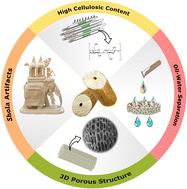
Transitioning from the fossil fuel era to a sustainable future requires increasing adoption of high-performing renewable materials in industrial applications. Natural polymers derived from lignocellulosic materials are often considered more environmentally friendly than their petroleum-based synthetic analogs. Aeschynomene aspera, commonly known as Shola, has been found to be a large source of amorphous cellulose and a useful sorbent for the removal of oil from water. The Shola pith, the pure white inner stem, is rich in cellulose and has an exquisite three-dimensional and hierarchical porous architecture created by nature. The pith consists of about 70 wt% cellulose as the main chemical component, which is much higher than what is found in other lignocellulosic sources. In addition, the pith has about 12 wt% hemicellulose, 2–3 wt% pectin, 10 wt% lignin, 2.5 wt% wax, and 2 wt% protein as other chemical components. It was observed that water has a high contact angle (135°) on the surface of the pith, while oil droplets instantly spread on the surface, indicating excellent hydrophobic–oleophilic properties. Further studies reveal that the Shola pith exhibits a fast and high sorption capacity of 40–60 g/g for various oils and organic liquids. Silicone oil shows a sorption capacity of about 166 g/g. When applied to oil-floating-over-water, the Shola pith exhibits high selectivity for oil over water; almost all oil on the surface could be removed, leaving no trace of oil on the water surface. The Shola pith can also efficiently separate oil from an oil-in-water emulsion. This behavior is unprecedented in natural sorbents. The used material sorbs a considerable volume of the oil even after the 7th cycle. Furthermore about 95% of sorbed oil could be recovered from the material by solvent extraction. This study reveals for the first time some of the unique and interesting properties of Shola, a widely found biomass native to the eastern parts of the Indian subcontinent, and opens up possibilities of exploiting it for valuable applications.
期刊介绍:
The Journal of Materials Chemistry A, B & C covers a wide range of high-quality studies in the field of materials chemistry, with each section focusing on specific applications of the materials studied. Journal of Materials Chemistry A emphasizes applications in energy and sustainability, including topics such as artificial photosynthesis, batteries, and fuel cells. Journal of Materials Chemistry B focuses on applications in biology and medicine, while Journal of Materials Chemistry C covers applications in optical, magnetic, and electronic devices. Example topic areas within the scope of Journal of Materials Chemistry A include catalysis, green/sustainable materials, sensors, and water treatment, among others.




 京公网安备 11010802042870号
京ICP备2023020795号-1
京公网安备 11010802042870号
京ICP备2023020795号-1

 分享
分享
 求助内容:
求助内容: 应助结果提醒方式:
 扫码关注我们
