Kaikai Ba, Hongda Li, Kai Zhang, Yanhong Lin, Wanchun Zhu and Tengfeng Xie
{"title":"原位形成用于高效光电化学水分离的 Co-MOF/Ti-Fe2O3 光阳极†。","authors":"Kaikai Ba, Hongda Li, Kai Zhang, Yanhong Lin, Wanchun Zhu and Tengfeng Xie","doi":"10.1039/D4TC01728E","DOIUrl":null,"url":null,"abstract":"<p >As a promising approach to convert solar energy into a low-cost form, photoelectrochemical (PEC) water splitting is attracting a lot of attention from researchers. However, the PEC hydrogen production is limited by the oxygen evolution reaction. Therefore, it is necessary to find effective means to accelerate the water oxidation kinetics of photoanodes. In this work, a Co-MOF cocatalyst was modified onto Ti–Fe<small><sub>2</sub></small>O<small><sub>3</sub></small> photoanodes using a simple hydrothermal method, which allowed greater adsorption and exposure of cobalt species with high catalytic activity. The composite photoanode Co-MOF/Ti–Fe<small><sub>2</sub></small>O<small><sub>3</sub></small> demonstrates a higher photocurrent density of 3.9 mA cm<small><sup>−2</sup></small> at 1.23 V <em>vs.</em> RHE, promoting water oxidation kinetics and the transfer of photogenerated carriers. This work provides an effective approach for constructing high-performance photoanodes using metal–organic framework materials.</p>","PeriodicalId":84,"journal":{"name":"Journal of Materials Chemistry C","volume":" 43","pages":" 17603-17610"},"PeriodicalIF":5.1000,"publicationDate":"2024-09-30","publicationTypes":"Journal Article","fieldsOfStudy":null,"isOpenAccess":false,"openAccessPdf":"","citationCount":"0","resultStr":"{\"title\":\"In situ formation of a Co-MOF/Ti–Fe2O3 photoanode for efficient photoelectrochemical water splitting†\",\"authors\":\"Kaikai Ba, Hongda Li, Kai Zhang, Yanhong Lin, Wanchun Zhu and Tengfeng Xie\",\"doi\":\"10.1039/D4TC01728E\",\"DOIUrl\":null,\"url\":null,\"abstract\":\"<p >As a promising approach to convert solar energy into a low-cost form, photoelectrochemical (PEC) water splitting is attracting a lot of attention from researchers. However, the PEC hydrogen production is limited by the oxygen evolution reaction. Therefore, it is necessary to find effective means to accelerate the water oxidation kinetics of photoanodes. In this work, a Co-MOF cocatalyst was modified onto Ti–Fe<small><sub>2</sub></small>O<small><sub>3</sub></small> photoanodes using a simple hydrothermal method, which allowed greater adsorption and exposure of cobalt species with high catalytic activity. The composite photoanode Co-MOF/Ti–Fe<small><sub>2</sub></small>O<small><sub>3</sub></small> demonstrates a higher photocurrent density of 3.9 mA cm<small><sup>−2</sup></small> at 1.23 V <em>vs.</em> RHE, promoting water oxidation kinetics and the transfer of photogenerated carriers. This work provides an effective approach for constructing high-performance photoanodes using metal–organic framework materials.</p>\",\"PeriodicalId\":84,\"journal\":{\"name\":\"Journal of Materials Chemistry C\",\"volume\":\" 43\",\"pages\":\" 17603-17610\"},\"PeriodicalIF\":5.1000,\"publicationDate\":\"2024-09-30\",\"publicationTypes\":\"Journal Article\",\"fieldsOfStudy\":null,\"isOpenAccess\":false,\"openAccessPdf\":\"\",\"citationCount\":\"0\",\"resultStr\":null,\"platform\":\"Semanticscholar\",\"paperid\":null,\"PeriodicalName\":\"Journal of Materials Chemistry C\",\"FirstCategoryId\":\"1\",\"ListUrlMain\":\"https://pubs.rsc.org/en/content/articlelanding/2024/tc/d4tc01728e\",\"RegionNum\":2,\"RegionCategory\":\"材料科学\",\"ArticlePicture\":[],\"TitleCN\":null,\"AbstractTextCN\":null,\"PMCID\":null,\"EPubDate\":\"\",\"PubModel\":\"\",\"JCR\":\"Q2\",\"JCRName\":\"MATERIALS SCIENCE, MULTIDISCIPLINARY\",\"Score\":null,\"Total\":0}","platform":"Semanticscholar","paperid":null,"PeriodicalName":"Journal of Materials Chemistry C","FirstCategoryId":"1","ListUrlMain":"https://pubs.rsc.org/en/content/articlelanding/2024/tc/d4tc01728e","RegionNum":2,"RegionCategory":"材料科学","ArticlePicture":[],"TitleCN":null,"AbstractTextCN":null,"PMCID":null,"EPubDate":"","PubModel":"","JCR":"Q2","JCRName":"MATERIALS SCIENCE, MULTIDISCIPLINARY","Score":null,"Total":0}
引用次数: 0
摘要
光电化学(PEC)分水技术作为一种将太阳能转化为低成本形式的有前途的方法,受到了研究人员的广泛关注。然而,PEC 制氢受到氧进化反应的限制。因此,有必要找到有效的方法来加速光阳极的水氧化动力学。在这项工作中,采用简单的水热法在 Ti-Fe2O3 光阳极上改性了 Co-MOF 助催化剂,从而使具有高催化活性的钴物种得到更多的吸附和暴露。Co-MOF/Ti-Fe2O3 复合光阳极在 1.23 V 相对于 RHE 时的光电流密度高达 3.9 mA cm-2,促进了水的氧化动力学和光生载流子的转移。这项工作为利用金属有机框架材料构建高性能光阳极提供了一种有效方法。
In situ formation of a Co-MOF/Ti–Fe2O3 photoanode for efficient photoelectrochemical water splitting†
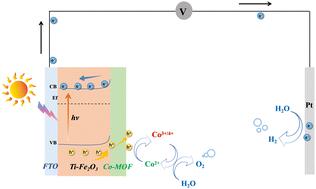
As a promising approach to convert solar energy into a low-cost form, photoelectrochemical (PEC) water splitting is attracting a lot of attention from researchers. However, the PEC hydrogen production is limited by the oxygen evolution reaction. Therefore, it is necessary to find effective means to accelerate the water oxidation kinetics of photoanodes. In this work, a Co-MOF cocatalyst was modified onto Ti–Fe2O3 photoanodes using a simple hydrothermal method, which allowed greater adsorption and exposure of cobalt species with high catalytic activity. The composite photoanode Co-MOF/Ti–Fe2O3 demonstrates a higher photocurrent density of 3.9 mA cm−2 at 1.23 V vs. RHE, promoting water oxidation kinetics and the transfer of photogenerated carriers. This work provides an effective approach for constructing high-performance photoanodes using metal–organic framework materials.
期刊介绍:
The Journal of Materials Chemistry is divided into three distinct sections, A, B, and C, each catering to specific applications of the materials under study:
Journal of Materials Chemistry A focuses primarily on materials intended for applications in energy and sustainability.
Journal of Materials Chemistry B specializes in materials designed for applications in biology and medicine.
Journal of Materials Chemistry C is dedicated to materials suitable for applications in optical, magnetic, and electronic devices.
Example topic areas within the scope of Journal of Materials Chemistry C are listed below. This list is neither exhaustive nor exclusive.
Bioelectronics
Conductors
Detectors
Dielectrics
Displays
Ferroelectrics
Lasers
LEDs
Lighting
Liquid crystals
Memory
Metamaterials
Multiferroics
Photonics
Photovoltaics
Semiconductors
Sensors
Single molecule conductors
Spintronics
Superconductors
Thermoelectrics
Topological insulators
Transistors




 京公网安备 11010802042870号
京ICP备2023020795号-1
京公网安备 11010802042870号
京ICP备2023020795号-1

 分享
分享
 求助内容:
求助内容: 应助结果提醒方式:
 扫码关注我们
