Ahmed Ismail M. Ali;Abdelfatah Ali;Mostafa F. Shaaban;Ahmed Abdelhakim;Alaaeldien Hassan;Mahmoud A. Sayed;Mahmoud S. R. Saeed
{"title":"用于光伏和燃料电池系统的具有选择性谐波补偿功能的隔离式三相并网反激式逆变器的非连续调制技术","authors":"Ahmed Ismail M. Ali;Abdelfatah Ali;Mostafa F. Shaaban;Ahmed Abdelhakim;Alaaeldien Hassan;Mahmoud A. Sayed;Mahmoud S. R. Saeed","doi":"10.1109/JESTPE.2024.3492734","DOIUrl":null,"url":null,"abstract":"Single-stage inverters, such as the proposed differentially structured flyback inverter (DSFI), offer many features, including reduced component count, voltage step-up/step-down capability, minimized cost and footprint, as well as high power density operation. Differential-type inverters comprise three dc-dc converters that are linked in parallel at the input side and differentially from the grid side. These structures are commonly modulated using continuous modulation schemes (CMSs) for simpler operation and low-order harmonic suppression. In the CMS, the three dc-dc modules are activated for the whole operating period, which increases the circulating power between the flyback modules and adversely affects the inverter efficiency. This article, therefore, applies the discontinuous modulation scheme (DMS) scheme for single-stage, three-phase DSFI and provides a comprehensive evaluation of the three-phase DSFI under CMS and DMS schemes. In addition, a simple single-pole selective harmonic compensation (SHC) loop is used for second-order harmonic compensation. The CMS reduces the low-order harmonic components in the grid currents; however, the voltage stress across the inverter’s different components is increased with increased circulating power. On the other hand, the proposed DMS reduces the voltage stress across the different components and the circulating power between the inverter’s modules, resulting in, as a consequence, enhanced system efficiency. The proposed DSFI system is experimentally validated under CMS and DMS based on a 1.6 kW prototype in grid connected mode.","PeriodicalId":13093,"journal":{"name":"IEEE Journal of Emerging and Selected Topics in Power Electronics","volume":"13 3","pages":"2849-2863"},"PeriodicalIF":4.9000,"publicationDate":"2024-11-08","publicationTypes":"Journal Article","fieldsOfStudy":null,"isOpenAccess":false,"openAccessPdf":"","citationCount":"0","resultStr":"{\"title\":\"Discontinuous Modulation Technique for Isolated Three-Phase Grid Connected Flyback Inverter With Selective Harmonic Compensation for PV and Fuel Cell Systems\",\"authors\":\"Ahmed Ismail M. Ali;Abdelfatah Ali;Mostafa F. Shaaban;Ahmed Abdelhakim;Alaaeldien Hassan;Mahmoud A. Sayed;Mahmoud S. R. Saeed\",\"doi\":\"10.1109/JESTPE.2024.3492734\",\"DOIUrl\":null,\"url\":null,\"abstract\":\"Single-stage inverters, such as the proposed differentially structured flyback inverter (DSFI), offer many features, including reduced component count, voltage step-up/step-down capability, minimized cost and footprint, as well as high power density operation. Differential-type inverters comprise three dc-dc converters that are linked in parallel at the input side and differentially from the grid side. These structures are commonly modulated using continuous modulation schemes (CMSs) for simpler operation and low-order harmonic suppression. In the CMS, the three dc-dc modules are activated for the whole operating period, which increases the circulating power between the flyback modules and adversely affects the inverter efficiency. This article, therefore, applies the discontinuous modulation scheme (DMS) scheme for single-stage, three-phase DSFI and provides a comprehensive evaluation of the three-phase DSFI under CMS and DMS schemes. In addition, a simple single-pole selective harmonic compensation (SHC) loop is used for second-order harmonic compensation. The CMS reduces the low-order harmonic components in the grid currents; however, the voltage stress across the inverter’s different components is increased with increased circulating power. On the other hand, the proposed DMS reduces the voltage stress across the different components and the circulating power between the inverter’s modules, resulting in, as a consequence, enhanced system efficiency. The proposed DSFI system is experimentally validated under CMS and DMS based on a 1.6 kW prototype in grid connected mode.\",\"PeriodicalId\":13093,\"journal\":{\"name\":\"IEEE Journal of Emerging and Selected Topics in Power Electronics\",\"volume\":\"13 3\",\"pages\":\"2849-2863\"},\"PeriodicalIF\":4.9000,\"publicationDate\":\"2024-11-08\",\"publicationTypes\":\"Journal Article\",\"fieldsOfStudy\":null,\"isOpenAccess\":false,\"openAccessPdf\":\"\",\"citationCount\":\"0\",\"resultStr\":null,\"platform\":\"Semanticscholar\",\"paperid\":null,\"PeriodicalName\":\"IEEE Journal of Emerging and Selected Topics in Power Electronics\",\"FirstCategoryId\":\"5\",\"ListUrlMain\":\"https://ieeexplore.ieee.org/document/10747391/\",\"RegionNum\":2,\"RegionCategory\":\"工程技术\",\"ArticlePicture\":[],\"TitleCN\":null,\"AbstractTextCN\":null,\"PMCID\":null,\"EPubDate\":\"\",\"PubModel\":\"\",\"JCR\":\"Q1\",\"JCRName\":\"ENGINEERING, ELECTRICAL & ELECTRONIC\",\"Score\":null,\"Total\":0}","platform":"Semanticscholar","paperid":null,"PeriodicalName":"IEEE Journal of Emerging and Selected Topics in Power Electronics","FirstCategoryId":"5","ListUrlMain":"https://ieeexplore.ieee.org/document/10747391/","RegionNum":2,"RegionCategory":"工程技术","ArticlePicture":[],"TitleCN":null,"AbstractTextCN":null,"PMCID":null,"EPubDate":"","PubModel":"","JCR":"Q1","JCRName":"ENGINEERING, ELECTRICAL & ELECTRONIC","Score":null,"Total":0}
Discontinuous Modulation Technique for Isolated Three-Phase Grid Connected Flyback Inverter With Selective Harmonic Compensation for PV and Fuel Cell Systems
Single-stage inverters, such as the proposed differentially structured flyback inverter (DSFI), offer many features, including reduced component count, voltage step-up/step-down capability, minimized cost and footprint, as well as high power density operation. Differential-type inverters comprise three dc-dc converters that are linked in parallel at the input side and differentially from the grid side. These structures are commonly modulated using continuous modulation schemes (CMSs) for simpler operation and low-order harmonic suppression. In the CMS, the three dc-dc modules are activated for the whole operating period, which increases the circulating power between the flyback modules and adversely affects the inverter efficiency. This article, therefore, applies the discontinuous modulation scheme (DMS) scheme for single-stage, three-phase DSFI and provides a comprehensive evaluation of the three-phase DSFI under CMS and DMS schemes. In addition, a simple single-pole selective harmonic compensation (SHC) loop is used for second-order harmonic compensation. The CMS reduces the low-order harmonic components in the grid currents; however, the voltage stress across the inverter’s different components is increased with increased circulating power. On the other hand, the proposed DMS reduces the voltage stress across the different components and the circulating power between the inverter’s modules, resulting in, as a consequence, enhanced system efficiency. The proposed DSFI system is experimentally validated under CMS and DMS based on a 1.6 kW prototype in grid connected mode.
期刊介绍:
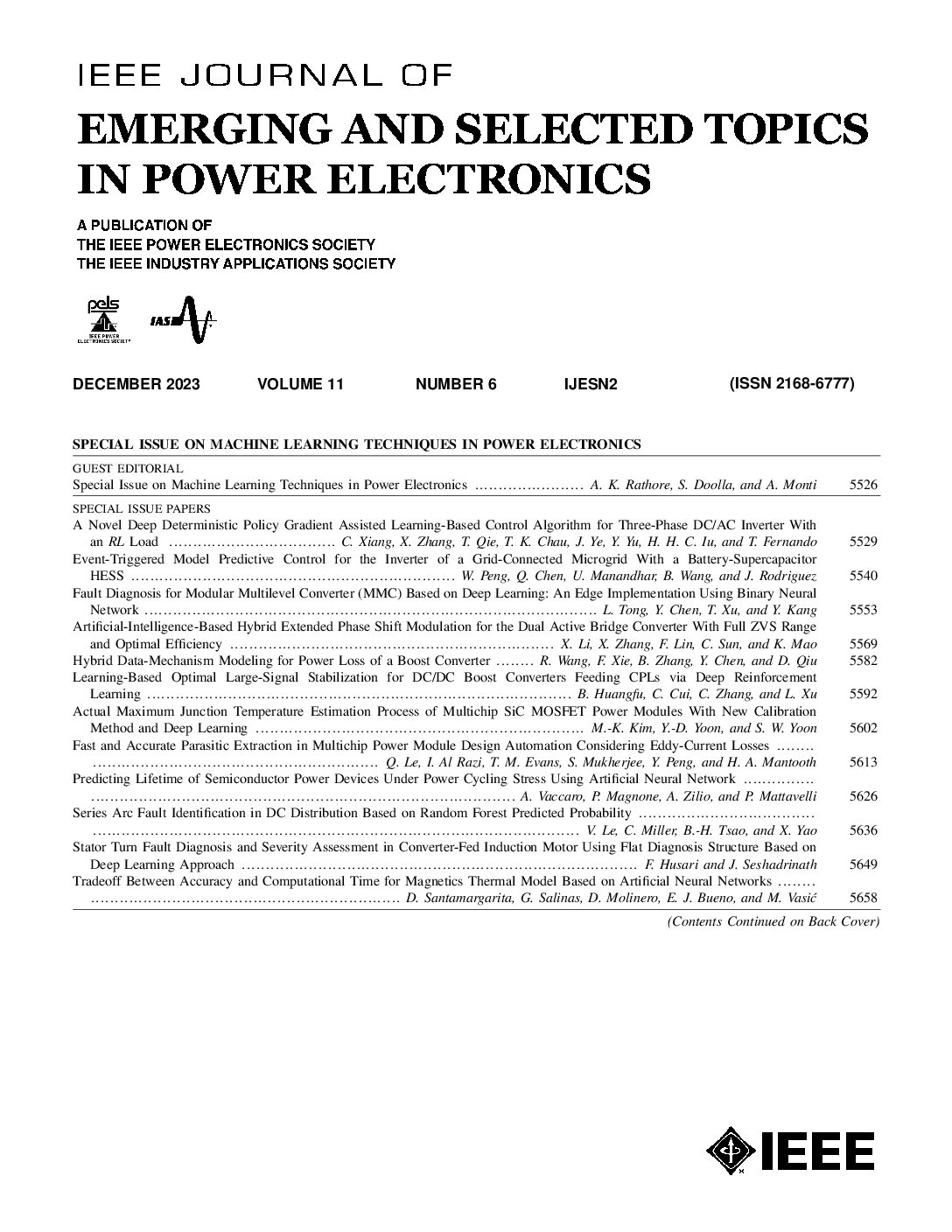
The aim of the journal is to enable the power electronics community to address the emerging and selected topics in power electronics in an agile fashion. It is a forum where multidisciplinary and discriminating technologies and applications are discussed by and for both practitioners and researchers on timely topics in power electronics from components to systems.




 京公网安备 11010802042870号
京ICP备2023020795号-1
京公网安备 11010802042870号
京ICP备2023020795号-1

 分享
分享
 求助内容:
求助内容: 应助结果提醒方式:
 扫码关注我们
