Shouyue Wang, Taiding Xu, Huitao Leng, Shengyu Liang, Wei Zhang, Yuheng Jin, Jingxia Qiu and Sheng Li
{"title":"用于先进钠离子电池的高熵 NASICON 型阴极的协同效应","authors":"Shouyue Wang, Taiding Xu, Huitao Leng, Shengyu Liang, Wei Zhang, Yuheng Jin, Jingxia Qiu and Sheng Li","doi":"10.1039/D4TA06950A","DOIUrl":null,"url":null,"abstract":"<p >Na<small><sub>3</sub></small>V<small><sub>2</sub></small>(PO<small><sub>4</sub></small>)<small><sub>3</sub></small> (NVP) is recognized as one of the most promising NASICON-type cathodes for sodium-ion storage. Enhancing electronic conductivity and further ensuring long-term structural stability when activating the high-voltage V<small><sup>4+</sup></small>/V<small><sup>5+</sup></small> redox reaction is crucial for the practical application of NVP cathodes. In this study, a high-entropy NVP cathode with carbon coating (Na<small><sub>3</sub></small>V<small><sub>1.5</sub></small>(CrMnFeMgAl)<small><sub>0.5</sub></small>(PO<small><sub>4</sub></small>)<small><sub>3</sub></small>@C, HE-NVMP@C) has been designed and synthesized. Due to the enhanced electronic/ionic conductivity facilitated by the carbon coating and lattice distortion from the high-entropy effect, HE-NVMP@C exhibits improved high-rate performance. Additionally, benefiting from the collaboration between the doped heteroatoms, HE-NVMP@C can effectively activate V<small><sup>3+</sup></small>/V<small><sup>4+</sup></small>/V<small><sup>5+</sup></small> redox reactions within the 2.5–4.3 V voltage window while maintaining excellent structural stability over extended cycles. This work provides an efficient approach to enhance the electrochemical performances of NASICON-type cathodes for sodium-ion batteries.</p>","PeriodicalId":82,"journal":{"name":"Journal of Materials Chemistry A","volume":" 48","pages":" 33617-33623"},"PeriodicalIF":9.5000,"publicationDate":"2024-11-12","publicationTypes":"Journal Article","fieldsOfStudy":null,"isOpenAccess":false,"openAccessPdf":"","citationCount":"0","resultStr":"{\"title\":\"Synergetic effects from a high-entropy NASICON-type cathode for advanced sodium-ion batteries†\",\"authors\":\"Shouyue Wang, Taiding Xu, Huitao Leng, Shengyu Liang, Wei Zhang, Yuheng Jin, Jingxia Qiu and Sheng Li\",\"doi\":\"10.1039/D4TA06950A\",\"DOIUrl\":null,\"url\":null,\"abstract\":\"<p >Na<small><sub>3</sub></small>V<small><sub>2</sub></small>(PO<small><sub>4</sub></small>)<small><sub>3</sub></small> (NVP) is recognized as one of the most promising NASICON-type cathodes for sodium-ion storage. Enhancing electronic conductivity and further ensuring long-term structural stability when activating the high-voltage V<small><sup>4+</sup></small>/V<small><sup>5+</sup></small> redox reaction is crucial for the practical application of NVP cathodes. In this study, a high-entropy NVP cathode with carbon coating (Na<small><sub>3</sub></small>V<small><sub>1.5</sub></small>(CrMnFeMgAl)<small><sub>0.5</sub></small>(PO<small><sub>4</sub></small>)<small><sub>3</sub></small>@C, HE-NVMP@C) has been designed and synthesized. Due to the enhanced electronic/ionic conductivity facilitated by the carbon coating and lattice distortion from the high-entropy effect, HE-NVMP@C exhibits improved high-rate performance. Additionally, benefiting from the collaboration between the doped heteroatoms, HE-NVMP@C can effectively activate V<small><sup>3+</sup></small>/V<small><sup>4+</sup></small>/V<small><sup>5+</sup></small> redox reactions within the 2.5–4.3 V voltage window while maintaining excellent structural stability over extended cycles. This work provides an efficient approach to enhance the electrochemical performances of NASICON-type cathodes for sodium-ion batteries.</p>\",\"PeriodicalId\":82,\"journal\":{\"name\":\"Journal of Materials Chemistry A\",\"volume\":\" 48\",\"pages\":\" 33617-33623\"},\"PeriodicalIF\":9.5000,\"publicationDate\":\"2024-11-12\",\"publicationTypes\":\"Journal Article\",\"fieldsOfStudy\":null,\"isOpenAccess\":false,\"openAccessPdf\":\"\",\"citationCount\":\"0\",\"resultStr\":null,\"platform\":\"Semanticscholar\",\"paperid\":null,\"PeriodicalName\":\"Journal of Materials Chemistry A\",\"FirstCategoryId\":\"88\",\"ListUrlMain\":\"https://pubs.rsc.org/en/content/articlelanding/2024/ta/d4ta06950a\",\"RegionNum\":2,\"RegionCategory\":\"材料科学\",\"ArticlePicture\":[],\"TitleCN\":null,\"AbstractTextCN\":null,\"PMCID\":null,\"EPubDate\":\"\",\"PubModel\":\"\",\"JCR\":\"Q1\",\"JCRName\":\"CHEMISTRY, PHYSICAL\",\"Score\":null,\"Total\":0}","platform":"Semanticscholar","paperid":null,"PeriodicalName":"Journal of Materials Chemistry A","FirstCategoryId":"88","ListUrlMain":"https://pubs.rsc.org/en/content/articlelanding/2024/ta/d4ta06950a","RegionNum":2,"RegionCategory":"材料科学","ArticlePicture":[],"TitleCN":null,"AbstractTextCN":null,"PMCID":null,"EPubDate":"","PubModel":"","JCR":"Q1","JCRName":"CHEMISTRY, PHYSICAL","Score":null,"Total":0}
Synergetic effects from a high-entropy NASICON-type cathode for advanced sodium-ion batteries†
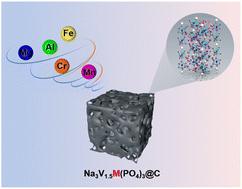
Na3V2(PO4)3 (NVP) is recognized as one of the most promising NASICON-type cathodes for sodium-ion storage. Enhancing electronic conductivity and further ensuring long-term structural stability when activating the high-voltage V4+/V5+ redox reaction is crucial for the practical application of NVP cathodes. In this study, a high-entropy NVP cathode with carbon coating (Na3V1.5(CrMnFeMgAl)0.5(PO4)3@C, HE-NVMP@C) has been designed and synthesized. Due to the enhanced electronic/ionic conductivity facilitated by the carbon coating and lattice distortion from the high-entropy effect, HE-NVMP@C exhibits improved high-rate performance. Additionally, benefiting from the collaboration between the doped heteroatoms, HE-NVMP@C can effectively activate V3+/V4+/V5+ redox reactions within the 2.5–4.3 V voltage window while maintaining excellent structural stability over extended cycles. This work provides an efficient approach to enhance the electrochemical performances of NASICON-type cathodes for sodium-ion batteries.
期刊介绍:
The Journal of Materials Chemistry A, B & C covers a wide range of high-quality studies in the field of materials chemistry, with each section focusing on specific applications of the materials studied. Journal of Materials Chemistry A emphasizes applications in energy and sustainability, including topics such as artificial photosynthesis, batteries, and fuel cells. Journal of Materials Chemistry B focuses on applications in biology and medicine, while Journal of Materials Chemistry C covers applications in optical, magnetic, and electronic devices. Example topic areas within the scope of Journal of Materials Chemistry A include catalysis, green/sustainable materials, sensors, and water treatment, among others.




 京公网安备 11010802042870号
京ICP备2023020795号-1
京公网安备 11010802042870号
京ICP备2023020795号-1

 分享
分享
 求助内容:
求助内容: 应助结果提醒方式:
 扫码关注我们
