{"title":"Thorase 缺乏症会导致小鼠大脑中 Aβ 积累和 tau 过度磷酸化","authors":"Han Zhang, Menghua Cai, Fei Gao, Jia Yang, Chao Li, Jingyi Han, Yue Wang, Yi Xu, Yu Hu, Hui Chen, Wei He, Jianmin Zhang","doi":"10.1002/alz.14329","DOIUrl":null,"url":null,"abstract":"<div>\n \n \n <section>\n \n <h3> INTRODUCTION</h3>\n \n <p>The pathogenesis of two major pathogenic characters—amyloid beta (Aβ) accumulation and hyperphosphorylated tau protein—in the brains of patients with Alzheimer's disease (AD) remains unclear.</p>\n </section>\n \n <section>\n \n <h3> METHODS</h3>\n \n <p>Western blot and immunofluorescence staining were performed to detect the proteins in the brains of Thorase conditional knockout/transgenic mice and their littermates. A co-immunoprecipitation assay was applied to examine the Thorase-interacting proteins.</p>\n </section>\n \n <section>\n \n <h3> RESULTS</h3>\n \n <p>Genetic deletion of Thorase resulted in tau hyperphosphorylation and promoted Aβ accumulation in the mouse brain. Conversely, Thorase overexpression alleviated the pathogenesis of AD. Thorase regulated the phosphorylation of tau by targeting specific kinases and theprotein phosphatase 2B (PP2B). Thorase deficiency also impaired microglial phagocytosis and induced neuroinflammation by the activation of the NOD-like receptor thermal protein domain associated protein 3 (NLRP3) inflammasomes in microglia.</p>\n </section>\n \n <section>\n \n <h3> DISCUSSION</h3>\n \n <p>Thorase may be a potential druggable target for developing therapeutic approaches to treat AD and other neurodegenerative diseases.</p>\n </section>\n \n <section>\n \n <h3> Highlights</h3>\n \n <div>\n <ul>\n \n <li>Thorase deletion leads to elevated amyloid beta (Aβ) deposition and hyperphosphorylated tau accumulation in the brain.</li>\n \n <li>Thorase regulates the phosphorylation of tau protein via PP2B.</li>\n \n <li>Thorase deficiency impairs microglial phagocytosis and promotesNLRP3-mediated neuroinflammation.</li>\n \n <li>Overexpression of Thorase alleviates Aβ deposition and tau phosphorylation in the AD mouse model.</li>\n </ul>\n </div>\n </section>\n </div>","PeriodicalId":7471,"journal":{"name":"Alzheimer's & Dementia","volume":"20 12","pages":"8769-8786"},"PeriodicalIF":11.1000,"publicationDate":"2024-11-13","publicationTypes":"Journal Article","fieldsOfStudy":null,"isOpenAccess":false,"openAccessPdf":"https://onlinelibrary.wiley.com/doi/epdf/10.1002/alz.14329","citationCount":"0","resultStr":"{\"title\":\"Thorase deficiency causes both Aβ accumulation and tau hyperphosphorylation in mouse brain\",\"authors\":\"Han Zhang, Menghua Cai, Fei Gao, Jia Yang, Chao Li, Jingyi Han, Yue Wang, Yi Xu, Yu Hu, Hui Chen, Wei He, Jianmin Zhang\",\"doi\":\"10.1002/alz.14329\",\"DOIUrl\":null,\"url\":null,\"abstract\":\"<div>\\n \\n \\n <section>\\n \\n <h3> INTRODUCTION</h3>\\n \\n <p>The pathogenesis of two major pathogenic characters—amyloid beta (Aβ) accumulation and hyperphosphorylated tau protein—in the brains of patients with Alzheimer's disease (AD) remains unclear.</p>\\n </section>\\n \\n <section>\\n \\n <h3> METHODS</h3>\\n \\n <p>Western blot and immunofluorescence staining were performed to detect the proteins in the brains of Thorase conditional knockout/transgenic mice and their littermates. A co-immunoprecipitation assay was applied to examine the Thorase-interacting proteins.</p>\\n </section>\\n \\n <section>\\n \\n <h3> RESULTS</h3>\\n \\n <p>Genetic deletion of Thorase resulted in tau hyperphosphorylation and promoted Aβ accumulation in the mouse brain. Conversely, Thorase overexpression alleviated the pathogenesis of AD. Thorase regulated the phosphorylation of tau by targeting specific kinases and theprotein phosphatase 2B (PP2B). Thorase deficiency also impaired microglial phagocytosis and induced neuroinflammation by the activation of the NOD-like receptor thermal protein domain associated protein 3 (NLRP3) inflammasomes in microglia.</p>\\n </section>\\n \\n <section>\\n \\n <h3> DISCUSSION</h3>\\n \\n <p>Thorase may be a potential druggable target for developing therapeutic approaches to treat AD and other neurodegenerative diseases.</p>\\n </section>\\n \\n <section>\\n \\n <h3> Highlights</h3>\\n \\n <div>\\n <ul>\\n \\n <li>Thorase deletion leads to elevated amyloid beta (Aβ) deposition and hyperphosphorylated tau accumulation in the brain.</li>\\n \\n <li>Thorase regulates the phosphorylation of tau protein via PP2B.</li>\\n \\n <li>Thorase deficiency impairs microglial phagocytosis and promotesNLRP3-mediated neuroinflammation.</li>\\n \\n <li>Overexpression of Thorase alleviates Aβ deposition and tau phosphorylation in the AD mouse model.</li>\\n </ul>\\n </div>\\n </section>\\n </div>\",\"PeriodicalId\":7471,\"journal\":{\"name\":\"Alzheimer's & Dementia\",\"volume\":\"20 12\",\"pages\":\"8769-8786\"},\"PeriodicalIF\":11.1000,\"publicationDate\":\"2024-11-13\",\"publicationTypes\":\"Journal Article\",\"fieldsOfStudy\":null,\"isOpenAccess\":false,\"openAccessPdf\":\"https://onlinelibrary.wiley.com/doi/epdf/10.1002/alz.14329\",\"citationCount\":\"0\",\"resultStr\":null,\"platform\":\"Semanticscholar\",\"paperid\":null,\"PeriodicalName\":\"Alzheimer's & Dementia\",\"FirstCategoryId\":\"3\",\"ListUrlMain\":\"https://alz-journals.onlinelibrary.wiley.com/doi/10.1002/alz.14329\",\"RegionNum\":1,\"RegionCategory\":\"医学\",\"ArticlePicture\":[],\"TitleCN\":null,\"AbstractTextCN\":null,\"PMCID\":null,\"EPubDate\":\"\",\"PubModel\":\"\",\"JCR\":\"Q1\",\"JCRName\":\"CLINICAL NEUROLOGY\",\"Score\":null,\"Total\":0}","platform":"Semanticscholar","paperid":null,"PeriodicalName":"Alzheimer's & Dementia","FirstCategoryId":"3","ListUrlMain":"https://alz-journals.onlinelibrary.wiley.com/doi/10.1002/alz.14329","RegionNum":1,"RegionCategory":"医学","ArticlePicture":[],"TitleCN":null,"AbstractTextCN":null,"PMCID":null,"EPubDate":"","PubModel":"","JCR":"Q1","JCRName":"CLINICAL NEUROLOGY","Score":null,"Total":0}
Thorase deficiency causes both Aβ accumulation and tau hyperphosphorylation in mouse brain
INTRODUCTION
The pathogenesis of two major pathogenic characters—amyloid beta (Aβ) accumulation and hyperphosphorylated tau protein—in the brains of patients with Alzheimer's disease (AD) remains unclear.
METHODS
Western blot and immunofluorescence staining were performed to detect the proteins in the brains of Thorase conditional knockout/transgenic mice and their littermates. A co-immunoprecipitation assay was applied to examine the Thorase-interacting proteins.
RESULTS
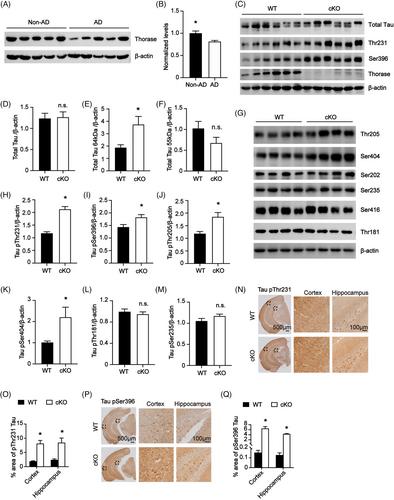
Genetic deletion of Thorase resulted in tau hyperphosphorylation and promoted Aβ accumulation in the mouse brain. Conversely, Thorase overexpression alleviated the pathogenesis of AD. Thorase regulated the phosphorylation of tau by targeting specific kinases and theprotein phosphatase 2B (PP2B). Thorase deficiency also impaired microglial phagocytosis and induced neuroinflammation by the activation of the NOD-like receptor thermal protein domain associated protein 3 (NLRP3) inflammasomes in microglia.
DISCUSSION
Thorase may be a potential druggable target for developing therapeutic approaches to treat AD and other neurodegenerative diseases.
Highlights
Thorase deletion leads to elevated amyloid beta (Aβ) deposition and hyperphosphorylated tau accumulation in the brain.
Thorase regulates the phosphorylation of tau protein via PP2B.
Thorase deficiency impairs microglial phagocytosis and promotesNLRP3-mediated neuroinflammation.
Overexpression of Thorase alleviates Aβ deposition and tau phosphorylation in the AD mouse model.
期刊介绍:
Alzheimer's & Dementia is a peer-reviewed journal that aims to bridge knowledge gaps in dementia research by covering the entire spectrum, from basic science to clinical trials to social and behavioral investigations. It provides a platform for rapid communication of new findings and ideas, optimal translation of research into practical applications, increasing knowledge across diverse disciplines for early detection, diagnosis, and intervention, and identifying promising new research directions. In July 2008, Alzheimer's & Dementia was accepted for indexing by MEDLINE, recognizing its scientific merit and contribution to Alzheimer's research.





 京公网安备 11010802042870号
京ICP备2023020795号-1
京公网安备 11010802042870号
京ICP备2023020795号-1

 分享
分享
 求助内容:
求助内容: 应助结果提醒方式:
 扫码关注我们
