Yu-Qian Mao, Shahrzad Jahanshahi, Ramy Malty, David A. J. Van Ommen, Yimei Wan, Trevor M. Morey, Stephanie H. W. Chuang, Veronika Pavlova, Choudhary Ahmed, Subha Dahal, Funing Lin, Maria Mangos, Jocelyn Nurtanto, Yuetong Song, Terek Been, Natasha Christie-Holmes, Scott D. Gray-Owen, Mohan Babu, Amy P. Wong, Robert A. Batey, Liliana Attisano, Alan Cochrane, Walid A. Houry
{"title":"将小分子靶向蛋白稳态作为开发泛冠状病毒抗病毒疗法的一种策略。","authors":"Yu-Qian Mao, Shahrzad Jahanshahi, Ramy Malty, David A. J. Van Ommen, Yimei Wan, Trevor M. Morey, Stephanie H. W. Chuang, Veronika Pavlova, Choudhary Ahmed, Subha Dahal, Funing Lin, Maria Mangos, Jocelyn Nurtanto, Yuetong Song, Terek Been, Natasha Christie-Holmes, Scott D. Gray-Owen, Mohan Babu, Amy P. Wong, Robert A. Batey, Liliana Attisano, Alan Cochrane, Walid A. Houry","doi":"10.1038/s42003-024-07143-z","DOIUrl":null,"url":null,"abstract":"The COVID-19 pandemic has created a global health crisis, with challenges arising from the ongoing evolution of the SARS-CoV-2 virus, the emergence of new strains, and the long-term effects of COVID-19. Aiming to overcome the development of viral resistance, our study here focused on developing broad-spectrum pan-coronavirus antiviral therapies by targeting host protein quality control mechanisms essential for viral replication. Screening an in-house compound library led to the discovery of three candidate compounds targeting cellular proteostasis. The three compounds are (1) the nucleotide analog cordycepin, (2) a benzothiozole analog, and (3) an acyldepsipeptide analog initially developed as part of a campaign to target the mitochondrial ClpP protease. These compounds demonstrated dose-dependent efficacy against multiple coronaviruses, including SARS-CoV-2, effectively inhibiting viral replication in vitro as well as in lung organoids. Notably, the compounds also showed efficacy against SARS-CoV-2 delta and omicron strains. As part of this work, we developed a BSL2-level cell-integrated SARS-CoV-2 replicon, which could serve as a valuable tool for high-throughput screening and studying intracellular viral replication. Our study should aid in the advancement of antiviral drug development efforts. A Study Identifies Broad-Spectrum Pan-Coronavirus Antiviral Drugs Targeting Host Protein Quality Control Mechanisms And Reports Development Of A Bsl2-Level Cell-Integrated Sars-Cov-2 Replicon, Which Can Be Used For High-Throughput Screening.","PeriodicalId":10552,"journal":{"name":"Communications Biology","volume":" ","pages":"1-19"},"PeriodicalIF":5.1000,"publicationDate":"2024-11-07","publicationTypes":"Journal Article","fieldsOfStudy":null,"isOpenAccess":false,"openAccessPdf":"https://www.ncbi.nlm.nih.gov/pmc/articles/PMC11543989/pdf/","citationCount":"0","resultStr":"{\"title\":\"Targeting protein homeostasis with small molecules as a strategy for the development of pan-coronavirus antiviral therapies\",\"authors\":\"Yu-Qian Mao, Shahrzad Jahanshahi, Ramy Malty, David A. J. Van Ommen, Yimei Wan, Trevor M. Morey, Stephanie H. W. Chuang, Veronika Pavlova, Choudhary Ahmed, Subha Dahal, Funing Lin, Maria Mangos, Jocelyn Nurtanto, Yuetong Song, Terek Been, Natasha Christie-Holmes, Scott D. Gray-Owen, Mohan Babu, Amy P. Wong, Robert A. Batey, Liliana Attisano, Alan Cochrane, Walid A. Houry\",\"doi\":\"10.1038/s42003-024-07143-z\",\"DOIUrl\":null,\"url\":null,\"abstract\":\"The COVID-19 pandemic has created a global health crisis, with challenges arising from the ongoing evolution of the SARS-CoV-2 virus, the emergence of new strains, and the long-term effects of COVID-19. Aiming to overcome the development of viral resistance, our study here focused on developing broad-spectrum pan-coronavirus antiviral therapies by targeting host protein quality control mechanisms essential for viral replication. Screening an in-house compound library led to the discovery of three candidate compounds targeting cellular proteostasis. The three compounds are (1) the nucleotide analog cordycepin, (2) a benzothiozole analog, and (3) an acyldepsipeptide analog initially developed as part of a campaign to target the mitochondrial ClpP protease. These compounds demonstrated dose-dependent efficacy against multiple coronaviruses, including SARS-CoV-2, effectively inhibiting viral replication in vitro as well as in lung organoids. Notably, the compounds also showed efficacy against SARS-CoV-2 delta and omicron strains. As part of this work, we developed a BSL2-level cell-integrated SARS-CoV-2 replicon, which could serve as a valuable tool for high-throughput screening and studying intracellular viral replication. Our study should aid in the advancement of antiviral drug development efforts. A Study Identifies Broad-Spectrum Pan-Coronavirus Antiviral Drugs Targeting Host Protein Quality Control Mechanisms And Reports Development Of A Bsl2-Level Cell-Integrated Sars-Cov-2 Replicon, Which Can Be Used For High-Throughput Screening.\",\"PeriodicalId\":10552,\"journal\":{\"name\":\"Communications Biology\",\"volume\":\" \",\"pages\":\"1-19\"},\"PeriodicalIF\":5.1000,\"publicationDate\":\"2024-11-07\",\"publicationTypes\":\"Journal Article\",\"fieldsOfStudy\":null,\"isOpenAccess\":false,\"openAccessPdf\":\"https://www.ncbi.nlm.nih.gov/pmc/articles/PMC11543989/pdf/\",\"citationCount\":\"0\",\"resultStr\":null,\"platform\":\"Semanticscholar\",\"paperid\":null,\"PeriodicalName\":\"Communications Biology\",\"FirstCategoryId\":\"99\",\"ListUrlMain\":\"https://www.nature.com/articles/s42003-024-07143-z\",\"RegionNum\":1,\"RegionCategory\":\"生物学\",\"ArticlePicture\":[],\"TitleCN\":null,\"AbstractTextCN\":null,\"PMCID\":null,\"EPubDate\":\"\",\"PubModel\":\"\",\"JCR\":\"Q1\",\"JCRName\":\"BIOLOGY\",\"Score\":null,\"Total\":0}","platform":"Semanticscholar","paperid":null,"PeriodicalName":"Communications Biology","FirstCategoryId":"99","ListUrlMain":"https://www.nature.com/articles/s42003-024-07143-z","RegionNum":1,"RegionCategory":"生物学","ArticlePicture":[],"TitleCN":null,"AbstractTextCN":null,"PMCID":null,"EPubDate":"","PubModel":"","JCR":"Q1","JCRName":"BIOLOGY","Score":null,"Total":0}
Targeting protein homeostasis with small molecules as a strategy for the development of pan-coronavirus antiviral therapies
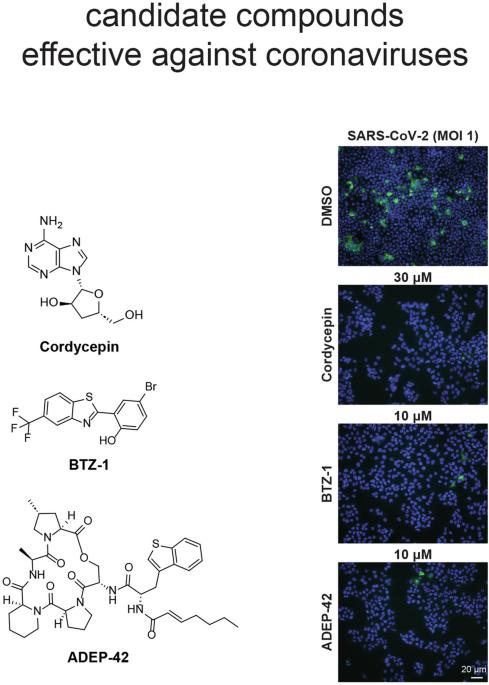
The COVID-19 pandemic has created a global health crisis, with challenges arising from the ongoing evolution of the SARS-CoV-2 virus, the emergence of new strains, and the long-term effects of COVID-19. Aiming to overcome the development of viral resistance, our study here focused on developing broad-spectrum pan-coronavirus antiviral therapies by targeting host protein quality control mechanisms essential for viral replication. Screening an in-house compound library led to the discovery of three candidate compounds targeting cellular proteostasis. The three compounds are (1) the nucleotide analog cordycepin, (2) a benzothiozole analog, and (3) an acyldepsipeptide analog initially developed as part of a campaign to target the mitochondrial ClpP protease. These compounds demonstrated dose-dependent efficacy against multiple coronaviruses, including SARS-CoV-2, effectively inhibiting viral replication in vitro as well as in lung organoids. Notably, the compounds also showed efficacy against SARS-CoV-2 delta and omicron strains. As part of this work, we developed a BSL2-level cell-integrated SARS-CoV-2 replicon, which could serve as a valuable tool for high-throughput screening and studying intracellular viral replication. Our study should aid in the advancement of antiviral drug development efforts. A Study Identifies Broad-Spectrum Pan-Coronavirus Antiviral Drugs Targeting Host Protein Quality Control Mechanisms And Reports Development Of A Bsl2-Level Cell-Integrated Sars-Cov-2 Replicon, Which Can Be Used For High-Throughput Screening.
期刊介绍:
Communications Biology is an open access journal from Nature Research publishing high-quality research, reviews and commentary in all areas of the biological sciences. Research papers published by the journal represent significant advances bringing new biological insight to a specialized area of research.




 京公网安备 11010802042870号
京ICP备2023020795号-1
京公网安备 11010802042870号
京ICP备2023020795号-1

 分享
分享
 求助内容:
求助内容: 应助结果提醒方式:
 扫码关注我们
