Angelo M. Dell’Aquila MD, MBA , Konrad Wisniewski MD , Adrian-Iustin Georgevici MD , Gábor Szabó MD , Francesco Onorati MD , Cecilia Rossetti MD , Lenard Conradi MD , Till Demal MD , Andreas Rukosujew MD , Sven Peterss MD , Radner Caroline MD , Joscha Buech MD , Antonio Fiore MD , Thierry Folliguet MD , Andrea Perrotti MD , Amélie Hervé MD , Francesco Nappi MD , Angel G. Pinto MD , Javier Rodriguez Lega MD , Marek Pol MD , Fausto Biancari MD
{"title":"急性 A 型主动脉夹层修复术患者的灌注不良综合征:表现、死亡率和宾夕法尼亚分类法的实用性。","authors":"Angelo M. Dell’Aquila MD, MBA , Konrad Wisniewski MD , Adrian-Iustin Georgevici MD , Gábor Szabó MD , Francesco Onorati MD , Cecilia Rossetti MD , Lenard Conradi MD , Till Demal MD , Andreas Rukosujew MD , Sven Peterss MD , Radner Caroline MD , Joscha Buech MD , Antonio Fiore MD , Thierry Folliguet MD , Andrea Perrotti MD , Amélie Hervé MD , Francesco Nappi MD , Angel G. Pinto MD , Javier Rodriguez Lega MD , Marek Pol MD , Fausto Biancari MD","doi":"10.1016/j.jtcvs.2024.11.003","DOIUrl":null,"url":null,"abstract":"<div><h3>Background</h3><div>The current study aims to report the presentation of the malperfusion syndrome in patients with acute type A aortic dissection admitted to surgery and its impact on mortality.</div></div><div><h3>Methods</h3><div>Data were retrieved from the multicenter European Registry of Type A Aortic Dissection. The Penn classification was used to categorize malperfusion syndromes. A machine-learning algorithm was applied to assess the multivariate interaction's importance regarding in-hospital mortality.</div></div><div><h3>Results</h3><div>A total of 3902 consecutive patients underwent repair for acute type A aortic dissection. Local malperfusion syndrome occurred in 1584 (40.59%) patients. Multiorgan involvement occurred in 582 patients (36.74%) whereas 1002 patients (63.26%) had single-organ malperfusion. The prevalence was the greatest for cerebral (21.27%) followed by peripheral (13.94%), myocardial (9.7%), renal (9.33%), mesenteric (4.15%), and spinal malperfusion (2.10%). Multiorgan involvement predominantly occurred in organs perfused by the downstream aorta. Malperfusion significantly increased the risk of mortality (<em>P</em> < .001; odds ratio, 1.94 ± 0.29). The Boruta machine-learning algorithm identified the Penn classification as significantly associated with in-hospital mortality (<em>P</em> < .0001, variable importance = 7.91); however, 8 other variables yielded greater prediction importance. According to the Penn classification, mortality rates were 12.38% for Penn A, 20.71% for Penn B, 28.90% for Penn C, and 31.84% for Penn BC, respectively.</div></div><div><h3>Conclusions</h3><div>Nearly one half of the examined cohort presented with signs of malperfusion syndrome predominantly attributable to local involvement. More than one third of patients with local malperfusion syndrome had a multivessel involvement. Furthermore, different levels of Penn classification can be used only as a first tool for preliminary stratification of early mortality risk.</div></div>","PeriodicalId":49975,"journal":{"name":"Journal of Thoracic and Cardiovascular Surgery","volume":"170 3","pages":"Pages 687-697"},"PeriodicalIF":4.7000,"publicationDate":"2025-09-01","publicationTypes":"Journal Article","fieldsOfStudy":null,"isOpenAccess":false,"openAccessPdf":"","citationCount":"0","resultStr":"{\"title\":\"Malperfusion syndrome in patients undergoing repair for acute type A aortic dissection: Presentation, mortality, and utility of the Penn classification\",\"authors\":\"Angelo M. Dell’Aquila MD, MBA , Konrad Wisniewski MD , Adrian-Iustin Georgevici MD , Gábor Szabó MD , Francesco Onorati MD , Cecilia Rossetti MD , Lenard Conradi MD , Till Demal MD , Andreas Rukosujew MD , Sven Peterss MD , Radner Caroline MD , Joscha Buech MD , Antonio Fiore MD , Thierry Folliguet MD , Andrea Perrotti MD , Amélie Hervé MD , Francesco Nappi MD , Angel G. Pinto MD , Javier Rodriguez Lega MD , Marek Pol MD , Fausto Biancari MD\",\"doi\":\"10.1016/j.jtcvs.2024.11.003\",\"DOIUrl\":null,\"url\":null,\"abstract\":\"<div><h3>Background</h3><div>The current study aims to report the presentation of the malperfusion syndrome in patients with acute type A aortic dissection admitted to surgery and its impact on mortality.</div></div><div><h3>Methods</h3><div>Data were retrieved from the multicenter European Registry of Type A Aortic Dissection. The Penn classification was used to categorize malperfusion syndromes. A machine-learning algorithm was applied to assess the multivariate interaction's importance regarding in-hospital mortality.</div></div><div><h3>Results</h3><div>A total of 3902 consecutive patients underwent repair for acute type A aortic dissection. Local malperfusion syndrome occurred in 1584 (40.59%) patients. Multiorgan involvement occurred in 582 patients (36.74%) whereas 1002 patients (63.26%) had single-organ malperfusion. The prevalence was the greatest for cerebral (21.27%) followed by peripheral (13.94%), myocardial (9.7%), renal (9.33%), mesenteric (4.15%), and spinal malperfusion (2.10%). Multiorgan involvement predominantly occurred in organs perfused by the downstream aorta. Malperfusion significantly increased the risk of mortality (<em>P</em> < .001; odds ratio, 1.94 ± 0.29). The Boruta machine-learning algorithm identified the Penn classification as significantly associated with in-hospital mortality (<em>P</em> < .0001, variable importance = 7.91); however, 8 other variables yielded greater prediction importance. According to the Penn classification, mortality rates were 12.38% for Penn A, 20.71% for Penn B, 28.90% for Penn C, and 31.84% for Penn BC, respectively.</div></div><div><h3>Conclusions</h3><div>Nearly one half of the examined cohort presented with signs of malperfusion syndrome predominantly attributable to local involvement. More than one third of patients with local malperfusion syndrome had a multivessel involvement. Furthermore, different levels of Penn classification can be used only as a first tool for preliminary stratification of early mortality risk.</div></div>\",\"PeriodicalId\":49975,\"journal\":{\"name\":\"Journal of Thoracic and Cardiovascular Surgery\",\"volume\":\"170 3\",\"pages\":\"Pages 687-697\"},\"PeriodicalIF\":4.7000,\"publicationDate\":\"2025-09-01\",\"publicationTypes\":\"Journal Article\",\"fieldsOfStudy\":null,\"isOpenAccess\":false,\"openAccessPdf\":\"\",\"citationCount\":\"0\",\"resultStr\":null,\"platform\":\"Semanticscholar\",\"paperid\":null,\"PeriodicalName\":\"Journal of Thoracic and Cardiovascular Surgery\",\"FirstCategoryId\":\"3\",\"ListUrlMain\":\"https://www.sciencedirect.com/science/article/pii/S0022522324010304\",\"RegionNum\":1,\"RegionCategory\":\"医学\",\"ArticlePicture\":[],\"TitleCN\":null,\"AbstractTextCN\":null,\"PMCID\":null,\"EPubDate\":\"2024/11/9 0:00:00\",\"PubModel\":\"Epub\",\"JCR\":\"Q1\",\"JCRName\":\"CARDIAC & CARDIOVASCULAR SYSTEMS\",\"Score\":null,\"Total\":0}","platform":"Semanticscholar","paperid":null,"PeriodicalName":"Journal of Thoracic and Cardiovascular Surgery","FirstCategoryId":"3","ListUrlMain":"https://www.sciencedirect.com/science/article/pii/S0022522324010304","RegionNum":1,"RegionCategory":"医学","ArticlePicture":[],"TitleCN":null,"AbstractTextCN":null,"PMCID":null,"EPubDate":"2024/11/9 0:00:00","PubModel":"Epub","JCR":"Q1","JCRName":"CARDIAC & CARDIOVASCULAR SYSTEMS","Score":null,"Total":0}
引用次数: 0
摘要
背景:本研究旨在报告入院手术的急性A型主动脉夹层患者的灌注不良综合征表现及其对死亡率的影响:本研究旨在报告接受手术的急性 A 型主动脉夹层患者出现灌注不良综合征的情况及其对死亡率的影响:数据取自欧洲 A 型主动脉夹层多中心登记处 (ERTAAD)。采用宾夕法尼亚分类法对灌注不良综合征进行分类。应用机器学习算法评估多变量相互作用对院内死亡率的重要性:共有3902名急性A型主动脉夹层患者接受了修复手术。1584例(40.58%)患者出现局部灌注不良综合征。582名患者(36.74%)出现多器官受累,1002名患者(63.26%)出现单器官灌注不良。发病率最高的是脑部(21.27%),其次是外周(13.94%)、心肌(9.7%)、肾脏(9.33%)、肠系膜(4.15%)和脊髓(2.10%)灌注不良。多器官受累主要发生在下游主动脉灌注的器官。灌注不良会明显增加死亡风险(P < 0.001,OR 1.95 ± 0.29)。Boruta 机器学习算法认为宾恩分类与院内死亡率有显著相关性(p< 0.0001,变量重要性 = 7.91),但其他 8 个变量的预测重要性更高。根据宾夕法尼亚分类法,死亡率分别为宾夕法尼亚A=12.38%、宾夕法尼亚B=20.71%、宾夕法尼亚C=28.90%和宾夕法尼亚BC=31.84%:近一半的受检者出现了灌注不良综合征的症状,主要是由于局部受累。超过三分之一的局部灌注不良综合征患者有多血管受累。此外,佩恩分类的不同级别只能作为初步分层早期死亡风险的第一工具。
Malperfusion syndrome in patients undergoing repair for acute type A aortic dissection: Presentation, mortality, and utility of the Penn classification
Background
The current study aims to report the presentation of the malperfusion syndrome in patients with acute type A aortic dissection admitted to surgery and its impact on mortality.
Methods
Data were retrieved from the multicenter European Registry of Type A Aortic Dissection. The Penn classification was used to categorize malperfusion syndromes. A machine-learning algorithm was applied to assess the multivariate interaction's importance regarding in-hospital mortality.
Results
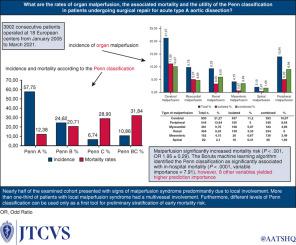
A total of 3902 consecutive patients underwent repair for acute type A aortic dissection. Local malperfusion syndrome occurred in 1584 (40.59%) patients. Multiorgan involvement occurred in 582 patients (36.74%) whereas 1002 patients (63.26%) had single-organ malperfusion. The prevalence was the greatest for cerebral (21.27%) followed by peripheral (13.94%), myocardial (9.7%), renal (9.33%), mesenteric (4.15%), and spinal malperfusion (2.10%). Multiorgan involvement predominantly occurred in organs perfused by the downstream aorta. Malperfusion significantly increased the risk of mortality (P < .001; odds ratio, 1.94 ± 0.29). The Boruta machine-learning algorithm identified the Penn classification as significantly associated with in-hospital mortality (P < .0001, variable importance = 7.91); however, 8 other variables yielded greater prediction importance. According to the Penn classification, mortality rates were 12.38% for Penn A, 20.71% for Penn B, 28.90% for Penn C, and 31.84% for Penn BC, respectively.
Conclusions
Nearly one half of the examined cohort presented with signs of malperfusion syndrome predominantly attributable to local involvement. More than one third of patients with local malperfusion syndrome had a multivessel involvement. Furthermore, different levels of Penn classification can be used only as a first tool for preliminary stratification of early mortality risk.
期刊介绍:
The Journal of Thoracic and Cardiovascular Surgery presents original, peer-reviewed articles on diseases of the heart, great vessels, lungs and thorax with emphasis on surgical interventions. An official publication of The American Association for Thoracic Surgery and The Western Thoracic Surgical Association, the Journal focuses on techniques and developments in acquired cardiac surgery, congenital cardiac repair, thoracic procedures, heart and lung transplantation, mechanical circulatory support and other procedures.




 京公网安备 11010802042870号
京ICP备2023020795号-1
京公网安备 11010802042870号
京ICP备2023020795号-1

 分享
分享
 求助内容:
求助内容: 应助结果提醒方式:
 扫码关注我们
