Ting Hu , Di Lan , Jian Wang , Xiaozhong Zhong , Guixian Bu , Pengfei Yin
{"title":"构建具有丰富异质界面的 NiCo2O4/NiCoO2 共嵌多孔生物碳,实现优异的微波辐射抑菌防护性能","authors":"Ting Hu , Di Lan , Jian Wang , Xiaozhong Zhong , Guixian Bu , Pengfei Yin","doi":"10.1016/j.carbon.2024.119798","DOIUrl":null,"url":null,"abstract":"<div><div>To attain the stable protection against electromagnetic radiation pollution in complex bacterial environment, herein the NiCo<sub>2</sub>O<sub>4</sub> and NiCoO<sub>2</sub> co-embedded porous bio-carbon (PBC) with outstanding microwave absorption and anti-bacterial ability was successfully obtained via facile carbonization and immersion-annealing route. The component and microstructure of composites are both tightly affected by the synthetic temperature, which also influences the oxygen vacancy content and defect density within them. The strong interface polarizations from plentiful heterogeneous interfaces and dipole polarizations generated by defects and vacancies contribute greatly to the dielectric absorption, while the eddy-current loss and magnetic resonances have a certain effect as well. Under the matched impedance from magnetic-dielectric balance, the optimized absorption strength of prepared composite achieves −38.2 dB at 2.0 mm thickness with broad absorbing bandwidth of 7.01 GHz for only 2.31 mm. Moreover, the plentiful oxygen vacancies induced reactive oxygen species (ROS) together with heavy metal ions from nickel-cobalt ferrites can suppress the reproduction of Gram negative <em>Escherichia coli</em> (<em>E. coli</em>) and Gram positive <em>Staphylococcus aureus</em> (<em>S. aureus</em>) with anti-bacterial rates of 92.4 % and 93.2 %, respectively. The paper offers a novel insight to design dual-functional microwave absorber with excellent bacteriostatic performance for long-term using in complex bacterial environment.</div></div>","PeriodicalId":262,"journal":{"name":"Carbon","volume":"232 ","pages":"Article 119798"},"PeriodicalIF":11.6000,"publicationDate":"2025-01-15","publicationTypes":"Journal Article","fieldsOfStudy":null,"isOpenAccess":false,"openAccessPdf":"","citationCount":"0","resultStr":"{\"title\":\"Construction of NiCo2O4/NiCoO2 co-embedded porous bio-carbon with rich heterogeneous interfaces for excellent bacteriostatic microwave radiation protection\",\"authors\":\"Ting Hu , Di Lan , Jian Wang , Xiaozhong Zhong , Guixian Bu , Pengfei Yin\",\"doi\":\"10.1016/j.carbon.2024.119798\",\"DOIUrl\":null,\"url\":null,\"abstract\":\"<div><div>To attain the stable protection against electromagnetic radiation pollution in complex bacterial environment, herein the NiCo<sub>2</sub>O<sub>4</sub> and NiCoO<sub>2</sub> co-embedded porous bio-carbon (PBC) with outstanding microwave absorption and anti-bacterial ability was successfully obtained via facile carbonization and immersion-annealing route. The component and microstructure of composites are both tightly affected by the synthetic temperature, which also influences the oxygen vacancy content and defect density within them. The strong interface polarizations from plentiful heterogeneous interfaces and dipole polarizations generated by defects and vacancies contribute greatly to the dielectric absorption, while the eddy-current loss and magnetic resonances have a certain effect as well. Under the matched impedance from magnetic-dielectric balance, the optimized absorption strength of prepared composite achieves −38.2 dB at 2.0 mm thickness with broad absorbing bandwidth of 7.01 GHz for only 2.31 mm. Moreover, the plentiful oxygen vacancies induced reactive oxygen species (ROS) together with heavy metal ions from nickel-cobalt ferrites can suppress the reproduction of Gram negative <em>Escherichia coli</em> (<em>E. coli</em>) and Gram positive <em>Staphylococcus aureus</em> (<em>S. aureus</em>) with anti-bacterial rates of 92.4 % and 93.2 %, respectively. The paper offers a novel insight to design dual-functional microwave absorber with excellent bacteriostatic performance for long-term using in complex bacterial environment.</div></div>\",\"PeriodicalId\":262,\"journal\":{\"name\":\"Carbon\",\"volume\":\"232 \",\"pages\":\"Article 119798\"},\"PeriodicalIF\":11.6000,\"publicationDate\":\"2025-01-15\",\"publicationTypes\":\"Journal Article\",\"fieldsOfStudy\":null,\"isOpenAccess\":false,\"openAccessPdf\":\"\",\"citationCount\":\"0\",\"resultStr\":null,\"platform\":\"Semanticscholar\",\"paperid\":null,\"PeriodicalName\":\"Carbon\",\"FirstCategoryId\":\"88\",\"ListUrlMain\":\"https://www.sciencedirect.com/science/article/pii/S0008622324010170\",\"RegionNum\":2,\"RegionCategory\":\"材料科学\",\"ArticlePicture\":[],\"TitleCN\":null,\"AbstractTextCN\":null,\"PMCID\":null,\"EPubDate\":\"2024/11/4 0:00:00\",\"PubModel\":\"Epub\",\"JCR\":\"Q1\",\"JCRName\":\"CHEMISTRY, PHYSICAL\",\"Score\":null,\"Total\":0}","platform":"Semanticscholar","paperid":null,"PeriodicalName":"Carbon","FirstCategoryId":"88","ListUrlMain":"https://www.sciencedirect.com/science/article/pii/S0008622324010170","RegionNum":2,"RegionCategory":"材料科学","ArticlePicture":[],"TitleCN":null,"AbstractTextCN":null,"PMCID":null,"EPubDate":"2024/11/4 0:00:00","PubModel":"Epub","JCR":"Q1","JCRName":"CHEMISTRY, PHYSICAL","Score":null,"Total":0}
引用次数: 0
摘要
为了在复杂的细菌环境中实现对电磁辐射污染的稳定防护,本文通过简便的碳化和浸渍-退火工艺,成功获得了具有优异微波吸收和抗菌能力的镍钴氧化物和镍钴氧化物共嵌多孔生物碳(PBC)。复合材料的组分和微观结构都受到合成温度的严格影响,而合成温度也会影响其中的氧空位含量和缺陷密度。丰富的异质界面产生的强界面极化以及缺陷和空位产生的偶极极化对介质吸收有很大的影响,同时涡流损耗和磁共振也有一定的影响。在磁介质平衡的匹配阻抗条件下,制备的复合材料在厚度为 2.0 mm 时的优化吸收强度达到了 -38.2 dB,仅 2.31 mm 就具有 7.01 GHz 的宽吸收带宽。此外,镍钴铁氧体中丰富的氧空位诱导的活性氧(ROS)和重金属离子可抑制革兰氏阴性大肠杆菌(E. coli)和革兰氏阳性金黄色葡萄球菌(S. aureus)的繁殖,抗菌率分别为 92.4 % 和 93.2 %。该论文为设计具有优异抑菌性能的双功能微波吸收器提供了新的思路,使其能够在复杂的细菌环境中长期使用。
Construction of NiCo2O4/NiCoO2 co-embedded porous bio-carbon with rich heterogeneous interfaces for excellent bacteriostatic microwave radiation protection
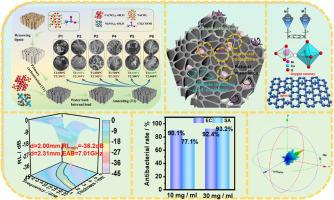
To attain the stable protection against electromagnetic radiation pollution in complex bacterial environment, herein the NiCo2O4 and NiCoO2 co-embedded porous bio-carbon (PBC) with outstanding microwave absorption and anti-bacterial ability was successfully obtained via facile carbonization and immersion-annealing route. The component and microstructure of composites are both tightly affected by the synthetic temperature, which also influences the oxygen vacancy content and defect density within them. The strong interface polarizations from plentiful heterogeneous interfaces and dipole polarizations generated by defects and vacancies contribute greatly to the dielectric absorption, while the eddy-current loss and magnetic resonances have a certain effect as well. Under the matched impedance from magnetic-dielectric balance, the optimized absorption strength of prepared composite achieves −38.2 dB at 2.0 mm thickness with broad absorbing bandwidth of 7.01 GHz for only 2.31 mm. Moreover, the plentiful oxygen vacancies induced reactive oxygen species (ROS) together with heavy metal ions from nickel-cobalt ferrites can suppress the reproduction of Gram negative Escherichia coli (E. coli) and Gram positive Staphylococcus aureus (S. aureus) with anti-bacterial rates of 92.4 % and 93.2 %, respectively. The paper offers a novel insight to design dual-functional microwave absorber with excellent bacteriostatic performance for long-term using in complex bacterial environment.
期刊介绍:
The journal Carbon is an international multidisciplinary forum for communicating scientific advances in the field of carbon materials. It reports new findings related to the formation, structure, properties, behaviors, and technological applications of carbons. Carbons are a broad class of ordered or disordered solid phases composed primarily of elemental carbon, including but not limited to carbon black, carbon fibers and filaments, carbon nanotubes, diamond and diamond-like carbon, fullerenes, glassy carbon, graphite, graphene, graphene-oxide, porous carbons, pyrolytic carbon, and other sp2 and non-sp2 hybridized carbon systems. Carbon is the companion title to the open access journal Carbon Trends. Relevant application areas for carbon materials include biology and medicine, catalysis, electronic, optoelectronic, spintronic, high-frequency, and photonic devices, energy storage and conversion systems, environmental applications and water treatment, smart materials and systems, and structural and thermal applications.



 京公网安备 11010802042870号
京ICP备2023020795号-1
京公网安备 11010802042870号
京ICP备2023020795号-1

 分享
分享
 求助内容:
求助内容: 应助结果提醒方式:
 扫码关注我们
