Chen Sun , Fei Gao , Jun-Yang Wu , Yiqiao Yang , Qiang Sun
{"title":"提取自微晶纤维素的硬碳,可实现稳健的低电位钠储存","authors":"Chen Sun , Fei Gao , Jun-Yang Wu , Yiqiao Yang , Qiang Sun","doi":"10.1016/j.carbon.2024.119771","DOIUrl":null,"url":null,"abstract":"<div><div>Developing hard carbon with unique and regulable microstructure is the key for the development of sodium ion batteries (SIBs), while the poor low-potential sodium storage property as well as ambiguous sodium storage mechanism arising from the intricate pseudo-graphitic and graphite-like structures present a great challenge to the commercialization of SIBs. Herein, microcrystalline cellulose was proposed as carbon precursor to synthesis hard carbons by controlling carbonization temperature. As expected, the resulting hard carbons simultaneously contained pseudo-graphitic and graphite-like structures, and in situ XRD analysis suggested that a larger interlayer spacing of pseudo-graphitic structure facilitated Na<sup>+</sup> insertion, whereas smaller spacing of graphite-like structure could enhance the electrical conductivity. As a result of the optimized carbonization temperature of 1400 °C, the obtained hard carbon with larger interlayer spacing, reduced defect sites, and more closed pores, displayed an initial discharge capacity of 376.7 mA h g<sup>−1</sup> with low-potential plateau capacity ratio of 57.58 % and a high initial Coulomb efficiency of 84.32 %, while an increased plateau capacity ratio of 63.91 % in the second discharge process using an ester-based electrolyte.</div></div>","PeriodicalId":262,"journal":{"name":"Carbon","volume":"232 ","pages":"Article 119771"},"PeriodicalIF":11.6000,"publicationDate":"2024-10-28","publicationTypes":"Journal Article","fieldsOfStudy":null,"isOpenAccess":false,"openAccessPdf":"","citationCount":"0","resultStr":"{\"title\":\"Microcrystalline cellulose-derived hard carbon for robust and low-potential sodium storage\",\"authors\":\"Chen Sun , Fei Gao , Jun-Yang Wu , Yiqiao Yang , Qiang Sun\",\"doi\":\"10.1016/j.carbon.2024.119771\",\"DOIUrl\":null,\"url\":null,\"abstract\":\"<div><div>Developing hard carbon with unique and regulable microstructure is the key for the development of sodium ion batteries (SIBs), while the poor low-potential sodium storage property as well as ambiguous sodium storage mechanism arising from the intricate pseudo-graphitic and graphite-like structures present a great challenge to the commercialization of SIBs. Herein, microcrystalline cellulose was proposed as carbon precursor to synthesis hard carbons by controlling carbonization temperature. As expected, the resulting hard carbons simultaneously contained pseudo-graphitic and graphite-like structures, and in situ XRD analysis suggested that a larger interlayer spacing of pseudo-graphitic structure facilitated Na<sup>+</sup> insertion, whereas smaller spacing of graphite-like structure could enhance the electrical conductivity. As a result of the optimized carbonization temperature of 1400 °C, the obtained hard carbon with larger interlayer spacing, reduced defect sites, and more closed pores, displayed an initial discharge capacity of 376.7 mA h g<sup>−1</sup> with low-potential plateau capacity ratio of 57.58 % and a high initial Coulomb efficiency of 84.32 %, while an increased plateau capacity ratio of 63.91 % in the second discharge process using an ester-based electrolyte.</div></div>\",\"PeriodicalId\":262,\"journal\":{\"name\":\"Carbon\",\"volume\":\"232 \",\"pages\":\"Article 119771\"},\"PeriodicalIF\":11.6000,\"publicationDate\":\"2024-10-28\",\"publicationTypes\":\"Journal Article\",\"fieldsOfStudy\":null,\"isOpenAccess\":false,\"openAccessPdf\":\"\",\"citationCount\":\"0\",\"resultStr\":null,\"platform\":\"Semanticscholar\",\"paperid\":null,\"PeriodicalName\":\"Carbon\",\"FirstCategoryId\":\"88\",\"ListUrlMain\":\"https://www.sciencedirect.com/science/article/pii/S0008622324009904\",\"RegionNum\":2,\"RegionCategory\":\"材料科学\",\"ArticlePicture\":[],\"TitleCN\":null,\"AbstractTextCN\":null,\"PMCID\":null,\"EPubDate\":\"\",\"PubModel\":\"\",\"JCR\":\"Q1\",\"JCRName\":\"CHEMISTRY, PHYSICAL\",\"Score\":null,\"Total\":0}","platform":"Semanticscholar","paperid":null,"PeriodicalName":"Carbon","FirstCategoryId":"88","ListUrlMain":"https://www.sciencedirect.com/science/article/pii/S0008622324009904","RegionNum":2,"RegionCategory":"材料科学","ArticlePicture":[],"TitleCN":null,"AbstractTextCN":null,"PMCID":null,"EPubDate":"","PubModel":"","JCR":"Q1","JCRName":"CHEMISTRY, PHYSICAL","Score":null,"Total":0}
引用次数: 0
摘要
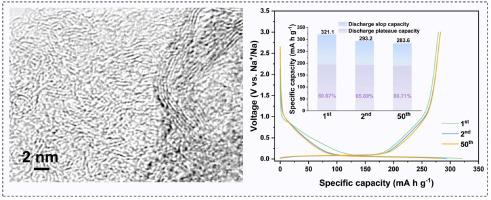
开发具有独特可调微观结构的硬质碳是钠离子电池(SIB)开发的关键,而错综复杂的伪石墨和类石墨结构导致的低电位储钠性能差、储钠机理不明确等问题给钠离子电池的商业化带来了巨大挑战。本文提出以微晶纤维素为碳前驱体,通过控制碳化温度合成硬质碳。原位 XRD 分析表明,较大的假石墨结构层间距有利于 Na+ 的插入,而较小的类石墨结构层间距则可提高导电性。由于碳化温度优化为 1400 °C,获得的硬碳具有更大的层间距、更少的缺陷位点和更封闭的孔隙,其初始放电容量为 376.7 mA h g-1,低电位高原容量比为 57.58 %,初始库仑效率高达 84.32 %,而在使用酯基电解质的第二次放电过程中,高原容量比提高了 63.91 %。
Microcrystalline cellulose-derived hard carbon for robust and low-potential sodium storage
Developing hard carbon with unique and regulable microstructure is the key for the development of sodium ion batteries (SIBs), while the poor low-potential sodium storage property as well as ambiguous sodium storage mechanism arising from the intricate pseudo-graphitic and graphite-like structures present a great challenge to the commercialization of SIBs. Herein, microcrystalline cellulose was proposed as carbon precursor to synthesis hard carbons by controlling carbonization temperature. As expected, the resulting hard carbons simultaneously contained pseudo-graphitic and graphite-like structures, and in situ XRD analysis suggested that a larger interlayer spacing of pseudo-graphitic structure facilitated Na+ insertion, whereas smaller spacing of graphite-like structure could enhance the electrical conductivity. As a result of the optimized carbonization temperature of 1400 °C, the obtained hard carbon with larger interlayer spacing, reduced defect sites, and more closed pores, displayed an initial discharge capacity of 376.7 mA h g−1 with low-potential plateau capacity ratio of 57.58 % and a high initial Coulomb efficiency of 84.32 %, while an increased plateau capacity ratio of 63.91 % in the second discharge process using an ester-based electrolyte.
期刊介绍:
The journal Carbon is an international multidisciplinary forum for communicating scientific advances in the field of carbon materials. It reports new findings related to the formation, structure, properties, behaviors, and technological applications of carbons. Carbons are a broad class of ordered or disordered solid phases composed primarily of elemental carbon, including but not limited to carbon black, carbon fibers and filaments, carbon nanotubes, diamond and diamond-like carbon, fullerenes, glassy carbon, graphite, graphene, graphene-oxide, porous carbons, pyrolytic carbon, and other sp2 and non-sp2 hybridized carbon systems. Carbon is the companion title to the open access journal Carbon Trends. Relevant application areas for carbon materials include biology and medicine, catalysis, electronic, optoelectronic, spintronic, high-frequency, and photonic devices, energy storage and conversion systems, environmental applications and water treatment, smart materials and systems, and structural and thermal applications.



 京公网安备 11010802042870号
京ICP备2023020795号-1
京公网安备 11010802042870号
京ICP备2023020795号-1

 分享
分享
 求助内容:
求助内容: 应助结果提醒方式:
 扫码关注我们
