Ruilin Yin , Tingkang Yuan , Chengwei Li , Hao Zhang , Huan Chen , Ningxuan Wen , Xueqing Zuo , Chen Chen , Lujun Pan , Zeng Fan
{"title":"通过简单的浸泡-过滤策略制备出高度可拉伸且对应变不敏感的多层电磁干扰屏蔽膜","authors":"Ruilin Yin , Tingkang Yuan , Chengwei Li , Hao Zhang , Huan Chen , Ningxuan Wen , Xueqing Zuo , Chen Chen , Lujun Pan , Zeng Fan","doi":"10.1016/j.carbon.2024.119809","DOIUrl":null,"url":null,"abstract":"<div><div>Stretchable electromagnetic interference (EMI) shielding films are crucial for wearable electronics. However, it is challenging to further endow the EMI shielding films with good stretchability and satisfactory EMI shielding effectiveness (EMI SE) under large strains. Herein, we successfully prepared high-performance stretchable polydimethylsiloxane (PDMS)/single-walled carbon nanotube buckypaper (SWNT BP)/PDMS EMI shielding films with multi-graded conductive networks via a soaking-infiltration strategy. In this multilayered film, infiltration layers of SWNT/PDMS were particularly created between elastic PDMS and brittle SWNT BP. Owing to the multilayered structure and conductivity compensation effects arising from infiltration layers, our EMI shielding films exhibited excellent EMI SE of 34.2 dB with high stretchability of >400 %. The outstanding EMI SE could be well maintained under large strains. At <50 % strain, the relative change in EMI SE (|ΔSE/SE<sub>0</sub>|) remained consistently below 10 %, while at even 100 % strain, |ΔSE/SE<sub>0</sub>| was only ∼35 %. Furthermore, we proposed a parallel-series hybrid model to describe electrical conduction in straining films. Due to their excellent conductivity under strain, the films could also serve as stretchable Joule heaters. This work provides a novel and simple approach for constructing strain-insensitive conductive films, with potential applications in stretchable EMI shielding and thermal management.</div></div>","PeriodicalId":262,"journal":{"name":"Carbon","volume":"232 ","pages":"Article 119809"},"PeriodicalIF":11.6000,"publicationDate":"2024-11-07","publicationTypes":"Journal Article","fieldsOfStudy":null,"isOpenAccess":false,"openAccessPdf":"","citationCount":"0","resultStr":"{\"title\":\"Highly stretchable and strain-insensitive multilayered electromagnetic interference shielding films prepared via a simple soaking-infiltration strategy\",\"authors\":\"Ruilin Yin , Tingkang Yuan , Chengwei Li , Hao Zhang , Huan Chen , Ningxuan Wen , Xueqing Zuo , Chen Chen , Lujun Pan , Zeng Fan\",\"doi\":\"10.1016/j.carbon.2024.119809\",\"DOIUrl\":null,\"url\":null,\"abstract\":\"<div><div>Stretchable electromagnetic interference (EMI) shielding films are crucial for wearable electronics. However, it is challenging to further endow the EMI shielding films with good stretchability and satisfactory EMI shielding effectiveness (EMI SE) under large strains. Herein, we successfully prepared high-performance stretchable polydimethylsiloxane (PDMS)/single-walled carbon nanotube buckypaper (SWNT BP)/PDMS EMI shielding films with multi-graded conductive networks via a soaking-infiltration strategy. In this multilayered film, infiltration layers of SWNT/PDMS were particularly created between elastic PDMS and brittle SWNT BP. Owing to the multilayered structure and conductivity compensation effects arising from infiltration layers, our EMI shielding films exhibited excellent EMI SE of 34.2 dB with high stretchability of >400 %. The outstanding EMI SE could be well maintained under large strains. At <50 % strain, the relative change in EMI SE (|ΔSE/SE<sub>0</sub>|) remained consistently below 10 %, while at even 100 % strain, |ΔSE/SE<sub>0</sub>| was only ∼35 %. Furthermore, we proposed a parallel-series hybrid model to describe electrical conduction in straining films. Due to their excellent conductivity under strain, the films could also serve as stretchable Joule heaters. This work provides a novel and simple approach for constructing strain-insensitive conductive films, with potential applications in stretchable EMI shielding and thermal management.</div></div>\",\"PeriodicalId\":262,\"journal\":{\"name\":\"Carbon\",\"volume\":\"232 \",\"pages\":\"Article 119809\"},\"PeriodicalIF\":11.6000,\"publicationDate\":\"2024-11-07\",\"publicationTypes\":\"Journal Article\",\"fieldsOfStudy\":null,\"isOpenAccess\":false,\"openAccessPdf\":\"\",\"citationCount\":\"0\",\"resultStr\":null,\"platform\":\"Semanticscholar\",\"paperid\":null,\"PeriodicalName\":\"Carbon\",\"FirstCategoryId\":\"88\",\"ListUrlMain\":\"https://www.sciencedirect.com/science/article/pii/S0008622324010285\",\"RegionNum\":2,\"RegionCategory\":\"材料科学\",\"ArticlePicture\":[],\"TitleCN\":null,\"AbstractTextCN\":null,\"PMCID\":null,\"EPubDate\":\"\",\"PubModel\":\"\",\"JCR\":\"Q1\",\"JCRName\":\"CHEMISTRY, PHYSICAL\",\"Score\":null,\"Total\":0}","platform":"Semanticscholar","paperid":null,"PeriodicalName":"Carbon","FirstCategoryId":"88","ListUrlMain":"https://www.sciencedirect.com/science/article/pii/S0008622324010285","RegionNum":2,"RegionCategory":"材料科学","ArticlePicture":[],"TitleCN":null,"AbstractTextCN":null,"PMCID":null,"EPubDate":"","PubModel":"","JCR":"Q1","JCRName":"CHEMISTRY, PHYSICAL","Score":null,"Total":0}
引用次数: 0
摘要
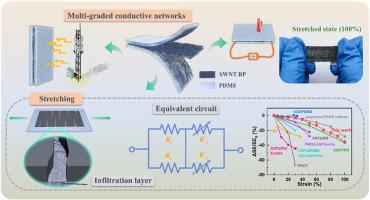
可拉伸电磁干扰(EMI)屏蔽膜对于可穿戴电子设备至关重要。然而,如何进一步赋予电磁干扰屏蔽膜良好的拉伸性和在大应变下令人满意的电磁干扰屏蔽效果(EMI SE)是一项挑战。在此,我们通过浸泡-过滤策略,成功制备了具有多级导电网络的高性能可拉伸聚二甲基硅氧烷(PDMS)/单壁碳纳米管降压纸(SWNT BP)/PDMS EMI 屏蔽膜。在这种多层薄膜中,SWNT/PDMS 的浸润层特别建立在弹性 PDMS 和脆性 SWNT BP 之间。由于多层结构和浸润层产生的传导补偿效应,我们的 EMI 屏蔽膜表现出 34.2 dB 的优异 EMI SE,并具有 400 % 的高拉伸性。出色的 EMI SE 在较大的应变下也能很好地保持。在应变为 50 % 时,EMI SE 的相对变化(|ΔSE/SE0|)始终保持在 10 % 以下,而在应变为 100 % 时,|ΔSE/SE0| 也仅为∼35 %。此外,我们还提出了一种平行序列混合模型来描述应变薄膜中的电导。由于薄膜在应变下具有出色的导电性,因此也可用作可拉伸焦耳加热器。这项研究为构建应变敏感导电薄膜提供了一种新颖而简单的方法,有望应用于可拉伸电磁干扰屏蔽和热管理领域。
Highly stretchable and strain-insensitive multilayered electromagnetic interference shielding films prepared via a simple soaking-infiltration strategy
Stretchable electromagnetic interference (EMI) shielding films are crucial for wearable electronics. However, it is challenging to further endow the EMI shielding films with good stretchability and satisfactory EMI shielding effectiveness (EMI SE) under large strains. Herein, we successfully prepared high-performance stretchable polydimethylsiloxane (PDMS)/single-walled carbon nanotube buckypaper (SWNT BP)/PDMS EMI shielding films with multi-graded conductive networks via a soaking-infiltration strategy. In this multilayered film, infiltration layers of SWNT/PDMS were particularly created between elastic PDMS and brittle SWNT BP. Owing to the multilayered structure and conductivity compensation effects arising from infiltration layers, our EMI shielding films exhibited excellent EMI SE of 34.2 dB with high stretchability of >400 %. The outstanding EMI SE could be well maintained under large strains. At <50 % strain, the relative change in EMI SE (|ΔSE/SE0|) remained consistently below 10 %, while at even 100 % strain, |ΔSE/SE0| was only ∼35 %. Furthermore, we proposed a parallel-series hybrid model to describe electrical conduction in straining films. Due to their excellent conductivity under strain, the films could also serve as stretchable Joule heaters. This work provides a novel and simple approach for constructing strain-insensitive conductive films, with potential applications in stretchable EMI shielding and thermal management.
期刊介绍:
The journal Carbon is an international multidisciplinary forum for communicating scientific advances in the field of carbon materials. It reports new findings related to the formation, structure, properties, behaviors, and technological applications of carbons. Carbons are a broad class of ordered or disordered solid phases composed primarily of elemental carbon, including but not limited to carbon black, carbon fibers and filaments, carbon nanotubes, diamond and diamond-like carbon, fullerenes, glassy carbon, graphite, graphene, graphene-oxide, porous carbons, pyrolytic carbon, and other sp2 and non-sp2 hybridized carbon systems. Carbon is the companion title to the open access journal Carbon Trends. Relevant application areas for carbon materials include biology and medicine, catalysis, electronic, optoelectronic, spintronic, high-frequency, and photonic devices, energy storage and conversion systems, environmental applications and water treatment, smart materials and systems, and structural and thermal applications.



 京公网安备 11010802042870号
京ICP备2023020795号-1
京公网安备 11010802042870号
京ICP备2023020795号-1

 分享
分享
 求助内容:
求助内容: 应助结果提醒方式:
 扫码关注我们
