Gang-Ding Wang, Wen-Jie Shi, Yong-Zhi Li, Weigang Lu, Lei Hou and Dan Li
{"title":"在具有多个超分子结合位点的笼状 MOF 中实现高浓度 C2H2 储存和高效 C2H2/CO2 分离","authors":"Gang-Ding Wang, Wen-Jie Shi, Yong-Zhi Li, Weigang Lu, Lei Hou and Dan Li","doi":"10.1039/D4TA06472K","DOIUrl":null,"url":null,"abstract":"<p >Separating acetylene (C<small><sub>2</sub></small>H<small><sub>2</sub></small>) from carbon dioxide (CO<small><sub>2</sub></small>) is of great industrial importance for achieving high-purity C<small><sub>2</sub></small>H<small><sub>2</sub></small> (>99%). However, overcoming the trade-off effect between adsorption capacity and selectivity remains a daunting challenge owing to their similar physicochemical properties. Herein, we present a novel cage-like metal–organic framework termed Cu-TPHC for efficiently purifying C<small><sub>2</sub></small>H<small><sub>2</sub></small> from C<small><sub>2</sub></small>H<small><sub>2</sub></small>/CO<small><sub>2</sub></small> mixtures. Cu-TPHC exhibits a high C<small><sub>2</sub></small>H<small><sub>2</sub></small> uptake (157.5 cm<small><sup>3</sup></small> g<small><sup>−1</sup></small>), C<small><sub>2</sub></small>H<small><sub>2</sub></small>/CO<small><sub>2</sub></small> selectivity (4.9), and a relatively low C<small><sub>2</sub></small>H<small><sub>2</sub></small> adsorption enthalpy (29.6 kJ mol<small><sup>−1</sup></small>) at 298 K. The excellent separation potential was demonstrated by breakthrough experiments for an equimolar C<small><sub>2</sub></small>H<small><sub>2</sub></small>/CO<small><sub>2</sub></small> mixture under various conditions, with good recyclability and a 99.4% purity of the recovered C<small><sub>2</sub></small>H<small><sub>2</sub></small>. Grand canonical Monte Carlo simulations reveal that the uncoordinated carboxylate oxygen atoms, coordinated water molecules and free OH<small><sup>−</sup></small> anions provide multiple supramolecular binding sites that preferentially interact with C<small><sub>2</sub></small>H<small><sub>2</sub></small> over CO<small><sub>2</sub></small>.</p>","PeriodicalId":82,"journal":{"name":"Journal of Materials Chemistry A","volume":" 2","pages":" 1213-1220"},"PeriodicalIF":9.5000,"publicationDate":"2024-11-20","publicationTypes":"Journal Article","fieldsOfStudy":null,"isOpenAccess":false,"openAccessPdf":"","citationCount":"0","resultStr":"{\"title\":\"Enabling high C2H2 storage and efficient C2H2/CO2 separation in a cage-like MOF with multiple supramolecular binding sites†\",\"authors\":\"Gang-Ding Wang, Wen-Jie Shi, Yong-Zhi Li, Weigang Lu, Lei Hou and Dan Li\",\"doi\":\"10.1039/D4TA06472K\",\"DOIUrl\":null,\"url\":null,\"abstract\":\"<p >Separating acetylene (C<small><sub>2</sub></small>H<small><sub>2</sub></small>) from carbon dioxide (CO<small><sub>2</sub></small>) is of great industrial importance for achieving high-purity C<small><sub>2</sub></small>H<small><sub>2</sub></small> (>99%). However, overcoming the trade-off effect between adsorption capacity and selectivity remains a daunting challenge owing to their similar physicochemical properties. Herein, we present a novel cage-like metal–organic framework termed Cu-TPHC for efficiently purifying C<small><sub>2</sub></small>H<small><sub>2</sub></small> from C<small><sub>2</sub></small>H<small><sub>2</sub></small>/CO<small><sub>2</sub></small> mixtures. Cu-TPHC exhibits a high C<small><sub>2</sub></small>H<small><sub>2</sub></small> uptake (157.5 cm<small><sup>3</sup></small> g<small><sup>−1</sup></small>), C<small><sub>2</sub></small>H<small><sub>2</sub></small>/CO<small><sub>2</sub></small> selectivity (4.9), and a relatively low C<small><sub>2</sub></small>H<small><sub>2</sub></small> adsorption enthalpy (29.6 kJ mol<small><sup>−1</sup></small>) at 298 K. The excellent separation potential was demonstrated by breakthrough experiments for an equimolar C<small><sub>2</sub></small>H<small><sub>2</sub></small>/CO<small><sub>2</sub></small> mixture under various conditions, with good recyclability and a 99.4% purity of the recovered C<small><sub>2</sub></small>H<small><sub>2</sub></small>. Grand canonical Monte Carlo simulations reveal that the uncoordinated carboxylate oxygen atoms, coordinated water molecules and free OH<small><sup>−</sup></small> anions provide multiple supramolecular binding sites that preferentially interact with C<small><sub>2</sub></small>H<small><sub>2</sub></small> over CO<small><sub>2</sub></small>.</p>\",\"PeriodicalId\":82,\"journal\":{\"name\":\"Journal of Materials Chemistry A\",\"volume\":\" 2\",\"pages\":\" 1213-1220\"},\"PeriodicalIF\":9.5000,\"publicationDate\":\"2024-11-20\",\"publicationTypes\":\"Journal Article\",\"fieldsOfStudy\":null,\"isOpenAccess\":false,\"openAccessPdf\":\"\",\"citationCount\":\"0\",\"resultStr\":null,\"platform\":\"Semanticscholar\",\"paperid\":null,\"PeriodicalName\":\"Journal of Materials Chemistry A\",\"FirstCategoryId\":\"88\",\"ListUrlMain\":\"https://pubs.rsc.org/en/content/articlelanding/2025/ta/d4ta06472k\",\"RegionNum\":2,\"RegionCategory\":\"材料科学\",\"ArticlePicture\":[],\"TitleCN\":null,\"AbstractTextCN\":null,\"PMCID\":null,\"EPubDate\":\"\",\"PubModel\":\"\",\"JCR\":\"Q1\",\"JCRName\":\"CHEMISTRY, PHYSICAL\",\"Score\":null,\"Total\":0}","platform":"Semanticscholar","paperid":null,"PeriodicalName":"Journal of Materials Chemistry A","FirstCategoryId":"88","ListUrlMain":"https://pubs.rsc.org/en/content/articlelanding/2025/ta/d4ta06472k","RegionNum":2,"RegionCategory":"材料科学","ArticlePicture":[],"TitleCN":null,"AbstractTextCN":null,"PMCID":null,"EPubDate":"","PubModel":"","JCR":"Q1","JCRName":"CHEMISTRY, PHYSICAL","Score":null,"Total":0}
Enabling high C2H2 storage and efficient C2H2/CO2 separation in a cage-like MOF with multiple supramolecular binding sites†
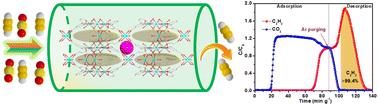
Separating acetylene (C2H2) from carbon dioxide (CO2) is of great industrial importance for achieving high-purity C2H2 (>99%). However, overcoming the trade-off effect between adsorption capacity and selectivity remains a daunting challenge owing to their similar physicochemical properties. Herein, we present a novel cage-like metal–organic framework termed Cu-TPHC for efficiently purifying C2H2 from C2H2/CO2 mixtures. Cu-TPHC exhibits a high C2H2 uptake (157.5 cm3 g−1), C2H2/CO2 selectivity (4.9), and a relatively low C2H2 adsorption enthalpy (29.6 kJ mol−1) at 298 K. The excellent separation potential was demonstrated by breakthrough experiments for an equimolar C2H2/CO2 mixture under various conditions, with good recyclability and a 99.4% purity of the recovered C2H2. Grand canonical Monte Carlo simulations reveal that the uncoordinated carboxylate oxygen atoms, coordinated water molecules and free OH− anions provide multiple supramolecular binding sites that preferentially interact with C2H2 over CO2.
期刊介绍:
The Journal of Materials Chemistry A, B & C covers a wide range of high-quality studies in the field of materials chemistry, with each section focusing on specific applications of the materials studied. Journal of Materials Chemistry A emphasizes applications in energy and sustainability, including topics such as artificial photosynthesis, batteries, and fuel cells. Journal of Materials Chemistry B focuses on applications in biology and medicine, while Journal of Materials Chemistry C covers applications in optical, magnetic, and electronic devices. Example topic areas within the scope of Journal of Materials Chemistry A include catalysis, green/sustainable materials, sensors, and water treatment, among others.




 京公网安备 11010802042870号
京ICP备2023020795号-1
京公网安备 11010802042870号
京ICP备2023020795号-1

 分享
分享
 求助内容:
求助内容: 应助结果提醒方式:
 扫码关注我们
