Dr. Yang Ni, Jonathan Lebelt, Milena Barp, Florian Kreuter, Hannah Buttkus, Jiaye Jin, Dr. Martin Kretzschmar, Prof. Dr. Ralf Tonner-Zech, Prof. Dr. Knut R. Asmis, Prof. Dr. Tanja Gulder
{"title":"氟化环境中六氟磷酸盐引发的氢同位素交换 (HIE):通过强键活化实现芳香族化合物氘化的平台","authors":"Dr. Yang Ni, Jonathan Lebelt, Milena Barp, Florian Kreuter, Hannah Buttkus, Jiaye Jin, Dr. Martin Kretzschmar, Prof. Dr. Ralf Tonner-Zech, Prof. Dr. Knut R. Asmis, Prof. Dr. Tanja Gulder","doi":"10.1002/anie.202417889","DOIUrl":null,"url":null,"abstract":"<p>There is a perpetual need for efficient and mild methods to integrate deuterium atoms into carbon frameworks through late-stage modifications. We have developed a simple and highly effective synthetic route for hydrogen isotope exchange (HIE) in aromatic compounds under ambient conditions. This method utilizes catalytic amounts of hexafluorophosphate (PF<sub>6</sub><sup>−</sup>) in deuterated 1,1,1,3,3,3-hexafluoroisopropanol (HFIP-<i>d<sub>1</sub></i>) and D<sub>2</sub>O. Phenols, anilines, anisoles, and heterocyclic compounds were converted with high yields and excellent deuterium incorporations, which allows for the synthesis of a wide range of deuterated aromatic compounds. Spectroscopic and theoretical studies show that an interactive H-bonding network triggered by HFIP-<i>d<sub>1</sub></i> activates the typically inert P−F bond in PF<sub>6</sub><sup>−</sup> for D<sub>2</sub>O addition. The thus in situ formed DPO<sub>2</sub>F<sub>2</sub> then triggers HIE, offering a new way to deuterated building blocks, drugs, and natural-product derivatives with high deuterium incorporation via the activation of strong bonds.</p>","PeriodicalId":125,"journal":{"name":"Angewandte Chemie International Edition","volume":"64 6","pages":""},"PeriodicalIF":16.9000,"publicationDate":"2024-11-20","publicationTypes":"Journal Article","fieldsOfStudy":null,"isOpenAccess":false,"openAccessPdf":"https://onlinelibrary.wiley.com/doi/epdf/10.1002/anie.202417889","citationCount":"0","resultStr":"{\"title\":\"Hexafluorophosphate-Triggered Hydrogen Isotope Exchange (HIE) in Fluorinated Environments: A Platform for the Deuteration of Aromatic Compounds via Strong Bond Activation\",\"authors\":\"Dr. Yang Ni, Jonathan Lebelt, Milena Barp, Florian Kreuter, Hannah Buttkus, Jiaye Jin, Dr. Martin Kretzschmar, Prof. Dr. Ralf Tonner-Zech, Prof. Dr. Knut R. Asmis, Prof. Dr. Tanja Gulder\",\"doi\":\"10.1002/anie.202417889\",\"DOIUrl\":null,\"url\":null,\"abstract\":\"<p>There is a perpetual need for efficient and mild methods to integrate deuterium atoms into carbon frameworks through late-stage modifications. We have developed a simple and highly effective synthetic route for hydrogen isotope exchange (HIE) in aromatic compounds under ambient conditions. This method utilizes catalytic amounts of hexafluorophosphate (PF<sub>6</sub><sup>−</sup>) in deuterated 1,1,1,3,3,3-hexafluoroisopropanol (HFIP-<i>d<sub>1</sub></i>) and D<sub>2</sub>O. Phenols, anilines, anisoles, and heterocyclic compounds were converted with high yields and excellent deuterium incorporations, which allows for the synthesis of a wide range of deuterated aromatic compounds. Spectroscopic and theoretical studies show that an interactive H-bonding network triggered by HFIP-<i>d<sub>1</sub></i> activates the typically inert P−F bond in PF<sub>6</sub><sup>−</sup> for D<sub>2</sub>O addition. The thus in situ formed DPO<sub>2</sub>F<sub>2</sub> then triggers HIE, offering a new way to deuterated building blocks, drugs, and natural-product derivatives with high deuterium incorporation via the activation of strong bonds.</p>\",\"PeriodicalId\":125,\"journal\":{\"name\":\"Angewandte Chemie International Edition\",\"volume\":\"64 6\",\"pages\":\"\"},\"PeriodicalIF\":16.9000,\"publicationDate\":\"2024-11-20\",\"publicationTypes\":\"Journal Article\",\"fieldsOfStudy\":null,\"isOpenAccess\":false,\"openAccessPdf\":\"https://onlinelibrary.wiley.com/doi/epdf/10.1002/anie.202417889\",\"citationCount\":\"0\",\"resultStr\":null,\"platform\":\"Semanticscholar\",\"paperid\":null,\"PeriodicalName\":\"Angewandte Chemie International Edition\",\"FirstCategoryId\":\"92\",\"ListUrlMain\":\"https://onlinelibrary.wiley.com/doi/10.1002/anie.202417889\",\"RegionNum\":1,\"RegionCategory\":\"化学\",\"ArticlePicture\":[],\"TitleCN\":null,\"AbstractTextCN\":null,\"PMCID\":null,\"EPubDate\":\"\",\"PubModel\":\"\",\"JCR\":\"Q1\",\"JCRName\":\"CHEMISTRY, MULTIDISCIPLINARY\",\"Score\":null,\"Total\":0}","platform":"Semanticscholar","paperid":null,"PeriodicalName":"Angewandte Chemie International Edition","FirstCategoryId":"92","ListUrlMain":"https://onlinelibrary.wiley.com/doi/10.1002/anie.202417889","RegionNum":1,"RegionCategory":"化学","ArticlePicture":[],"TitleCN":null,"AbstractTextCN":null,"PMCID":null,"EPubDate":"","PubModel":"","JCR":"Q1","JCRName":"CHEMISTRY, MULTIDISCIPLINARY","Score":null,"Total":0}
Hexafluorophosphate-Triggered Hydrogen Isotope Exchange (HIE) in Fluorinated Environments: A Platform for the Deuteration of Aromatic Compounds via Strong Bond Activation
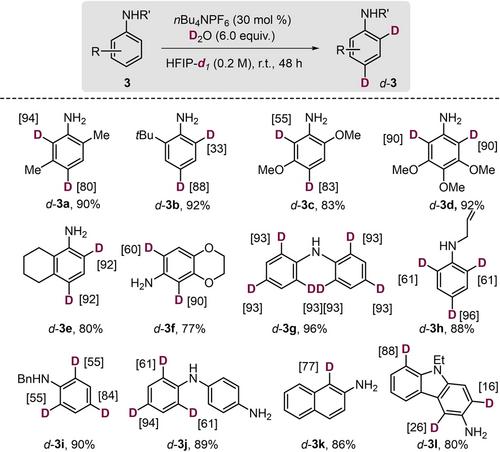
There is a perpetual need for efficient and mild methods to integrate deuterium atoms into carbon frameworks through late-stage modifications. We have developed a simple and highly effective synthetic route for hydrogen isotope exchange (HIE) in aromatic compounds under ambient conditions. This method utilizes catalytic amounts of hexafluorophosphate (PF6−) in deuterated 1,1,1,3,3,3-hexafluoroisopropanol (HFIP-d1) and D2O. Phenols, anilines, anisoles, and heterocyclic compounds were converted with high yields and excellent deuterium incorporations, which allows for the synthesis of a wide range of deuterated aromatic compounds. Spectroscopic and theoretical studies show that an interactive H-bonding network triggered by HFIP-d1 activates the typically inert P−F bond in PF6− for D2O addition. The thus in situ formed DPO2F2 then triggers HIE, offering a new way to deuterated building blocks, drugs, and natural-product derivatives with high deuterium incorporation via the activation of strong bonds.
期刊介绍:
Angewandte Chemie, a journal of the German Chemical Society (GDCh), maintains a leading position among scholarly journals in general chemistry with an impressive Impact Factor of 16.6 (2022 Journal Citation Reports, Clarivate, 2023). Published weekly in a reader-friendly format, it features new articles almost every day. Established in 1887, Angewandte Chemie is a prominent chemistry journal, offering a dynamic blend of Review-type articles, Highlights, Communications, and Research Articles on a weekly basis, making it unique in the field.




 京公网安备 11010802042870号
京ICP备2023020795号-1
京公网安备 11010802042870号
京ICP备2023020795号-1

 分享
分享
 求助内容:
求助内容: 应助结果提醒方式:
 扫码关注我们
