{"title":"在间隙区用磺酰胺取代硫代磷酸酯连接的 LNA 间隙聚合物的合成及其与互补 RNA 靶标形成双链的能力。","authors":"Kohji Seio , Rie Ohnishi , Shigetoshi Tachibana , Hiroki Mikagi , Yoshiaki Masaki","doi":"10.1039/d4ob01350f","DOIUrl":null,"url":null,"abstract":"<div><div>Antisense oligodeoxynucleotides can bind to target RNAs and cleave them using RNase H. Despite the high activity of antisense oligodeoxynucleotides modified with locked nucleic acids (LNA) at several bases at both the 5′ and 3′ ends (LNA gapmer), toxicity has been reported, necessitating additional backbone modifications to reduce toxicity. In this study, we introduced a sulfonamide linkage into the LNA gapmer to elucidate its fundamental properties such as hybridization, base recognition, and induction of RNase H activity. A new chemically stable sulfonyltriazole was used as a synthetic intermediate to introduce a sulfonamide linkage between the two nucleosides. We studied the properties of the duplex of the sulfonamide-linked gapmer and target RNAs, such as melting temperature, circular dichroism, and cleavage of RNA strands by RNase H. We found that the gapmers had a lower but tolerable duplex stability with base-pair specificity and the ability to induce RNase H activity.</div></div>","PeriodicalId":96,"journal":{"name":"Organic & Biomolecular Chemistry","volume":"23 2","pages":"Pages 400-409"},"PeriodicalIF":2.8000,"publicationDate":"2024-11-06","publicationTypes":"Journal Article","fieldsOfStudy":null,"isOpenAccess":false,"openAccessPdf":"","citationCount":"0","resultStr":"{\"title\":\"Synthesis of LNA gapmers that replace a phosphorothioate linkage with a sulfonamide in the gap region, and their ability to form duplexes with complementary RNA targets†\",\"authors\":\"Kohji Seio , Rie Ohnishi , Shigetoshi Tachibana , Hiroki Mikagi , Yoshiaki Masaki\",\"doi\":\"10.1039/d4ob01350f\",\"DOIUrl\":null,\"url\":null,\"abstract\":\"<div><div>Antisense oligodeoxynucleotides can bind to target RNAs and cleave them using RNase H. Despite the high activity of antisense oligodeoxynucleotides modified with locked nucleic acids (LNA) at several bases at both the 5′ and 3′ ends (LNA gapmer), toxicity has been reported, necessitating additional backbone modifications to reduce toxicity. In this study, we introduced a sulfonamide linkage into the LNA gapmer to elucidate its fundamental properties such as hybridization, base recognition, and induction of RNase H activity. A new chemically stable sulfonyltriazole was used as a synthetic intermediate to introduce a sulfonamide linkage between the two nucleosides. We studied the properties of the duplex of the sulfonamide-linked gapmer and target RNAs, such as melting temperature, circular dichroism, and cleavage of RNA strands by RNase H. We found that the gapmers had a lower but tolerable duplex stability with base-pair specificity and the ability to induce RNase H activity.</div></div>\",\"PeriodicalId\":96,\"journal\":{\"name\":\"Organic & Biomolecular Chemistry\",\"volume\":\"23 2\",\"pages\":\"Pages 400-409\"},\"PeriodicalIF\":2.8000,\"publicationDate\":\"2024-11-06\",\"publicationTypes\":\"Journal Article\",\"fieldsOfStudy\":null,\"isOpenAccess\":false,\"openAccessPdf\":\"\",\"citationCount\":\"0\",\"resultStr\":null,\"platform\":\"Semanticscholar\",\"paperid\":null,\"PeriodicalName\":\"Organic & Biomolecular Chemistry\",\"FirstCategoryId\":\"92\",\"ListUrlMain\":\"https://www.sciencedirect.com/org/science/article/pii/S1477052024009972\",\"RegionNum\":3,\"RegionCategory\":\"化学\",\"ArticlePicture\":[],\"TitleCN\":null,\"AbstractTextCN\":null,\"PMCID\":null,\"EPubDate\":\"2024/11/21 0:00:00\",\"PubModel\":\"Epub\",\"JCR\":\"Q1\",\"JCRName\":\"CHEMISTRY, ORGANIC\",\"Score\":null,\"Total\":0}","platform":"Semanticscholar","paperid":null,"PeriodicalName":"Organic & Biomolecular Chemistry","FirstCategoryId":"92","ListUrlMain":"https://www.sciencedirect.com/org/science/article/pii/S1477052024009972","RegionNum":3,"RegionCategory":"化学","ArticlePicture":[],"TitleCN":null,"AbstractTextCN":null,"PMCID":null,"EPubDate":"2024/11/21 0:00:00","PubModel":"Epub","JCR":"Q1","JCRName":"CHEMISTRY, ORGANIC","Score":null,"Total":0}
引用次数: 0
摘要
反义寡聚脱氧核苷酸可与靶 RNA 结合,并利用 RNase H 将其裂解。尽管在 5' 和 3' 端用锁定核酸(LNA)修饰的反义寡聚脱氧核苷酸(LNA 间隙聚合物)具有很高的活性,但也有毒性的报道,因此有必要对其骨架进行额外修饰以降低毒性。在这项研究中,我们在 LNA 间隙聚合物中引入了磺酰胺连接,以阐明其基本特性,如杂交、碱基识别和诱导 RNase H 活性。我们使用了一种化学性质稳定的新型磺酰三唑作为合成中间体,在两个核苷之间引入磺酰胺连接。我们研究了磺酰胺连接的间隙聚合物和目标 RNA 的双链特性,如熔化温度、圆二色性和 RNase H 对 RNA 链的裂解。
Synthesis of LNA gapmers that replace a phosphorothioate linkage with a sulfonamide in the gap region, and their ability to form duplexes with complementary RNA targets†
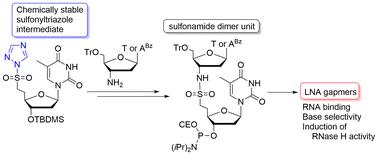
Antisense oligodeoxynucleotides can bind to target RNAs and cleave them using RNase H. Despite the high activity of antisense oligodeoxynucleotides modified with locked nucleic acids (LNA) at several bases at both the 5′ and 3′ ends (LNA gapmer), toxicity has been reported, necessitating additional backbone modifications to reduce toxicity. In this study, we introduced a sulfonamide linkage into the LNA gapmer to elucidate its fundamental properties such as hybridization, base recognition, and induction of RNase H activity. A new chemically stable sulfonyltriazole was used as a synthetic intermediate to introduce a sulfonamide linkage between the two nucleosides. We studied the properties of the duplex of the sulfonamide-linked gapmer and target RNAs, such as melting temperature, circular dichroism, and cleavage of RNA strands by RNase H. We found that the gapmers had a lower but tolerable duplex stability with base-pair specificity and the ability to induce RNase H activity.
期刊介绍:
Organic & Biomolecular Chemistry is an international journal using integrated research in chemistry-organic chemistry. Founded in 2003 by the Royal Society of Chemistry, the journal is published in Semimonthly issues and has been indexed by SCIE, a leading international database. The journal focuses on the key research and cutting-edge progress in the field of chemistry-organic chemistry, publishes and reports the research results in this field in a timely manner, and is committed to becoming a window and platform for rapid academic exchanges among peers in this field. The journal's impact factor in 2023 is 2.9, and its CiteScore is 5.5.




 京公网安备 11010802042870号
京ICP备2023020795号-1
京公网安备 11010802042870号
京ICP备2023020795号-1

 分享
分享
 求助内容:
求助内容: 应助结果提醒方式:
 扫码关注我们
