{"title":"基于MPH-I计算的地聚合物膏体流动特性反演","authors":"Masahiro Kondo , Sui Satomi , Ryo Yokoyama , Shunichi Suzuki","doi":"10.1016/j.nucengdes.2024.113731","DOIUrl":null,"url":null,"abstract":"<div><div>A method for inversely predicting the flow properties of Bingham fluid, i.e., yield stress and plastic viscosity of the geopolymer paste, from a simple dam-break experiment was developed based on the MPH-I ((Moving Particle Hydrodynamics for Incompressible flows) calculations. In the decommissioning of Fukushima-Daiichi nuclear power plant, geopolymer is one of the candidate materials for stabilizing the fuel debris and for sealing the PCV (Primary Containment Vessel), where it is important to predict and control the fluidity of the paste of the material. Therefore, the flow property is to be confirmed just before practically pouring the paste. In the inverse estimation, the MPH-I calculations are used only in the preparation phase to obtain the base curve of the front position history with respect to the various yield stresses. Then, both the yield stress and plastic viscosity are estimated using the base curve with an assumption that the inertial force is negligible. Since no additional calculation is needed in the prediction phase, it is applicable for the checking before the pouring. In this study, the methodology was tested against the geopolymer pastes with adding various amount of silica sand for enlarging viscosity. It was confirmed that the front position history obtained from the experiment was well reproduced by the predicted flow properties. This indicates that the Bingham parameters were inversely estimated well.</div></div>","PeriodicalId":19170,"journal":{"name":"Nuclear Engineering and Design","volume":"431 ","pages":"Article 113731"},"PeriodicalIF":2.5000,"publicationDate":"2025-01-01","publicationTypes":"Journal Article","fieldsOfStudy":null,"isOpenAccess":false,"openAccessPdf":"","citationCount":"0","resultStr":"{\"title\":\"Inversely estimating flow characteristics of geopolymer paste based on the MPH-I calculations\",\"authors\":\"Masahiro Kondo , Sui Satomi , Ryo Yokoyama , Shunichi Suzuki\",\"doi\":\"10.1016/j.nucengdes.2024.113731\",\"DOIUrl\":null,\"url\":null,\"abstract\":\"<div><div>A method for inversely predicting the flow properties of Bingham fluid, i.e., yield stress and plastic viscosity of the geopolymer paste, from a simple dam-break experiment was developed based on the MPH-I ((Moving Particle Hydrodynamics for Incompressible flows) calculations. In the decommissioning of Fukushima-Daiichi nuclear power plant, geopolymer is one of the candidate materials for stabilizing the fuel debris and for sealing the PCV (Primary Containment Vessel), where it is important to predict and control the fluidity of the paste of the material. Therefore, the flow property is to be confirmed just before practically pouring the paste. In the inverse estimation, the MPH-I calculations are used only in the preparation phase to obtain the base curve of the front position history with respect to the various yield stresses. Then, both the yield stress and plastic viscosity are estimated using the base curve with an assumption that the inertial force is negligible. Since no additional calculation is needed in the prediction phase, it is applicable for the checking before the pouring. In this study, the methodology was tested against the geopolymer pastes with adding various amount of silica sand for enlarging viscosity. It was confirmed that the front position history obtained from the experiment was well reproduced by the predicted flow properties. This indicates that the Bingham parameters were inversely estimated well.</div></div>\",\"PeriodicalId\":19170,\"journal\":{\"name\":\"Nuclear Engineering and Design\",\"volume\":\"431 \",\"pages\":\"Article 113731\"},\"PeriodicalIF\":2.5000,\"publicationDate\":\"2025-01-01\",\"publicationTypes\":\"Journal Article\",\"fieldsOfStudy\":null,\"isOpenAccess\":false,\"openAccessPdf\":\"\",\"citationCount\":\"0\",\"resultStr\":null,\"platform\":\"Semanticscholar\",\"paperid\":null,\"PeriodicalName\":\"Nuclear Engineering and Design\",\"FirstCategoryId\":\"5\",\"ListUrlMain\":\"https://www.sciencedirect.com/science/article/pii/S0029549324008318\",\"RegionNum\":3,\"RegionCategory\":\"工程技术\",\"ArticlePicture\":[],\"TitleCN\":null,\"AbstractTextCN\":null,\"PMCID\":null,\"EPubDate\":\"2024/11/28 0:00:00\",\"PubModel\":\"Epub\",\"JCR\":\"Q1\",\"JCRName\":\"NUCLEAR SCIENCE & TECHNOLOGY\",\"Score\":null,\"Total\":0}","platform":"Semanticscholar","paperid":null,"PeriodicalName":"Nuclear Engineering and Design","FirstCategoryId":"5","ListUrlMain":"https://www.sciencedirect.com/science/article/pii/S0029549324008318","RegionNum":3,"RegionCategory":"工程技术","ArticlePicture":[],"TitleCN":null,"AbstractTextCN":null,"PMCID":null,"EPubDate":"2024/11/28 0:00:00","PubModel":"Epub","JCR":"Q1","JCRName":"NUCLEAR SCIENCE & TECHNOLOGY","Score":null,"Total":0}
引用次数: 0
摘要
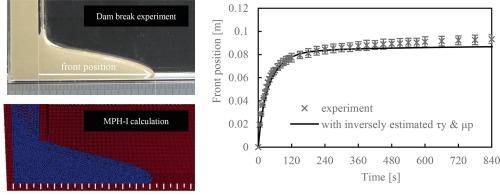
基于MPH-I (Moving Particle Hydrodynamics for Incompressible flows)计算,提出了一种基于简单溃坝实验反演Bingham流体流动特性(即地聚合物浆体的屈服应力和塑性粘度)的方法。在福岛第一核电站退役过程中,地聚合物是稳定燃料碎片和密封PCV(主安全壳)的候选材料之一,对材料浆料的流动性预测和控制具有重要意义。因此,在实际浇注膏体之前,需要确认其流动特性。在反估计中,仅在准备阶段使用MPH-I计算来获得相对于各种屈服应力的前沿位置历史的基本曲线。然后,在假定惯性力可以忽略的情况下,利用基本曲线估计屈服应力和塑性粘度。由于预测阶段不需要额外计算,因此适用于浇筑前的校核。在本研究中,通过添加不同数量的硅砂来增加黏度,对该方法进行了测试。实验得到的锋面位置历史与预测的流动特性吻合较好。这表明宾汉姆参数反演得很好。
Inversely estimating flow characteristics of geopolymer paste based on the MPH-I calculations
A method for inversely predicting the flow properties of Bingham fluid, i.e., yield stress and plastic viscosity of the geopolymer paste, from a simple dam-break experiment was developed based on the MPH-I ((Moving Particle Hydrodynamics for Incompressible flows) calculations. In the decommissioning of Fukushima-Daiichi nuclear power plant, geopolymer is one of the candidate materials for stabilizing the fuel debris and for sealing the PCV (Primary Containment Vessel), where it is important to predict and control the fluidity of the paste of the material. Therefore, the flow property is to be confirmed just before practically pouring the paste. In the inverse estimation, the MPH-I calculations are used only in the preparation phase to obtain the base curve of the front position history with respect to the various yield stresses. Then, both the yield stress and plastic viscosity are estimated using the base curve with an assumption that the inertial force is negligible. Since no additional calculation is needed in the prediction phase, it is applicable for the checking before the pouring. In this study, the methodology was tested against the geopolymer pastes with adding various amount of silica sand for enlarging viscosity. It was confirmed that the front position history obtained from the experiment was well reproduced by the predicted flow properties. This indicates that the Bingham parameters were inversely estimated well.
期刊介绍:
Nuclear Engineering and Design covers the wide range of disciplines involved in the engineering, design, safety and construction of nuclear fission reactors. The Editors welcome papers both on applied and innovative aspects and developments in nuclear science and technology.
Fundamentals of Reactor Design include:
• Thermal-Hydraulics and Core Physics
• Safety Analysis, Risk Assessment (PSA)
• Structural and Mechanical Engineering
• Materials Science
• Fuel Behavior and Design
• Structural Plant Design
• Engineering of Reactor Components
• Experiments
Aspects beyond fundamentals of Reactor Design covered:
• Accident Mitigation Measures
• Reactor Control Systems
• Licensing Issues
• Safeguard Engineering
• Economy of Plants
• Reprocessing / Waste Disposal
• Applications of Nuclear Energy
• Maintenance
• Decommissioning
Papers on new reactor ideas and developments (Generation IV reactors) such as inherently safe modular HTRs, High Performance LWRs/HWRs and LMFBs/GFR will be considered; Actinide Burners, Accelerator Driven Systems, Energy Amplifiers and other special designs of power and research reactors and their applications are also encouraged.




 京公网安备 11010802042870号
京ICP备2023020795号-1
京公网安备 11010802042870号
京ICP备2023020795号-1

 分享
分享
 求助内容:
求助内容: 应助结果提醒方式:
 扫码关注我们
