{"title":"氩对氮微波等离子体发射光谱参数的影响","authors":"Oleg V. Komin, Oleg V. Pelipasov","doi":"10.1016/j.sab.2024.107084","DOIUrl":null,"url":null,"abstract":"<div><div>The effect of Ar content in the range of 0–100 % was studied separately in the outer, intermediate and nebulizer gas flow on the excitation temperature and electron density, the intensity of element lines and the molecular background in a N<sub>2</sub> microwave induced plasma. The addition of Ar to the nebulizer flow leads to an increase in the intensities of both atomic and ionic lines with total excitation energies (E<sub>sum</sub>) 3–13 eV to 1.7 times, depending on the selected line. Addition to the outer or intermediate flow shifts the atomic-ionic equilibrium towards the formation of ions. As a result, the intensity of ionic lines (E<sub>sum</sub> = 10–13 eV) increases up to 1.2 times, the decrease in the intensity of atomic lines (E<sub>sum</sub> = 3–6 eV) reaches up to 20 %. The excitation temperature and electron density in the plasma did not change significantly regardless of which flow the argon was fed into. The intensity of the molecular components of the plasma background (OH, NH, NO) changes significantly when Ar is introduced into the nebulizer flow. The OH intensity increases to 1.8 times, and NH intensity increases to 1.5 times at 100 % Ar relative to pure N<sub>2</sub> plasma. Supplying 100 % Ar simultaneously into the intermediate and nebulizer gas flow and N<sub>2</sub> into the outer flow allows one to reduce the limits of detection by up to 3.3 times, depending on the selected spectral line of the element.</div></div>","PeriodicalId":21890,"journal":{"name":"Spectrochimica Acta Part B: Atomic Spectroscopy","volume":"223 ","pages":"Article 107084"},"PeriodicalIF":3.5000,"publicationDate":"2025-01-01","publicationTypes":"Journal Article","fieldsOfStudy":null,"isOpenAccess":false,"openAccessPdf":"","citationCount":"0","resultStr":"{\"title\":\"Effect of Ar on parameters of nitrogen microwave-induced plasma optical emission spectrometry\",\"authors\":\"Oleg V. Komin, Oleg V. Pelipasov\",\"doi\":\"10.1016/j.sab.2024.107084\",\"DOIUrl\":null,\"url\":null,\"abstract\":\"<div><div>The effect of Ar content in the range of 0–100 % was studied separately in the outer, intermediate and nebulizer gas flow on the excitation temperature and electron density, the intensity of element lines and the molecular background in a N<sub>2</sub> microwave induced plasma. The addition of Ar to the nebulizer flow leads to an increase in the intensities of both atomic and ionic lines with total excitation energies (E<sub>sum</sub>) 3–13 eV to 1.7 times, depending on the selected line. Addition to the outer or intermediate flow shifts the atomic-ionic equilibrium towards the formation of ions. As a result, the intensity of ionic lines (E<sub>sum</sub> = 10–13 eV) increases up to 1.2 times, the decrease in the intensity of atomic lines (E<sub>sum</sub> = 3–6 eV) reaches up to 20 %. The excitation temperature and electron density in the plasma did not change significantly regardless of which flow the argon was fed into. The intensity of the molecular components of the plasma background (OH, NH, NO) changes significantly when Ar is introduced into the nebulizer flow. The OH intensity increases to 1.8 times, and NH intensity increases to 1.5 times at 100 % Ar relative to pure N<sub>2</sub> plasma. Supplying 100 % Ar simultaneously into the intermediate and nebulizer gas flow and N<sub>2</sub> into the outer flow allows one to reduce the limits of detection by up to 3.3 times, depending on the selected spectral line of the element.</div></div>\",\"PeriodicalId\":21890,\"journal\":{\"name\":\"Spectrochimica Acta Part B: Atomic Spectroscopy\",\"volume\":\"223 \",\"pages\":\"Article 107084\"},\"PeriodicalIF\":3.5000,\"publicationDate\":\"2025-01-01\",\"publicationTypes\":\"Journal Article\",\"fieldsOfStudy\":null,\"isOpenAccess\":false,\"openAccessPdf\":\"\",\"citationCount\":\"0\",\"resultStr\":null,\"platform\":\"Semanticscholar\",\"paperid\":null,\"PeriodicalName\":\"Spectrochimica Acta Part B: Atomic Spectroscopy\",\"FirstCategoryId\":\"92\",\"ListUrlMain\":\"https://www.sciencedirect.com/science/article/pii/S0584854724002295\",\"RegionNum\":2,\"RegionCategory\":\"化学\",\"ArticlePicture\":[],\"TitleCN\":null,\"AbstractTextCN\":null,\"PMCID\":null,\"EPubDate\":\"2024/11/20 0:00:00\",\"PubModel\":\"Epub\",\"JCR\":\"Q1\",\"JCRName\":\"SPECTROSCOPY\",\"Score\":null,\"Total\":0}","platform":"Semanticscholar","paperid":null,"PeriodicalName":"Spectrochimica Acta Part B: Atomic Spectroscopy","FirstCategoryId":"92","ListUrlMain":"https://www.sciencedirect.com/science/article/pii/S0584854724002295","RegionNum":2,"RegionCategory":"化学","ArticlePicture":[],"TitleCN":null,"AbstractTextCN":null,"PMCID":null,"EPubDate":"2024/11/20 0:00:00","PubModel":"Epub","JCR":"Q1","JCRName":"SPECTROSCOPY","Score":null,"Total":0}
Effect of Ar on parameters of nitrogen microwave-induced plasma optical emission spectrometry
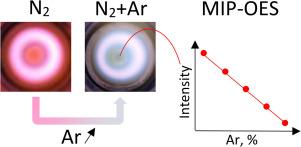
The effect of Ar content in the range of 0–100 % was studied separately in the outer, intermediate and nebulizer gas flow on the excitation temperature and electron density, the intensity of element lines and the molecular background in a N2 microwave induced plasma. The addition of Ar to the nebulizer flow leads to an increase in the intensities of both atomic and ionic lines with total excitation energies (Esum) 3–13 eV to 1.7 times, depending on the selected line. Addition to the outer or intermediate flow shifts the atomic-ionic equilibrium towards the formation of ions. As a result, the intensity of ionic lines (Esum = 10–13 eV) increases up to 1.2 times, the decrease in the intensity of atomic lines (Esum = 3–6 eV) reaches up to 20 %. The excitation temperature and electron density in the plasma did not change significantly regardless of which flow the argon was fed into. The intensity of the molecular components of the plasma background (OH, NH, NO) changes significantly when Ar is introduced into the nebulizer flow. The OH intensity increases to 1.8 times, and NH intensity increases to 1.5 times at 100 % Ar relative to pure N2 plasma. Supplying 100 % Ar simultaneously into the intermediate and nebulizer gas flow and N2 into the outer flow allows one to reduce the limits of detection by up to 3.3 times, depending on the selected spectral line of the element.
期刊介绍:
Spectrochimica Acta Part B: Atomic Spectroscopy, is intended for the rapid publication of both original work and reviews in the following fields:
Atomic Emission (AES), Atomic Absorption (AAS) and Atomic Fluorescence (AFS) spectroscopy;
Mass Spectrometry (MS) for inorganic analysis covering Spark Source (SS-MS), Inductively Coupled Plasma (ICP-MS), Glow Discharge (GD-MS), and Secondary Ion Mass Spectrometry (SIMS).
Laser induced atomic spectroscopy for inorganic analysis, including non-linear optical laser spectroscopy, covering Laser Enhanced Ionization (LEI), Laser Induced Fluorescence (LIF), Resonance Ionization Spectroscopy (RIS) and Resonance Ionization Mass Spectrometry (RIMS); Laser Induced Breakdown Spectroscopy (LIBS); Cavity Ringdown Spectroscopy (CRDS), Laser Ablation Inductively Coupled Plasma Atomic Emission Spectroscopy (LA-ICP-AES) and Laser Ablation Inductively Coupled Plasma Mass Spectrometry (LA-ICP-MS).
X-ray spectrometry, X-ray Optics and Microanalysis, including X-ray fluorescence spectrometry (XRF) and related techniques, in particular Total-reflection X-ray Fluorescence Spectrometry (TXRF), and Synchrotron Radiation-excited Total reflection XRF (SR-TXRF).
Manuscripts dealing with (i) fundamentals, (ii) methodology development, (iii)instrumentation, and (iv) applications, can be submitted for publication.




 京公网安备 11010802042870号
京ICP备2023020795号-1
京公网安备 11010802042870号
京ICP备2023020795号-1

 分享
分享
 求助内容:
求助内容: 应助结果提醒方式:
 扫码关注我们
